


📋 TABLE OF CONTENTS
- The Blue That Doesn’t Exist Anywhere Else on Earth
- Where is Pangong Lake Located?
- How to Get to Pangong Lake from Leh
- Getting Around Pangong Lake
- Where to Stay at Pangong Lake
- Top Things to Do at Pangong Lake
- Practical Travel Tips for Pangong Lake
- Best Time to Visit Pangong Lake
- 2-Day Pangong Lake Itinerary with Costs
- Complete Budget Breakdown
- Final Honest Verdict
1. The Blue That Doesn’t Exist Anywhere Else on Earth {#intro}
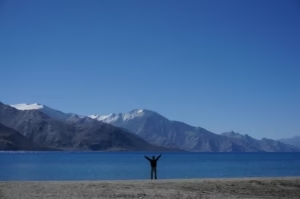
I had seen hundreds of photographs of Pangong Lake before I arrived. I thought I understood what it looked like. I was entirely wrong.
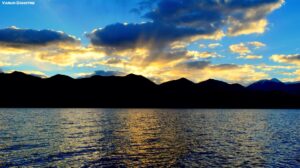
The photographs flatten it. They collapse the altitude, the scale, the way the colour of the water shifts as clouds move across the sky — from turquoise to cobalt to deep navy to a shade of green-blue that has no name in any language I know. Photographs don’t capture the silence. They don’t capture the specific quality of the cold at 4,350 metres — a dry, clean cold that is completely different from the damp cold of hill stations further south. They don’t show you the way the bare brown mountains on both sides of the lake reflect in the water when the wind drops, turning the surface into something mirror-still and completely unreal.
I sat on the shore for forty-five minutes without taking a single photograph. Just watching the colour change. My driver, who had seen Pangong Lake hundreds of times, sat down next to me and said nothing for fifteen minutes.
That’s what Pangong does to people.
This is your complete guide to planning a Pangong Lake trip in 2026 — the scenic routes, the best places to stay, how to do it on a budget, and the honest things nobody tells you before you go.
2. Where is Pangong Lake Located? {#location}

Pangong Tso (Tso means “lake” in Tibetan) sits at 4,350 metres above sea level in the eastern Ladakh region of India, roughly 160 km southeast of Leh. The lake is 134 km long, making it one of the longest high-altitude lakes in Asia — but only about 40% of it falls within Indian territory. The remaining 60% extends into Tibet, making Pangong Tso technically a trans-boundary lake crossing the Line of Actual Control between India and China.
Its relative remoteness from Leh and the Inner Line Permit requirement kept it largely inaccessible until the late 1990s. The lake became internationally famous after its feature in the 2009 Bollywood film 3 Idiots — and visitation has grown exponentially since. Despite the crowds it now attracts in peak season, the lake itself is so vast and the landscape so overwhelming that it absorbs the visitors without being diminished.
3. How to Get to Pangong Lake from Leh {#get-there}
By Shared Jeep — Standard Budget Option
Shared Innova or Sumo taxis depart from the Leh Taxi Union stand near the main market from approximately 6–7 AM. The journey takes 5–6 hours via the Chang La pass route (the standard road). Cost: ₹800–₹1,200/seat in a shared vehicle. Taxis return from Pangong to Leh the following morning — you’ll need at least one overnight to make this trip worthwhile.
By Private Jeep — Flexible Option
A private jeep with driver for the Pangong trip runs ₹6,000–₹8,000/day from Leh. This allows you to stop at Chang La summit, pause at the viewpoints, and arrive at the lake on your own timeline. Split among 4–5 people and private becomes close to shared in per-person cost.
By Motorbike — The Romantic Choice
Renting a Royal Enfield in Leh (₹1,000–₹1,500/day) and riding to Pangong is one of the great Indian road journeys. The road is paved to reasonable standard and passes through some of the most dramatic valley scenery in Ladakh. Only attempt this from Day 3+ of your Leh stay after proper acclimatization — and read our Day 1 in Leh guide before you plan any high-altitude riding.
Two Scenic Route Options:
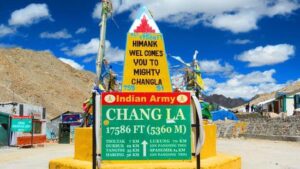
Route 1 — Via Chang La (Standard, 160 km, 5–6 hours): The classic route crossing Chang La pass at 5,360m through Durbuk and Tangtse villages. Fully paved, well-traveled, reliable.
Route 2 — Via Shyok Valley (Longer, 230 km, 7–8 hours): A newer road that follows the Shyok River through remote villages before joining the Pangong road near Tangtse. More dramatic scenery, less traffic, longer travel time. Excellent for motorbike travellers who have an extra half-day.
Inner Line Permit: All Indian nationals need an ILP for Pangong — available at the DC Office in Leh (₹20–₹40, same day). Your hotel or tour operator will arrange this if you ask.
4. Getting Around Pangong Lake {#getting-around}
The north shore of Pangong Lake (where most tourists stay, in the Spangmik–Man–Merak stretch) is about 7–8 km of road from Spangmik camp area to Merak village. The road runs alongside the lake and is the only road.
Walking: Perfectly feasible between camps in the Spangmik area — the road is flat and the distance short. Walking along the lakeshore itself is the best way to experience the lake’s colour shifts at different times of day.
Motorbike: The Pangong north shore road is ideal for slow motorcycle riding — flat, paved, almost no traffic, extraordinary views. If you rode in, use the bike to explore the full length of the accessible north shore.
Local e-rickshaw/auto: Available within the Spangmik camp area for short hops (₹50–₹100). Useful if you’re not on a bike.
To the South Bank: The south bank of Pangong Lake (accessible since 2021 via the Chushul–Pangong road) offers dramatically different and less crowded views. A private vehicle is needed — ₹2,500–₹3,500 for the Spangmik–south bank–Merak circuit. The famous “3 Idiots” filming location (Rezang La Memorial area) is on the south bank approach road.
Difficulty for first-timers: Low for the north shore. The lake area itself is flat and manageable. The passes on the way there (Chang La, 5,360m) are the main physical challenge — crossed in the vehicle rather than walked.
5. Where to Stay at Pangong Lake {#stay}

All accommodation is clustered along the north shore in the Spangmik–Man–Merak stretch. There are no permanent structures — all accommodation is temporary camps and tents that are assembled each May and dismantled each November. This changes the nature of the stay: you are sleeping in a tent at 4,350 metres with Pangong Lake effectively outside your door.
Budget (₹800–₹1,800/night)
Local Family Camps, Spangmik: Several Ladakhi families run basic tent camps along the lakeshore. Tents are simple — sleeping bag, mat, rough blanket — but the lake view from the tent opening is identical to the expensive camps next door. Around ₹800–₹1,200/night including dinner and breakfast.
Village guesthouses, Spangmik and Merak: Basic rooms in local homes — clean, simple, genuinely warm with a wood stove in the common area. ₹600–₹1,000/night.
Honest tip: The budget camps and the luxury camps are on the same lakeshore. The sky, the silence, and the colour of the water are identical at every price point. You are paying for the mattress quality and the bathroom — not for the view.
Mid-Range (₹2,500–₹5,000/night)
Pangong Sarai Camp: Well-established camp operation with proper beds in lined tents, attached toilet facilities, and a dining tent serving hot food. Around ₹3,500–₹4,500/night including meals.
The Glamping Pangong: A newer mid-ranger with slightly more comfortable tents than the budget options — proper beds, reading lights, and a campfire area. Around ₹3,000–₹4,000/night.
Luxury (₹8,000+/night)
The Lake Camp Pangong (operated by Mahindra Homestays): The most established luxury offering at Pangong — heated tents with proper beds, attached warm bathrooms, restaurant dining, and the best lakeshore location. Around ₹10,000–₹14,000/night including all meals.
For a Ladakh package with Pangong included alongside Leh and Nubra, the Leh escape packages on Tripyverse cover all three destinations with accommodation pre-arranged.
6. Top Things to Do at Pangong Lake {#things-to-do}
6.1 Sunrise at Pangong — The Most Important Hour of the Trip
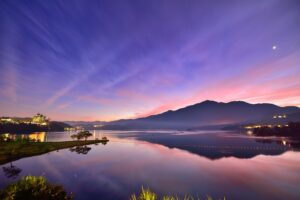
Waking at 5 AM at Pangong Lake is not optional — it is the entire point of staying overnight. The sunrise over Pangong is unlike any other mountain sunrise I’ve experienced: the lake turns from black to deepest navy to cobalt to turquoise to a blazing mirror of orange and gold as the sun clears the eastern peaks, and the process takes maybe twenty-five minutes. By 6:30 AM the day colour has settled and the magic of that transition is gone until the following morning.
Most people who do Pangong as a day trip from Leh miss this completely. They arrive mid-morning when the lake is beautiful but ordinary-beautiful — not the specific impossible beauty of the dawn.
What to do: Walk 200–300 metres from your camp along the shore, away from other people. Find a rock. Sit down at 5 AM. Watch.
Insider tip: The eastern end of the Spangmik stretch (closer to Man village) has fewer camps directly on the shore and gives you more space for an undisturbed sunrise experience. Walk east from the main camp cluster.
6.2 The Colour Study — How Pangong’s Blue Changes All Day

Pangong Lake’s extraordinary colour comes from a combination of its high altitude (thinner atmosphere means more scattered blue light), its mineral-rich glacial water, and its depth. The lake is not one colour — it is a continuous shifting palette that moves through the day.
Dawn: deep navy with orange highlights. Early morning (7–9 AM): bright turquoise-green in the shallows, deeper cobalt mid-lake. Midday: vivid cobalt under clear sky, shifting to greenish in cloudy conditions. Late afternoon: the most vivid phase — deep saturated blue-turquoise when the angle of light hits at around 4–5 PM. Sunset: the water turns a remarkable pewter-silver before going dark.
The single best time for photography is the 4–5 PM late afternoon window — when the sun is lower, the light is golden, and the lake’s colour is at its most saturated.
Honest warning: Midday photographs of Pangong look good everywhere and identical everywhere. If you want images that look different from everyone else’s, shoot at the extreme ends of the day.
6.3 Walking the North Shore — The Free Best Thing at Pangong
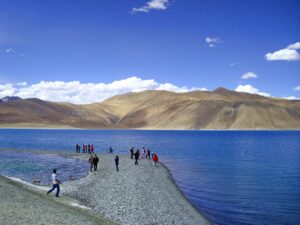
The north shore road from Spangmik to Merak is about 7–8 km one way — walkable in 2–2.5 hours each way at a leisurely altitude-adjusted pace. This walk is completely free, requires no permit beyond what you already have, and produces better encounters with the lake than any jeep tour.
Walking means you stop when you want. You find the exact rock by the exact patch of water that looks exactly right. You watch the colour shift in real time at ground level rather than from a moving vehicle. You meet the yaks that occasionally appear at the lakeside in the mornings. You find the small prayer cairns left by previous travellers along the shore.
Insider tip: The stretch between Man and Merak villages is the least visited section of the north shore. The camps thin out here and the lakeshore becomes quieter. The reflection of the Chushul mountains in the still water at this eastern end of the accessible north shore is the best reflection photograph at Pangong.
6.4 Pangong South Bank — The Empty Side Nobody Tells You About
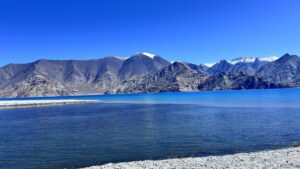
Since the opening of the Chushul–Pangong road in 2021, the south bank of Pangong Lake has been accessible to Indian tourists with a standard Pangong ILP. The south bank is dramatically less visited than the north shore — the road is rougher, the camps fewer, and the tourist infrastructure basic. What it offers in return is a completely different perspective on the lake: looking north across the water toward the Ladakh Range, with the north shore camps visible as tiny dots in the far distance.
The south bank viewpoints are some of the best photography positions at Pangong. You’re elevated above the lake, looking across the full width of the water, with mountain ranges on both visible shores simultaneously.
Getting there: Private vehicle from Spangmik (₹2,500–₹3,500 for the circuit, depending on distance). Route: Spangmik–Lukung–Chushul–south bank viewpoints–Merak return. Allow a full day.
Insider tip: The Rezang La War Memorial on the south bank approach is one of the most moving monuments in India — commemorating the 1962 battle where 120 soldiers of the 13 Kumaon regiment held off a Chinese force several times their size. Visit even if you’re only doing a quick south bank loop.
6.5 Chang La Pass — The Third Highest Motorable Road

Chang La pass (5,360m) is on the route between Leh and Pangong and most travellers stop briefly at the summit. The pass sits 5 metres lower than Khardung La but is just as cold, just as dramatic, and considerably less crowded. The army-run tea stall at the top serves instant noodles and hot chai — both taste extraordinary at 5,360m.
Photo opportunity: The Chang La summit marker with prayer flags and mountains behind. Also worthwhile: looking back down the Leh side of the pass, where the switchback road is visible descending into the valley.
Honest warning: As with Khardung La — limit summit time to 20–30 minutes. AMS symptoms develop quickly here, especially in travellers who flew to Leh and haven’t fully acclimatized. Cross it, photograph it, and descend.
6.6 Stargazing at Pangong — The Night Sky at 4,350 Metres
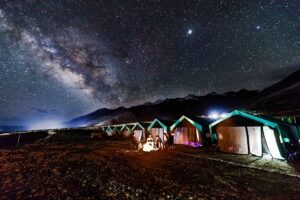
Pangong Lake sits in a zone of near-zero light pollution. On a clear night — which in Ladakh from June to October is most nights — the sky above the lake is extraordinary. The Milky Way is visible clearly to the naked eye. Shooting stars are common. The elevation means less atmosphere between you and the stars.
Bring a warm sleeping bag rated to at least -5°C. The night temperature even in July can drop to 2–5°C at the lakeshore. Lie on the rocks away from camp light for 10 minutes and let your eyes adjust. Then look up.
Insider tip: Face south toward the main bulk of the Milky Way. Lie on your back rather than sitting — the peripheral vision adds the mountain silhouettes on both sides of the lake, framing the sky.
6.7 Tangtse Village — The Underrated Stop on the Way
Tangtse, about 50 km before Pangong on the Chang La route, is a small Ladakhi village that almost every tourist drives through without stopping. It shouldn’t be skipped. The village has a functioning 17th-century monastery (Tangtse Monastery), a small market, and a handful of dhabas serving excellent Ladakhi Thukpa and butter tea.
Stopping at Tangtse for 30–45 minutes on the way to Pangong breaks the long drive, fuels you for the remaining journey, and gives you a genuine Ladakhi village experience that the lakeside camp area — geared entirely toward tourism — doesn’t provide.
7. Practical Travel Tips for Pangong Lake {#tips}
Cash only everywhere: There are zero ATMs at Pangong Lake. The entire lakeside camp economy runs on cash. Carry ₹3,000–₹5,000 minimum from Leh covering accommodation, meals, and activities for your overnight stay. Note that camp meals are typically included in the room rate — confirm this when booking.
Mobile signal: No private network (Jio, Airtel, Vi) works at Pangong Lake. BSNL has occasional weak signal at Spangmik. Download all offline maps, music, and reading material before leaving Leh. There is no Wi-Fi at any camp.
Cold at night — even in July: Night temperatures at Pangong drop to 2–5°C in midsummer and lower in September–October. Camps provide basic blankets but these are often insufficient. Carry your own sleeping bag rated to -5°C minimum. A thermal base layer makes a significant difference.
Acclimatization warning: Pangong sits at 4,350m — 826 metres higher than Leh. Travellers who are still adjusting from flying should not attempt Pangong until at least Day 3 of their Leh stay. Add Chang La (5,360m) to the altitude equation and rushing this trip can trigger AMS quickly. Read the full acclimatization guidance in our Day 1 Leh guide before planning your Pangong timing.
Toilet situation: Budget camps have basic squat toilet tents with minimal facilities. Mid-range and luxury camps have better facilities. The lakeshore itself should not be used as a toilet — the lake’s ecosystem is fragile and overtourism is already stressing it. Follow camp facilities only.
Permits: ILP for Pangong available at DC Office in Leh or through your hotel. ₹20–₹40 per person. Required at the checkpoint before Chang La. Your driver will usually know when to show it.
8. Best Time to Visit Pangong Lake {#best-time}

| Month | Road Status | Conditions | Verdict |
| Jan–Apr | Closed (Chang La inaccessible) | Lake partially frozen, no tourist access | ❌ Not accessible |
| May | Opens (usually mid-May) | Some snow on pass, cool, very quiet | ⚠️ Possible but limited facilities |
| Jun | Fully open | Clear skies, pleasant 15–20°C days, manageable crowds | ✅ Excellent — first good month |
| Jul–Aug | Fully open, peak | Warmest days, very busy, all camps operational | ☀️ Best weather, most crowded |
| Sep | Fully open | Clear crystalline skies, cooler (5–15°C days), thinning crowds | ⭐ Best overall for the trip |
| Oct | Open early October, may close mid-October | Cold nights (-5°C), snow possible, very quiet | ⚠️ Go early October or risk closure |
| Nov–Apr | Closed | — | ❌ |
The sweet spot for a Pangong Lake trip: September is objectively the best month. The summer crowds have thinned by 40–50%, the sky is crystalline after the Indian subcontinent’s monsoon pushes through, the lake’s colour reaches its most vivid in the clear post-monsoon atmosphere, and the cold is manageable with the right clothing. Sunrise in September at Pangong Lake — with steam rising off the water and the air absolutely still — is one of the finest things I’ve experienced in twenty years of travelling India.
Peak season honest warning (July–August): The Pangong north shore in peak season is genuinely congested. Hundreds of camps, hundreds of jeeps, and a camp strip that resembles a mountain festival site rather than a remote lake. The lake itself is unchanged — but the human foreground is unavoidable. If flexibility allows, go in June or September.
9. 2-Day Pangong Lake Itinerary with Costs {#itinerary}
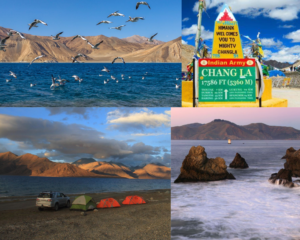
This assumes you’re leaving from Leh on Day 3+ of your Ladakh trip, after proper acclimatization. Never attempt Pangong on Day 1 or 2 if you flew to Leh.
Day 1 — Leh to Pangong via Chang La
6:00 AM: Depart Leh in shared or private jeep. The road out of Leh follows the Indus Valley east before climbing toward Chang La.
9:00 AM: Chang La summit (5,360m). 20–30 minute stop — chai at the army dhaba, prayer flags photographs, brief moment of altitude awe. Descend the far side.
10:30 AM: Tangtse village stop. 30 minutes — Thukpa breakfast at a local dhaba (₹100–₹120), walk through the village, stretch legs.
1:00 PM: Arrive at Pangong Spangmik camp area. Check in. First sight of the lake.
1:30 PM: Walk to the lakeshore. Sit. Watch the colour. Don’t immediately photograph.
3:00 PM: Explore the north shore on foot or by motorbike (if you rode). Walk east toward Man village.
4:30 PM: Return to the lakeshore for the late-afternoon golden hour — the best photography window.
7:00 PM: Camp dinner (usually included in accommodation price).
9:30 PM: Stargazing session — walk away from camp lights, lie on your back, look at the Milky Way.
Estimated daily spend: ₹3,500–₹5,000 (shared jeep ₹900 + accommodation with meals ₹1,500 + snacks/dhaba ₹400 + misc ₹300)
Day 2 — Sunrise, South Bank (Optional), Return to Leh
5:00 AM: Wake. Walk to the lakeshore before sunrise. Watch the dawn transformation. This is the reason you stayed overnight.
7:00 AM: Breakfast at camp.
8:30 AM: Optional south bank excursion (requires private vehicle, add ₹2,500–₹3,000 to day cost). Rezang La Memorial, south bank viewpoints, Chushul crossing. 4–5 hours for the circuit.
OR
8:30 AM (standard): Walk the Spangmik–Merak stretch of north shore in the morning light. The reflections are best in the 8–10 AM window.
11:00 AM: Depart Pangong for Leh.
5:00 PM: Arrive Leh.
Estimated daily spend: ₹1,500–₹4,500 (depending on whether south bank circuit added; shared jeep return ₹900 + meals ₹400)
10. Complete Budget Breakdown {#budget}
Budget Traveller — ₹5,500–₹7,500 for 2 Days (from Leh, excluding flights)
| Expense | Cost (₹) |
| Shared jeep Leh–Pangong return | 1,800 |
| Accommodation 1 night (budget camp with meals) | 1,500 |
| Tangtse dhaba breakfast + snacks | 300 |
| Chang La chai | 50 |
| Inner Line Permit | 40 |
| Lakeshore walks, stargazing, sunrise | 0 |
| Miscellaneous (tips, water, extras) | 400 |
| TOTAL | ₹4,090 |
Mid-Range Traveller: ₹10,000–₹15,000 for 2 days (private jeep, Pangong Sarai camp, south bank excursion)
Luxury Traveller: ₹25,000–₹35,000 (private vehicle, The Lake Camp luxury tents, guided photography session, south bank private circuit)
Where to save: Shared jeep over private (₹900 vs ₹3,000+ per person). Budget lakeside family camp (₹800–₹1,200/night with meals) versus luxury tents (₹10,000+/night). The lake view is literally identical. The single biggest cost driver on the Pangong trip is the vehicle — share it.
Where to splurge: One upgraded camp night. The difference between a basic camp blanket at 4,350m and a warm bed in a properly lined tent is significant in terms of sleep quality — and good sleep at altitude aids your body’s acclimatization considerably. If you can budget ₹3,000–₹4,000 for accommodation over the ₹800–₹1,000 basic option, it’s worth it specifically here.
For a Ladakh trip that packages Pangong with Leh acclimatization days and Nubra Valley into a single efficient itinerary, the Leh escape packages on Tripyverse remove the considerable logistical complexity of coordinating permits, vehicles, and camps across all three destinations simultaneously.
If you’re building a broader Himalayan comparison — Pangong versus Ladakh’s other hidden jewels — our Nubra Valley and Khardung La guide covers the northern side of the Leh circuit in equal detail. Both are essential; neither substitutes for the other.
11. Final Honest Verdict {#verdict}
Pangong Lake is, without any exaggeration, one of the most visually extraordinary places in India. I’ve been to a lot of places that people describe that way and am usually underwhelmed by the gap between expectation and reality. Pangong is one of the rare cases where the reality genuinely exceeds what photographs suggest — because the colour is real, the scale is real, and the silence is real in a way that no screen conveys.
What genuinely impressed me most: The overnight stay transformed my understanding of the place. Day-trippers from Leh see a beautiful lake. Overnight travellers see a sunrise that redefines the colour blue and a Milky Way that makes everything feel small in the right way. The overnight is non-negotiable.
The honest drawback: The north shore in peak season (July–August) is genuinely overcrowded. The camp strip at Spangmik is dense, the jeeps are constant through the day, and finding any solitude between 10 AM and 4 PM requires either walking further east than most tourists bother or going to the south bank. The lake survives the crowds because it is so vast and so beautiful — but the experience is materially better in June or September, and I say that with no hedge.
Second honest drawback: The litter situation at Pangong is improving but not resolved. The fragility of the high-altitude ecosystem and the volume of tourists are in visible tension. Carry all your waste out, use camp toilet facilities only, and don’t be the person who leaves a plastic bottle on the lakeshore.
Perfect for: Anyone who responds to pure landscape on a primal level. Photographers, particularly those who prioritise colour and light. Couples — Pangong at sunrise is one of the most romantic natural scenes in India. Anyone building a Ladakh circuit who has already done Nubra and wants the contrasting experience.
Might want to modify or skip if: You have serious altitude sensitivity — 4,350m is demanding, and the Chang La crossing at 5,360m on the way is the third-highest motorable road in the world. Also worth noting: if you’re comparing Ladakh against beach destinations or culturally rich food travel, our guides on Kerala 2026 and our Kashmiri food guide serve entirely different travel needs — both are worth reading if landscape alone is not what you’re chasing on this trip.
Go. Stay overnight. Wake at 5 AM. Watch.