


📋 TABLE OF CONTENTS
- Vietnam Hit Me Differently Than I Expected
- Where Is Vietnam?
- How To Get To Vietnam From India
- Getting Around Vietnam
- Where To Stay in Vietnam
- Hidden Cafés, Beautiful Places & Things You Can’t Miss
- Practical Travel Tips for Indian Travellers
- Best Time To Visit Vietnam
- 10-Day Vietnam Itinerary
- Complete Budget Breakdown
- Final Honest Verdict
- 🌿 Vietnam Hit Me Differently Than I Expected
I arrived in Hanoi on a Tuesday evening in October with a small bag, a phone full of saved Instagram locations, and the confident assumption that I had Vietnam fairly well figured out from the photographs.
By Wednesday morning I was sitting in a narrow four-storey café on a lane called Dinh Liet, drinking a glass of cà phê trứng — egg coffee, a Hanoi invention involving whipped egg yolk and sweetened condensed milk beaten into a foam over strong Vietnamese coffee — and completely revising my assumptions. The lane below was narrow enough that the buildings on either side nearly touched above the street. A woman on a motorbike passed below carrying what appeared to be an entire living room’s worth of furniture. An elderly man at the adjacent table was reading a newspaper with a concentration that suggested he’d been doing exactly this in exactly this café every morning for thirty years. The coffee tasted like a dessert and a stimulant simultaneously and I couldn’t quite explain why it was making me feel so warmly about being alive.
Vietnam is not the country the photographs show you. It’s better. The photographs show you the landscapes — Ha Long Bay’s limestone karsts, Hoi An’s lantern-lit streets, the rice terraces of Sapa at sunrise. What they can’t show you is the specific, layered, caffeinated, flavour-saturated, motorbike-scored texture of daily life in a country that has one of the most extraordinary food cultures on earth, a coastline that goes on for 3,200 kilometres, and a café-going tradition that puts most of the world to shame.
Here’s what you need to know for 2026.
- 📍 Where Is Vietnam?
Vietnam is a long, narrow S-shaped country running 1,650 km along the eastern edge of the Indochina Peninsula in Southeast Asia, bordered by China to the north, Laos and Cambodia to the west, and the South China Sea to the east. Its three major zones — the north (Hanoi, Ha Long Bay, Sapa, Ninh Binh), the central coast (Da Nang, Hoi An, Hue), and the south (Ho Chi Minh City, Mekong Delta, Phu Quoc) — each have distinctly different landscapes, weather patterns, climates, and food cultures. You can, in theory, fly from one end to the other in two hours, which makes it uniquely flexible as a long-trip destination: you can do north-to-south in 10–14 days or spend two weeks in just one region and barely scratch the surface.
- ✈️ How To Get To Vietnam From India
E-visa: Indian passport holders can apply for a Vietnam e-visa online at evisa.xuatnhapcanh.gov.vn — valid for 90 days, single or multiple entry, costs approximately ₹1,500–2,000 (US $25). Processing takes 3 business days. This is straightforward and has been reliable since 2023.
By Air: Vietnam has three international airports — Noi Bai (Hanoi, HAN), Da Nang (DAD), and Tan Son Nhat (Ho Chi Minh City, SGN). Direct flights from India:
From Delhi to Hanoi: IndiGo, Vietnam Airlines, Vietjet (~5.5 hours, ₹12,000–30,000 return depending on advance booking).
From Delhi/Mumbai to Ho Chi Minh City: Multiple airlines via one stop (Bangkok, Kuala Lumpur, Singapore), ~8–10 hours total travel, ₹15,000–35,000 return.
Budget tip: Book 6–8 weeks in advance for the best return fares. Vietjet and IndiGo tend to run the lowest Delhi–Hanoi prices.
Within Vietnam by domestic flight: Vietnam Airlines, Vietjet, and Bamboo Airways connect all major cities. Hanoi to Da Nang: ~1.5 hours, ₹1,500–4,000. Da Nang to Ho Chi Minh City: ~1.5 hours, ₹1,500–4,500. Book well in advance for budget prices.
Train (scenic option): The Reunification Express runs the full length of Vietnam from Hanoi to Ho Chi Minh City (34+ hours total, but most people do it in 2–3 day segments). Hanoi to Hue: 14 hours overnight (sleeper berth ₹1,500–2,500). Da Nang to Ho Chi Minh City: 16–18 hours. The coastal section between Da Nang and Hue through the Hai Van Pass is widely considered one of the most beautiful train journeys in Southeast Asia.
- 🚗 Getting Around Vietnam
Within cities:
Grab: The Southeast Asian ride-hailing app equivalent of Ola/Uber. Works flawlessly across all major Vietnamese cities. Grab car is ₹80–250 for most intra-city trips. Grab bike (motorbike taxi) is ₹30–80 and ideal for short distances in congested cities. Download before landing — it’s the single most important app for independent travel in Vietnam.
Motorbike rental: The authentic Vietnam experience. Available everywhere from ₹400–800/day. You need an international driving licence valid for motorcycles. Traffic in Hanoi and Ho Chi Minh City is dense and moves according to logic that takes time to understand — not recommended for first-timers in cities. On rural roads and coastal routes (Hoi An to Hue, Da Lat, Phu Quoc), motorbike travel is outstanding.
Sleeper buses: The backbone of budget backpacker transport. Hanoi to Hue: ₹600–1,000, 12–14 hours (overnight). Hoi An to Da Lat: ₹800–1,200. More comfortable than they sound — lie-flat berths, reasonably reliable schedule.
Between cities: Domestic flights for speed, overnight trains for scenic experience, sleeper buses for budget. For a 10-day itinerary, use one flight and one train segment to cover the length of the country efficiently.
First-timer difficulty: Low in cities thanks to Grab. Moderate for independent motorbike travel in rural areas. Vietnam is one of the more navigable Southeast Asian countries for first-time international travellers.
- 🏨 Where To Stay in Vietnam
Vietnam has exceptional accommodation value across all categories — the mid-range here is genuinely comparable to luxury in many Indian cities, and actual luxury is a fraction of what you’d pay in Europe.
Best base by region:
- Hanoi: Old Quarter for walking access to everything
- Ha Long Bay: on a cruise boat (not a hotel)
- Hoi An: the Ancient Town area or beachside An Bang
- Ho Chi Minh City: District 1 or District 3 for first-timers
Budget (₹700–2,000/night)
Hanoi Backpacker’s Hostel (Old Quarter): A long-running institution on Ma May Street. Dorms from ₹700, private rooms from ₹1,500. Social, reliable, well-located for Old Quarter exploration.
Tribee Bana Hostel (Hoi An): Consistently rated among Vietnam’s best hostels — bamboo and wood design, great pool, short walk to the Ancient Town. Dorms from ₹800, private from ₹1,800.
Mid-Range (₹3,000–8,000/night)
Essence Palace Hotel (Hanoi Old Quarter): Small boutique hotel with excellent service, rooftop breakfast, and rooms from ₹3,500. One of the best value mid-range hotels in Hanoi.
Anantara Hoi An Resort: On the Thu Bon River in Hoi An, beautifully designed colonial-style resort, pool, excellent food. From ₹7,000/night. If you’re spending 2–3 nights in Hoi An, this is the upgrade that makes the town feel special.
Luxury (₹12,000+/night)
Sofitel Legend Metropole Hanoi: A 1901 French colonial landmark in the heart of Hanoi — the most iconic hotel in Vietnam. History, architecture, excellent restaurant, and the famous Bamboo Bar. From ₹22,000/night.
Four Seasons The Nam Hai (Hoi An): On Hoi An’s beach, with private pools, an exceptional spa, and the kind of villa-and-garden setting that makes you reorganise your life priorities. From ₹35,000/night.
- ☕ Hidden Cafés, Beautiful Places & Things You Can’t Miss
Egg Coffee at a Hanoi Hidden Café

Cà phê trứng (egg coffee) was invented in Hanoi in the 1940s as a substitute for scarce milk. A raw egg yolk is whisked with sweetened condensed milk until it forms a dense, mousse-like foam, then poured over a small, intensely strong cup of Vietnamese Robusta coffee. The result tastes like a tiramisu has been set on fire and made into a beverage.
The original and best is served at Café Giang, on a narrow alley off Dinh Liet Street in the Old Quarter — it’s been here since 1946 and the owner’s family still makes it from the same recipe. The café occupies two floors of a crumbling building and seats perhaps 30 people. ₹120–180 for a cup.
Insider tip: Go at 8–9 AM or after 3 PM. The midday egg coffee rush involves waiting for a table in a space the size of a large wardrobe.
Ha Long Bay — Better Than the Photos, If You Do It Right
Ha Long Bay’s 1,969 limestone karsts rising from emerald-green water is one of Southeast Asia’s iconic landscapes, and it is entirely real — the photographs are not exaggerated. The challenge is doing it in a way that isn’t a tourist conveyor belt.
The right approach: A 2-night cruise on a smaller boat (maximum 20 cabins) gives you evenings on the bay when the day-tripper boats have gone, kayaking through caves and lagoons in the early morning, and sunrise from the bow with mist on the water and silence. Budget cruises run ₹5,000–8,000/person/night including meals. Mid-range: ₹10,000–18,000. Luxury (Indochine Sail, Paradise Elegance, Orchid Cruises): ₹25,000–45,000/person/night. For a structured and well-organised Ha Long cruise combined with the broader Vietnam itinerary, the Tripyverse Vietnam Explore package organises the cruise logistics which is genuinely helpful.
Honest warning: Ha Long Bay now has a two-zone system — Ha Long proper (more congested, more boats) and Lan Ha Bay (quieter, fewer boats, equally beautiful, adjacent). Ask specifically for a Lan Ha Bay routing when booking your cruise. The difference in crowd density is significant.
Hoi An Ancient Town at Night

Hoi An’s Ancient Town — a UNESCO World Heritage-listed trading port dating to the 15th century — is the most photogenic town in Southeast Asia. The Japanese Covered Bridge, the merchant houses with their ornate facades, the Thu Bon River reflecting paper lanterns in orange and yellow light — at night, when the Ancient Town is lit entirely by lanterns and the neon signs of the surrounding tourist areas disappear behind it, it looks like a film set that the art department got slightly too right.
Walk it between 7–9 PM. Buy a lantern (₹50–100) and release it on the river on a Tuesday or Saturday (Full Moon Lantern Festival — the town turns off electric lights entirely). Eat Cao Lau (thick rice noodles in a pork broth unique to Hoi An — the local claim is that only water from Hoi An’s specific wells makes it authentic) at Morning Glory Restaurant or a street stall near the covered market. ₹200–400 for a full meal.
Ninh Binh — “Ha Long Bay on Land”

About 100 km south of Hanoi, Ninh Binh is a landscape of limestone karsts rising from rice paddies and rivers — the same geological drama as Ha Long Bay, but on land, with boats that navigate through flooded cave systems and under arching stone. The boat rides at Trang An (UNESCO listed, ₹500–800 per person) and Tam Coc (₹400–600) row through three river caves and emerge into paddy fields flanked by vertical cliffs.
Ninh Binh is consistently one of Vietnam’s most beautiful and most underrated experiences — better for most visitors than Ha Long Bay because the surrounding landscape is more varied, the cave rowing is extraordinary, and the day-trip distance from Hanoi makes it a natural addition.
Sapa Rice Terraces and Fansipan Trek

In the far northwest of Vietnam, near the Chinese border, the Muong Hoa Valley is terraced in rice paddies that cascade down the hillsides in curves of gold (harvest season, September–October) or vivid green (May–June). The Hmong, Dao, and Tay communities who farm these terraces have done so for centuries and still wear their traditional clothing to the Saturday Bac Ha Market.
Fansipan, at 3,143 metres the highest peak in Indochina, is reachable by cable car (₹1,500–2,000 return, 20 minutes) or by a 2-day trek through cloud forest with a guide. The cable car gives extraordinary views with minimal effort; the trek gives you the mountain properly.
Getting there: Hanoi to Sapa by overnight train (8 hours, ₹1,200–2,500 in a sleeper berth) is the classic and most atmospheric route. For a structured Sapa and northern highlights itinerary, the Tripyverse Northern Highlights Vietnam package covers the Hanoi–Ninh Binh–Sapa circuit efficiently.
Pho in Hanoi — The Version That Defines All Others
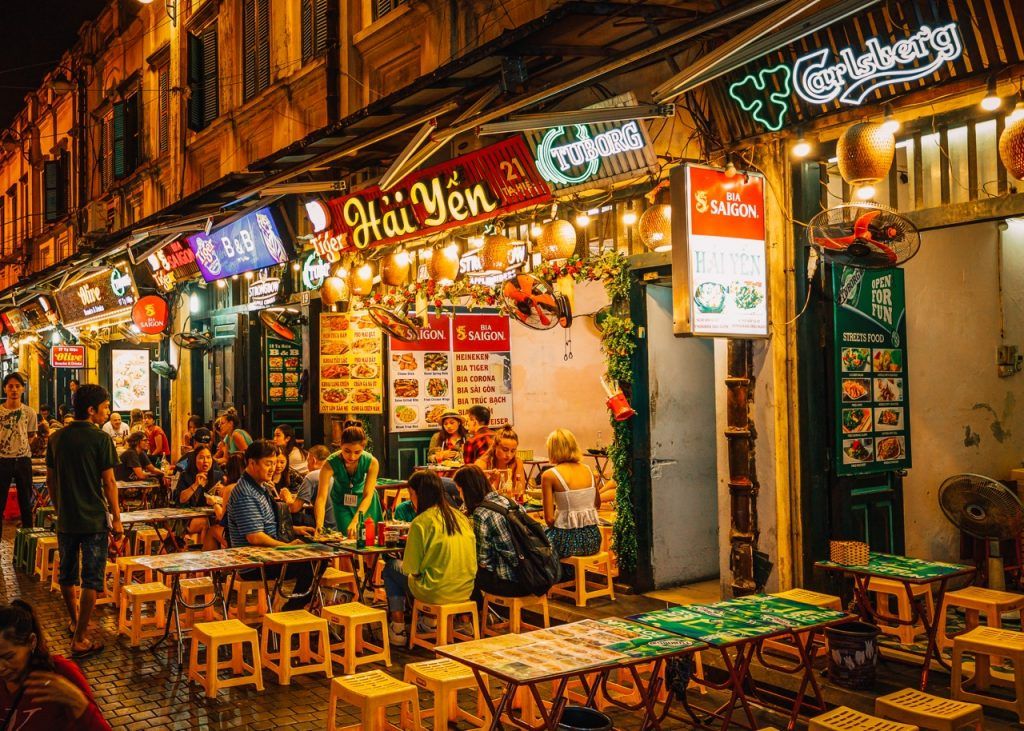
Hanoi’s pho is different from the Southern version — cleaner broth, more restrained garnish, the balance between star anise and charred ginger more precise and less sweet. The correct way to eat it is at a street stall that opens at 6 AM, seats 30 people on plastic stools at low tables, and sells out by 9:30 AM. Pho Gia Truyen on Bat Dan Street in Hanoi’s Old Quarter has been doing exactly this for decades. A bowl costs ₹150–250. Go early.
Hue — The Imperial City and Its Food

Vietnam’s former imperial capital sits on the Perfume River and contains the UNESCO-listed Imperial Citadel, the Nguyen emperors’ tombs scattered through a landscape of pine forest and river, and — critically — the most complex and refined cuisine in the country. Bun Bo Hue (spicy beef noodle soup with lemongrass, far more intense than pho), Banh Khoai (crispy turmeric-battered crepes with shrimp and pork), and Com Hen (tiny river clams over cold rice) are Hue specialities not found elsewhere with the same character.
The Royal Tombs — particularly Minh Mang’s, with its lakes and gardens — are some of the most beautiful funerary architecture in Southeast Asia. Budget a full day for the citadel and two tombs.
Ho Chi Minh City Rooftop Bars and Ben Thanh Market
HCMC moves fast, eats well, and doesn’t sleep until it needs to. The Ben Thanh Market is overpriced for tourists but genuinely lively; the surrounding streets at night are better. The Cu Chi Tunnels (a day trip, 40 km outside the city) give a visceral understanding of the Vietnam War’s guerrilla phase that no museum exhibit can match. And the rooftop bar scene — particularly Chill Skybar and Air360 Sky Bar — gives you the city from above, which is the most spectacular version of HCMC.
- 💡 Practical Travel Tips for Indian Travellers
Visa: E-visa is the standard route — 90 days, available online, ₹1,500–2,000. Apply at least a week before travel.
Currency: Vietnamese Dong (VND). ₹1 = approximately 290–300 VND in 2026. Cash is essential in markets, street food, local cafés, and rural areas. ATMs widely available in cities; withdraw at bank ATMs (Vietcombank, BIDV) to avoid high private-ATM fees.
Cards: Accepted at hotels, restaurants in tourist zones, and most mid-range establishments. Not at street stalls or markets. Carry VND 500,000–1,000,000 (approximately ₹1,700–3,400) in cash at all times.
SIM card: Buy a Viettel or Mobifone tourist SIM at the airport on arrival — ₹400–600 for 15–30 days with good data. Coverage is excellent across the country including rural areas.
Grab app: Download before landing. It is the most important transport tool in Vietnam, more reliable and consistent than negotiating with street taxi or motorbike drivers.
Safety: Vietnam is one of Southeast Asia’s safer countries for tourists. Petty theft (phone snatching from motorbikes in HCMC) is the primary concern — keep phones pocketed in busy areas, especially on the back of Grab bikes. Solo female travellers visit Vietnam extensively without issue; exercise standard precautions at night in tourist areas.
Indian vegetarian food note: Vietnam’s food culture is heavily meat and seafood-based. Vegetarian options are available but limited outside dedicated vegetarian restaurants in major cities. Buddhist-vegetarian restaurants (com chay) can be found in most cities and offer excellent options. If you have strict vegetarian requirements, research ahead for each city.
- 📅 Best Time To Visit Vietnam
Vietnam’s length means weather varies significantly by region — timing your visit correctly matters.
| Month | North (Hanoi, Sapa) | Central (Hoi An, Hue) | South (HCMC, Phu Quoc) |
| Jan–Feb | Cool–Cold (15–20°C), dry | Cooler, some rain | ✅ Dry, warm (28–32°C) |
| March–April | Warming, pleasant | ✅ Dry, 25–30°C | ✅ Dry, peak season |
| May–June | Hot, humid (30–35°C) | Hot, dry | Warm, end of dry |
| July–Sept | Hot, some rain | ✅ Hot, some rain — manageable | Wet season |
| Oct–Nov | ✅ Best (20–28°C), clear | Rain/flooding in Hoi An | Transitioning |
| December | Cool, dry | Cooler, some rain | ✅ Good |
For a north-to-south itinerary: February–April is the closest to universally good across all regions. October–November is excellent for the north, though central Vietnam (Hoi An, Hue) can experience flooding.
For Indians travelling from the subcontinent: October–April is generally the recommended window. The monsoon months in Vietnam (May–September in the north, October–November in the centre) can limit certain experiences but don’t close the country.
- ⏳ 10-Day Vietnam Itinerary
Day 1–2: Hanoi — Old Quarter, Egg Coffee, Hoan Kiem Lake
- Day 1: Arrive Hanoi. Old Quarter walk, egg coffee at Café Giang, Hoan Kiem Lake at sunset, Bun Cha dinner. Daily spend: ₹3,000–5,000
- Day 2: Temple of Literature (₹200), Ho Chi Minh Mausoleum complex, West Lake cycle or scooter. Evening at a rooftop bar near the Old Quarter. Daily spend: ₹2,500–4,500
Day 3: Ninh Binh Day Trip
- Early bus or car to Ninh Binh (2 hours, ₹300–500 bus).
- Trang An boat row through limestone caves and rice paddies (₹500–800).
- Bich Dong pagoda walk.
- Return to Hanoi by evening or stay overnight in Ninh Binh.
- Daily spend: ₹2,500–4,500
Day 4–5: Ha Long Bay / Lan Ha Bay Cruise
- Morning transfer to port (3.5 hours by private transfer, ₹800–1,200).
- 2-night cruise — kayaking, cave visits, sunset on the bay, seafood meals included.
- Daily spend: ₹5,000–18,000 per person (depending on cruise tier)
Day 6: Return to Hanoi — Overnight Train to Hue or Fly to Da Nang
- Return from cruise. Afternoon in Hanoi.
- Evening: Board overnight train to Hue (14 hours, sleeper ₹1,500–2,500) or fly to Da Nang (1.5 hours, ₹2,000–5,000).
- Daily spend: ₹3,000–6,000
Day 7: Hue — Imperial Citadel + Royal Tombs + Bun Bo Hue
- Morning: Imperial Citadel (₹500 entry).
- Afternoon: Minh Mang or Tu Duc Royal Tomb (₹400 each). Perfume River boat.
- Evening: Bun Bo Hue at a local stall. ₹200.
- Daily spend: ₹3,000–5,000
Day 8–9: Hoi An — Ancient Town, Tailor, Beach, Cao Lau
- Day 8: Ancient Town on foot — Covered Bridge, merchant houses (₹300 combo entry), Thu Bon River. Tailor-made clothing order (₹2,000–8,000 for a custom outfit, ready in 24–48 hours). Cao Lau dinner. Daily spend: ₹4,000–8,000
- Day 9: An Bang Beach morning. Cooking class (₹1,500–3,000 — highly recommended; Vietnamese cooking is a skill worth acquiring). Evening lantern release on the river. Daily spend: ₹3,000–6,000
Day 10: Fly to Ho Chi Minh City — Ben Thanh + Cu Chi Tunnels
- Morning flight Da Nang to HCMC (1.5 hours, ₹1,500–4,000).
- Afternoon: Ben Thanh Market area + Bui Vien Walking Street (evening).
- OR: Cu Chi Tunnels half-day tour (₹800–1,200 including transfer).
- Rooftop bar sunset.
- Daily spend: ₹4,000–8,000
- 💰 Complete Budget Breakdown

| Category | Budget Traveller | Mid-Range | Luxury |
| Accommodation (10 nights) | ₹7,000–15,000 | ₹30,000–65,000 | ₹1,00,000–2,50,000 |
| Food (10 days) | ₹4,000–7,000 | ₹8,000–15,000 | ₹20,000–45,000 |
| Domestic flights (2–3) | ₹5,000–10,000 | ₹8,000–15,000 | ₹15,000–25,000 |
| International return flight | ₹14,000–22,000 | ₹18,000–30,000 | ₹35,000–70,000 |
| Ha Long Bay cruise (2 nights) | ₹8,000–14,000 | ₹18,000–30,000 | ₹45,000–80,000 |
| Transport (Grab, buses) | ₹2,000–4,000 | ₹4,000–8,000 | ₹10,000–20,000 |
| Entry fees + activities | ₹2,000–4,000 | ₹4,000–8,000 | ₹10,000–20,000 |
| Shopping + tailor | ₹2,000–5,000 | ₹5,000–15,000 | ₹20,000–60,000 |
| Visa (e-visa) | ₹1,800 | ₹1,800 | ₹1,800 |
| Total 10-Day Trip | ₹45,800–82,000 | ₹96,800–1,87,800 | ₹2,56,800–5,71,800 |
Where to save: Street food for every breakfast and most lunches (₹200–400 per meal for outstanding pho, banh mi, and rice dishes). Sleeper buses between cities. Dorm hostels in Hanoi and Hoi An. Ha Long Bay budget cruise — the scenery is the same.
Where to splurge: One night at Sofitel Metropole Hanoi for the history. The best Ha Long Bay cruise you can afford — 2 nights on a quality boat is the experience; a day trip is not. A custom tailor-made outfit in Hoi An for ₹3,000–6,000 is an extraordinary value that you’ll use for years.
Vietnam rewards travellers who splurge in the right categories and save in the others. The street food is so good that spending more on restaurant meals is frequently a downgrade in flavour, not an upgrade.
- 🤔 Final Honest Verdict
Vietnam is — I’ll just say it plainly — one of the best travel destinations on earth for Indian travellers in 2026. The value is exceptional: ₹1 buys you roughly 290–300 Vietnamese Dong, which means a full pho breakfast costs ₹200, a good mid-range hotel room runs ₹3,500–5,000, and a two-night Ha Long Bay cruise with meals included is feasible for under ₹15,000. The food culture is one of Asia’s finest. The country is long enough that you can have genuinely different experiences — urban, mountain, coastal, historical — without leaving its borders. And the infrastructure for independent travel (Grab, reliable domestic flights, good hostels, tourist-friendly visa process) is among the most accessible in Southeast Asia.
What genuinely impressed me most: The café culture. Vietnam treats coffee-drinking as an art form and a daily ritual, and the variety — cà phê trứng, cà phê sữa đá (iced coffee with condensed milk poured slowly over ice), coconut coffee, salt coffee in Da Nang — reflects a country that has thought seriously about this for a very long time. Sitting in a Hanoi hidden café at 8 AM with a glass of egg coffee and the Old Quarter waking up below is one of those simple travel experiences that sticks with you.
The honest drawback: Ha Long Bay is genuinely crowded in peak season (December–March), and the budget cruise boats can be disappointing — some operators pack in too many passengers for too short a time. Do your research before booking, ask specifically for Lan Ha Bay routing, and consider spending ₹3,000–5,000 more per night for a noticeably better experience. The difference between a budget Ha Long cruise and a mid-range one is more significant than almost anywhere else in Vietnam.
Perfect for: Indian couples looking for a Southeast Asia honeymoon alternative to Bali (the Bali travel guide 2026 is excellent for comparison — both deserve a trip, but Vietnam offers more geographic variety), solo travellers building their first international itinerary, foodies, history enthusiasts, photographers, and anyone who wants luxury-level experiences at mid-range prices.
Might not suit: Strict vegetarians who don’t plan carefully — Vietnam’s food is meat-forward and the vegetarian options, while available, require advance research in smaller cities. And travellers visiting only Hanoi or only Ho Chi Minh City — Vietnam rewards the full north-to-south journey and the country only reveals itself properly over 10+ days.