

📋 TABLE OF CONTENTS
- The State That Looks Like a Dream Someone Painted Over Reality
- Where Is Meghalaya?
- How To Get To Meghalaya
- Getting Around Meghalaya
- Where To Stay in Meghalaya
- Top Experiences: Waterfalls, Bridges & Hidden Villages
- Practical Travel Tips
- Best Time To Visit Meghalaya
- 5-Day Meghalaya Itinerary
- Complete Budget Breakdown
- Final Honest Verdict
- 🌿 The State That Looks Like a Dream Someone Painted Over Reality
I was standing knee-deep in the Umngot River at Dawki, and I had to keep looking down just to confirm I was actually in water.
The river is so transparent — not clear like clean glass, but genuinely, optically transparent — that the boats above it appear to float in mid-air. The riverbed is visible in full colour detail at depths of four and five metres. The boulders below are green and rust and silver and the light comes through in columns. Fishermen in wooden canoes cast nets and the nets seem to fall through air. I’d seen photographs before arriving and dismissed them as edited. They weren’t. Standing in that river was the first time in years that a landscape made me feel like language was entirely inadequate.
And Dawki is not even Meghalaya’s most famous attraction.
In 2026, Meghalaya is finally getting the sustained attention it has deserved for years — and this guide is my attempt to help you see it properly rather than rushing through a checklist of waterfalls. Because the state rewards slowness. It rewards walking off the marked trail, staying in village homestays, asking the right person in Cherrapunji which waterfall has no tourists today. It rewards the traveller who comes without a fixed plan and with at least five days to spend.
Here’s everything I learned.
- 📍 Where Is Meghalaya?
Meghalaya — the name means “abode of clouds” in Sanskrit, which is either romantic or meteorologically accurate depending on your visit — is a small hill state in Northeast India, wedged between Assam to the north and Bangladesh to the south. Its capital, Shillong, sits at 1,496 metres in the Khasi Hills, about 100 km from Guwahati. The state is home to three major hill ranges — the Khasi, Jaintia, and Garo Hills — and contains Cherrapunji (Sohra) and Mawsynram, which hold records for the world’s highest rainfall. This is important context for both its extraordinary biodiversity and for understanding the living root bridge phenomenon: centuries of rainfall in a landscape of ravines produced a people who learned to grow their bridges from living rubber fig tree roots across gorges where no wooden structure would survive.
- ✈️ How To Get To Meghalaya
By Air: The most practical arrival point is Lokpriya Gopinath Bordoloi International Airport in Guwahati, Assam — 100 km from Shillong. Direct flights from Delhi (2.5 hours, ₹3,000–8,000), Mumbai (3 hours, ₹4,000–9,000), Kolkata (1 hour, ₹2,000–5,000), and Bangalore (3 hours, ₹4,000–9,000). Shillong also has a small airport at Umroi (35 km from the city), with limited connectivity from Kolkata. The Guwahati route is far more reliable.
From Guwahati airport to Shillong: shared sumo (shared jeep/taxi) costs ₹250–350 per person and takes 2.5–3 hours. Private taxis run ₹1,500–2,000. This is a beautiful drive through the Meghalaya foothills — worth a window seat.
By Train: Guwahati is the nearest major railhead, connected to Delhi (~38 hours, Rajdhani ₹1,500–4,500), Kolkata (~17 hours, ₹600–2,000), and other major cities. From Guwahati station, shared sumos to Shillong depart from Paltan Bazaar.
By Road: From Guwahati, NH6 to Shillong takes 2.5–3 hours. Well-maintained, scenic, and the only practical road option.
| Mode | From Delhi | From Kolkata | From Guwahati to Shillong |
| Flight + sumo | ₹3,500–8,500 / ~5.5 hrs total | ₹2,500–5,500 / ~3.5 hrs total | ₹250–350 / 3 hrs |
| Train + sumo | ₹1,800–5,000 / ~40 hrs | ₹700–2,200 / ~18 hrs | ₹250–350 / 3 hrs |
- 🚗 Getting Around Meghalaya
Meghalaya is not a public-transport-friendly destination in the conventional sense — it’s a mountainous state where most of the places worth visiting are reached by winding single-lane roads through forest and gorge. Here’s what actually works:
Shared sumos (shared taxis): The backbone of Meghalaya’s transport system. These shared jeeps run fixed routes between Shillong, Cherrapunji, Mawlynnong, and Dawki from early morning. Shillong to Cherrapunji: ₹150–200/person (1.5 hours). Shillong to Dawki: ₹200–250/person (2.5 hours). Shillong to Mawlynnong: ₹200–250/person (2.5 hours). Departures are usually from the Police Bazaar area in Shillong.
Private taxi/cab hire: The most flexible option for covering multiple sites in one day. Hire for the day: ₹2,500–4,500 depending on distance and vehicle. Essential for reaching lesser-known waterfalls and trails.
Renting a scooter: Available in Shillong (₹400–600/day). Best for the Shillong city area and closer day trips. Not advisable for long mountain drives if you’re not experienced with hilly terrain.
Walking: Non-negotiable for the living root bridge treks (1.5–5 hours each way depending on depth), waterfall approaches, and village exploration. Wear proper shoes. Don’t underestimate the descent — the return climb is what gets people.
First-timer difficulty: Moderate to high for independent travellers. Routes are not always well-signed, English is spoken in cities but variable in remote areas, and the terrain requires physical fitness for the best sites. Having a local guide (₹800–1,500/day) for the root bridge and waterfall trails adds immeasurably to the experience. If you’d rather not navigate this independently, the Tripyverse Meghalaya-Shillong-Dawki package handles transport, accommodation, and guide logistics across the key sites.
- 🏨 Where To Stay in Meghalaya
Best base: Shillong for the first night (city access, rest), then Cherrapunji/Sohra area for 2–3 nights to access the root bridges and falls without long daily drives, then Dawki or Mawlynnong for the last night.
Budget (₹700–2,000/night)
Ri Kynmaw Hostel (Shillong): Shillong’s best hostel — dorms from ₹700, clean private rooms from ₹1,400, great social atmosphere and a rooftop with hill views. Staff are genuinely helpful with local route planning.
Cherrapunji Holiday Resort (Sohra) — Budget Rooms: The resort has a range of options including budget rooms from ₹1,800. Location on the plateau edge means incredible gorge views, especially in the morning.
Village Homestays (Nongriat, Mawlynnong): The best accommodation in Meghalaya and also the cheapest — ₹500–1,000 per person per night including meals. Staying in Nongriat village (near the Double Decker root bridge) means you’re already at the trailhead at dawn. Mawlynnong village has several family homestays from ₹800–1,200. Booking is done by phone or through guesthouse-connected networks — ask in Shillong or Cherrapunji for current contacts.
Mid-Range (₹3,000–7,000/night)
Polo Orchid Resort (Shillong): Well-located near the city centre, comfortable rooms, reliable breakfast. From ₹3,500. Good base for the first night before heading toward the hills.
Cherrapunji Holiday Resort (Sohra) — Cottages: The same resort’s cottage option gives you a private terrace with gorge views at around ₹5,000/night. Worth the upgrade for one night.
Luxury (₹8,000+/night)
Ri Kynjai Resort (Umiam Lake, near Shillong): One of Northeast India’s finest properties — wooden cottages built over Umiam Lake, surrounded by forest. The silence here is extraordinary. Rooms from ₹9,000/night. If luxury is your preference, this is the standard to aim for in Meghalaya.
- 🌊 Top Experiences in Meghalaya: Waterfalls, Bridges & Hidden Villages
The Double Decker Living Root Bridge — Nongriat

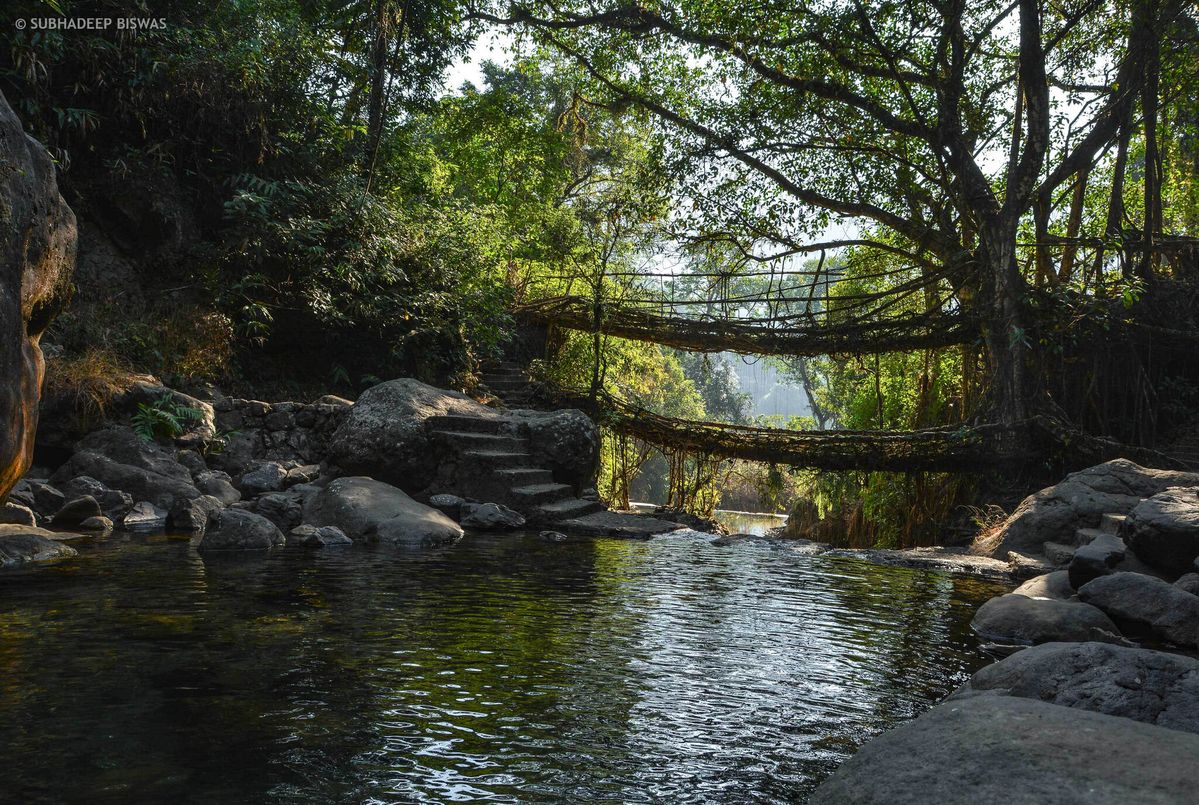
This is Meghalaya’s most famous image and it is fully earned. Living root bridges are created by the Khasi people over centuries — the aerial roots of rubber fig trees are guided across gorges using bamboo scaffolding, intertwined, and left to grow until they support the weight of dozens of people. The Double Decker bridge at Nongriat is two of these structures stacked vertically above a turquoise-green stream, draped in moss and ferns, in a gorge so humid and green it feels subtropical.
Getting there involves a descent of 3,500 stone steps (roughly 2.5–3 hours each way) from Tyrna village into the gorge. The trail passes through several Khasi villages, past single-span root bridges, over streams on bamboo walkways. I arrived at the Double Decker at 8 AM, before most day-trippers reach it, and had 20 minutes alone with it. The sound was the stream below and birds and nothing else.
Insider tip: Stay overnight in Nongriat village (₹500–800 per person including meals). You get the bridge at dawn, before any crowd arrives, and the gorge in early morning light is completely different from midday. The return climb takes 3–4 hours — start early, carry water, wear grip footwear.
Dawki and the Umngot River — The Transparent Water Experience

I described it in the introduction, but the full picture: Dawki is a small town on the Bangladesh border in the Jaintia Hills, about 82 km from Shillong. The Umngot River here is fed by underground springs through limestone rock, which creates a filtration system that makes the water appear completely transparent. Boat rides on the river run ₹400–600 per boat (not per person — negotiate, and if you’re solo, join another group). The optimal time is November through April; during monsoon the river runs fast and sediment-rich.
Honest warning: Dawki has become significantly more popular in the last three years. Weekends now see genuine crowds of boats. Visit on a weekday, arrive early morning (8–9 AM), and stay until 10–11 AM before the bulk of tourists arrive.
Mawlynnong — Asia’s Cleanest Village

Mawlynnong was designated Asia’s cleanest village by Discover India magazine in 2003 and the designation, though old, is not inaccurate. The village is swept continuously, bamboo dustbins hang from every tree, plastic is banned, and the community has maintained this standard cooperatively for decades. It’s about 90 km from Shillong near the Bangladesh border, often combined with a Dawki day trip.
The village itself is a pleasant 30-minute wander — flower-lined paths, wooden houses with kitchen gardens, a community hall, and a “sky walk” bamboo tower (₹30) from which you can see the Bangladesh plains below the escarpment on a clear day. What makes it worth visiting beyond the tidiness is the conversation with residents about how a village collectively decides to maintain this standard — it’s a genuine model and the community is rightly proud.
Insider tip: Stay one night in a Mawlynnong homestay (₹800–1,200 including meals). The village after 5 PM, when day visitors leave, is completely quiet and extraordinarily peaceful.
Nohkalikai Falls — India’s Tallest Plunge Waterfall

At 340 metres, Nohkalikai is India’s tallest plunge waterfall — a single unbroken drop from the plateau edge near Cherrapunji into a pool of vivid turquoise-green at the base. The viewing point is accessible from the road (short walk, free entry). I stood at the railing for 30 minutes and watched the water fall — it takes long enough to drop that you can track individual threads of white against the dark cliff face. The pool at the base is so far below it looks like a gemstone.
The falls are at their most dramatic during and immediately after monsoon (July–October) when the full volume flows. In the dry season (February–April), they’re thinner but the turquoise pool is clearer and more visible. Both are worth seeing; just different.
Elephant Falls — Shillong’s Accessible Three-Tiered Waterfall
About 12 km from Shillong city, Elephant Falls cascades in three stages through a forested gorge. Entry ₹20. It’s the most accessible waterfall from Shillong and is genuinely beautiful — the lower tier in particular, where the water spreads across a wide stone face into a pool fringed with ferns. Good for an afternoon half-day from the city before heading to Cherrapunji the next day.
Honest warning: The path to the lower fall involves steep, sometimes slippery steps. Wet season can make it quite hazardous. Hold the rope railings.
Mawsmai Cave — Cherrapunji’s Limestone Cavern
About 6 km from Cherrapunji town, Mawsmai Cave is a 150-metre illuminated limestone cave system. Entry ₹20. The formations inside — stalactites, root networks threading through the ceiling from the forest above, narrow passage sections — are interesting rather than extraordinary, but the cave itself is visually unique and the 15–20 minute walk through is worth it as part of a Cherrapunji day. Not a spelunking adventure — more of a scenic tunnel walk.
Umiam Lake (Barapani) — Meghalaya’s Hill Lake
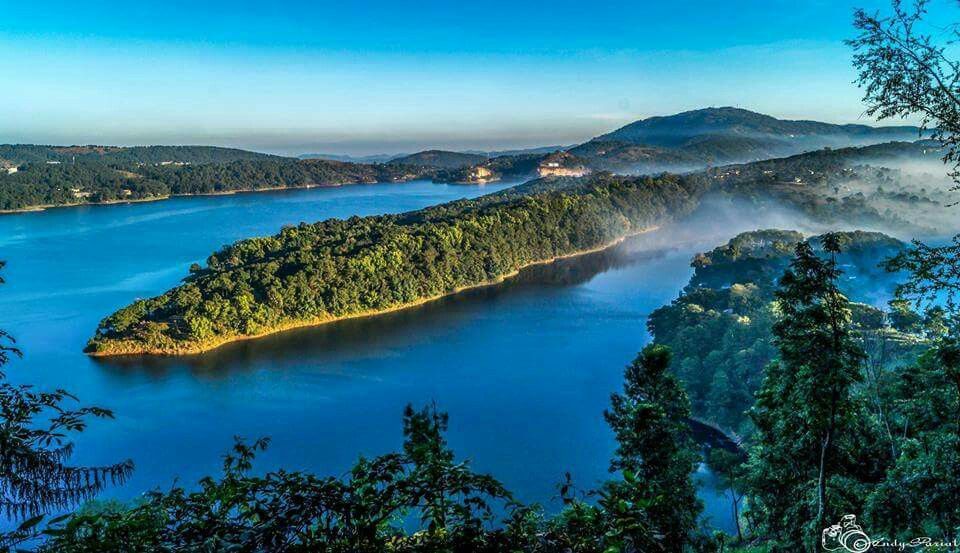
About 15 km north of Shillong, Umiam Lake is a large reservoir surrounded by pine-forested hills that looks, in certain light, like something from the Scottish Highlands. You can kayak or pedal-boat (₹200–500), walk the lakeside, or simply drive past and stop for photographs. The Ri Kynjai Resort sits on its banks and is worth visiting even if you’re not staying there.
Shillong Night Market and Local Food

Shillong is a surprisingly good food city with a strong café culture, excellent Khasi food, and one of the most functional night markets in Northeast India. Try: Jadoh (red rice and pork, the Khasi staple — rich, slightly smoky, deeply satisfying), Doh Khleh (pork salad with onion and ginger), Tungrymbai (fermented soybean chutney), and Pukhlein (deep-fried rice and jaggery snacks). The Police Bazaar area and the Laitumkhrah neighbourhood have the best cafés and the most lively evening food street scene.
- 💡 Practical Travel Tips
Cash is essential outside Shillong. Cherrapunji, Nongriat, Mawlynnong, Dawki, and most village areas have no ATMs. Carry significant cash before leaving Shillong — ₹5,000–8,000 for a multi-day interior trip is not excessive.
SIM and internet: BSNL is the most reliable network in remote Meghalaya — Jio and Airtel have good coverage in Shillong and Cherrapunji but can be patchy in gorges and border areas. Pick up a BSNL SIM in Shillong if you’re going deep into the hills.
Physical fitness: This is a genuine consideration. The root bridge treks involve thousands of stone steps with significant elevation change. The Nongriat Double Decker involves 3,500 steps down and the same back up. This is moderate to strenuous hiking, not a gentle nature walk. Come with proper footwear and a realistic assessment of your fitness level.
Permits: Inner Line Permits are not currently required for most of Meghalaya’s main tourist sites for Indian nationals. Foreign visitors should check requirements at the time of travel, as regulations can change.
Safety: Meghalaya is safe for solo travellers including solo women. Exercise normal caution on remote trails — tell your homestay host where you’re going and expected return time. Monsoon increases waterfall and trail hazards significantly; check conditions locally.
- 📅 Best Time To Visit Meghalaya
| Month | Weather | Waterfalls | Crowds |
| Jan–Feb | Cool (10–18°C), dry | Reduced flow | Low |
| March–April | Warming up, pleasant | Good flow | Low-Medium |
| May–June | Pre-monsoon, occasional rain | Good–heavy | Medium |
| July–Sept | Full monsoon, heavy rain | Peak flow, dramatic | Low |
| October | Post-monsoon, lush | Excellent | Medium |
| November | Beautiful (15–22°C), clear | Good | Medium-High |
| December | Cool, clear | Reduced | Low-Medium |
Best overall: October–November and March–April. October gives you post-monsoon lushness with waterfalls still running strong and the gorges and forests at their most vivid green. March–April offers pleasant temperatures and the Dawki river at its clearest.
Monsoon (July–September): The waterfalls are spectacular and the landscape is intensely, overwhelmingly green — but trails become treacherous, roads can close due to landslides, and some areas flood. Experienced travellers willing to accept the risk find monsoon Meghalaya extraordinary. First-timers should avoid it.
- ⏳ 5-Day Meghalaya Itinerary

Day 1: Arrive Shillong — City, Lake, Night Market
- Arrive Shillong via sumo from Guwahati airport. Check into hostel or hotel.
- 3:00 PM: Umiam Lake (15 km) — drive, lakeside walk, photographs.
- 5:30 PM: Return to Shillong. Police Bazaar walk.
- 7:00 PM: Dinner — Jadoh and Doh Khleh at a Khasi food restaurant in Laitumkhrah.
- Daily spend: ₹2,000–3,500 (including accommodation ₹700–3,500)
Day 2: Shillong to Cherrapunji — Waterfalls & Plateau Views
- 8:00 AM: Shared sumo to Cherrapunji (₹200 pp, 1.5 hrs).
- 10:00 AM: Seven Sisters Falls viewpoint (seasonal, best in monsoon/post-monsoon).
- 11:00 AM: Mawsmai Cave (₹20 entry, 30 min).
- 12:30 PM: Nohkalikai Falls — 30–45 minutes at the viewpoint.
- 2:00 PM: Lunch at Cherrapunji town. Check into resort or homestay.
- 4:30 PM: Gorge viewpoint walk from the resort — the plateau edge at sunset is one of Meghalaya’s finest views.
- Daily spend: ₹2,000–4,000
Day 3: Nongriat Root Bridge Trek — Overnight in Gorge
- 7:00 AM: Drive to Tyrna village (20 min from Cherrapunji).
- 7:30 AM–10:30 AM: Descend 3,500 steps to Nongriat. Stop at single root bridges en route.
- 10:30 AM–12:00 PM: Double Decker Root Bridge — swim in the stream below, explore the gorge.
- Check into Nongriat village homestay. (₹500–800 including dinner and breakfast.)
- Afternoon: Walk to Rainbow Falls (additional 45 min from the bridge) if energy allows.
- Daily spend: ₹1,500–2,500 (very low cost day — remote area)
Day 4: Return from Nongriat — Drive to Dawki
- 6:00 AM: At the Double Decker Root Bridge before any other visitors arrive. This is the reason you stayed overnight.
- 7:30 AM: Begin the climb out (3–4 hours, stop for chai in gorge villages en route).
- 12:00 PM: Reach Tyrna. Taxi to Dawki (1.5 hrs, ₹1,000–1,500 for private cab, or share with others from Nongriat).
- 3:00 PM: Umngot River boat ride (₹400–600/boat). Late afternoon light on the transparent water is exceptional.
- Evening: Check into Dawki guesthouse or drive to Mawlynnong (30 km, ₹400–600 by cab).
- Daily spend: ₹2,000–3,500
Day 5: Mawlynnong Village — Sky Walk — Return to Shillong
- 8:00 AM: Mawlynnong village walk — flower paths, bamboo dustbins, community gardens.
- 9:30 AM: Sky Walk bamboo tower (₹30). Bangladesh plains visible on clear days.
- 11:00 AM: Drive back to Shillong (90 km, 2.5 hrs by shared sumo ₹200 pp or private cab ₹1,500–2,000).
- 2:00 PM: Arrive Shillong. Lunch, rest.
- 4:00 PM: Onward sumo to Guwahati airport for evening flight, or overnight in Shillong.
- Daily spend: ₹1,500–2,500
- 💰 Complete Budget Breakdown
| Category | Budget Traveller | Mid-Range | Luxury |
| Accommodation (5 nights) | ₹3,500–6,000 | ₹15,000–27,000 | ₹40,000–65,000 |
| Food (5 days) | ₹1,500–2,500 | ₹3,000–5,000 | ₹6,000–12,000 |
| Transport (Guwahati + local) | ₹2,000–3,500 | ₹5,000–9,000 | ₹12,000–20,000 |
| Waterfall entries | ₹100–200 | ₹200–400 | ₹400–800 |
| Boat ride (Dawki) | ₹400–600 | ₹600–1,000 | ₹1,000–2,000 |
| Root bridge trek | Free | Free | ₹1,500–3,000 (guide) |
| Caves / Sky Walk | ₹50–100 | ₹100–200 | ₹200–400 |
| Guide (optional) | ₹800–1,500/day | ₹1,500–2,500/day | ₹2,500–4,000/day |
| Misc (chai, tips, etc.) | ₹500–800 | ₹800–1,500 | ₹2,000–4,000 |
| Total 5-Day Trip | ₹8,850–15,200 | ₹26,200–51,600 | ₹64,100–1,11,200 |
Where to save: Village homestays in Nongriat and Mawlynnong are both cheaper and better than hotels. Shared sumos everywhere. Root bridge treks are free. The Dawki boat ride split across a group is very affordable.
Where to splurge: Ri Kynjai Resort for one night if budget allows — the lake cottage experience is genuinely extraordinary. And hiring a private cab for the Dawki–Mawlynnong–Shillong return day saves time and energy that you’ll need for the trek.

- 🤔 Final Honest Verdict
Meghalaya is, without qualification, one of the most visually extraordinary travel destinations in India. I’ve been to Ladakh and Kerala and the Andamans — the Andaman travel guide 2026 covers a different kind of beauty entirely — and Meghalaya belongs in that conversation. The living root bridges are not a tourist gimmick; they are a genuinely remarkable human and biological phenomenon that took centuries to create. The Dawki river is real. The gorge views from the Cherrapunji plateau edge, on a clear October evening, are as good as landscape views get in India.
The honest drawback: Meghalaya is physically demanding in a way that catches people off guard. The Nongriat root bridge trek is 7,000 steps round-trip with significant elevation change. The roads are mountain roads, winding and sometimes unpaved. Village homestays, while wonderful, mean bucket showers and basic food. And the state is genuinely remote — if something goes wrong logistically (a road closes, a vehicle breaks down), your options are limited. If you’re expecting resort-style comfort throughout, you’ll be disappointed. If you’re prepared for physical effort and basic comforts in exchange for extraordinary experiences, Meghalaya will exceed almost any expectation.
Perfect for: Trekking and nature enthusiasts, photographers, solo adventurers, couples willing to rough it, travellers who’ve done the standard India circuit and want something completely different, and anyone who has been comparing India with destinations like Bali or Kerala and wants proof that India’s natural beauty needs no comparison.
Might want to skip if: You have mobility limitations that make 3,500-step descents impractical, you’re visiting only in peak monsoon without experience of hazardous trail conditions, or you need reliable internet and urban comforts throughout.
Go in October or November. Stay in Nongriat overnight. Arrive at the Double Decker bridge at 6 AM. That hour alone will justify the entire trip.