


📋 TABLE OF CONTENTS
- Seven Days, Three Hill Ranges, One State That Broke My Expectations
- Where Is Meghalaya?
- How To Get To Meghalaya
- Getting Around — The Road Trip Reality
- Where To Stay Across 7 Days
- Everything Worth Doing — Adventures, Hidden Places & Food
- Practical Tips I Learned the Hard Way
- Best Time To Visit Meghalaya
- My Exact 7-Day Road Trip Itinerary
- Complete Honest Budget Breakdown
- Final Verdict — 7 Days Well Spent?
- 🌿 Seven Days, Three Hill Ranges, One State That Broke My Expectations
On Day 4, I was sitting on a flat granite boulder in the middle of a stream, somewhere in the East Khasi Hills, with no mobile signal, a half-eaten pack of cream crackers in my lap, and the sound of a waterfall I’d found by accident 200 metres downstream. I had no idea what the waterfall was called. My driver — a quiet, dry-humoured man named Donbok who’d been driving me across Meghalaya for four days — was asleep in the car parked on the dirt trail behind me. The forest around the stream was so green it appeared almost luminescent.
I’d come to Meghalaya expecting the highlights: the Dawki river, the Double Decker Root Bridge, Mawlynnong, Nohkalikai Falls. What I got was all of those — and also this: an anonymous waterfall down an unmarked track, a lunch of Jadoh and pork from a roadside stall that I pointed at without knowing what it was, a night in a village homestay where the family showed me photographs from their harvest festival and we communicated largely through hand gestures and smiling. Seven days felt simultaneously too long and not long enough.
Meghalaya rewards time. The five-day version is good. The seven-day version takes you into the Garo Hills, into waterfalls that have no crowd problem because nobody knows about them yet, and into a slower rhythm where the state actually reveals itself.
Here’s the honest account of all of it.
- 📍 Where Is Meghalaya?
Meghalaya is a small, mountainous state in Northeast India, nestled between Assam to the north and Bangladesh to the south, with an area roughly the size of Switzerland. Its capital Shillong sits at 1,496 metres in the Khasi Hills, about 100 km east of Guwahati — the nearest major transit hub. The state spans three distinct hill ranges: the Khasi Hills in the central zone (Shillong, Cherrapunji, Nongriat, Mawlynnong), the Jaintia Hills in the east (Dawki, Krang Suri, Phe Phe), and the Garo Hills in the west (Tura, Nokrek, Balpakram). Most travellers visit only the Khasi Hills, which means the Jaintia and Garo zones are still genuinely uncrowded — a rare thing in Indian tourism in 2026.
- ✈️ How To Get To Meghalaya
By Air (Most Practical): Fly into Lokpriya Gopinath Bordoloi International Airport, Guwahati — direct flights from Delhi (2.5 hours, ₹3,000–8,000), Mumbai (3 hours, ₹4,000–9,000), Kolkata (1 hour, ₹2,000–5,000). From the airport, pre-arranged shared sumos (₹250–350 per person) or private taxis (₹1,500–2,000) make the 3-hour drive to Shillong.
Shillong has its own small airport at Umroi — flights from Kolkata only, limited schedule, not recommended as a primary option.
By Train: Guwahati Junction is the nearest major railhead — connected to Delhi (Rajdhani: ~38 hours, ₹1,500–4,500), Kolkata (~17 hours, ₹600–2,000), and other major cities. From Guwahati, sumos to Shillong depart from Paltan Bazaar from 6 AM.
For a 7-day road trip: If you’re planning to cover Khasi Hills, Jaintia Hills, and Garo Hills, consider entering via Guwahati and exiting via Tura (nearest airport for Garo Hills) if available, or doing a circular route back to Guwahati. The state is compact enough for a full loop in 7 days with proper planning.
| Mode | From Delhi | From Kolkata | Guwahati → Shillong |
| Flight + sumo | ₹3,500–8,500 / 5.5 hrs | ₹2,500–5,500 / 3.5 hrs | ₹250–350 pp / 3 hrs |
| Train + sumo | ₹1,800–5,000 / 40 hrs | ₹700–2,200 / 18 hrs | ₹250–350 pp / 3 hrs |
- 🚗 Getting Around — The Road Trip Reality
This is not a destination where you rely on public transport and figure it out as you go. Let me be direct about that from the start.
Shared sumos run between Shillong and Cherrapunji (₹150–200 pp), Shillong and Dawki (₹200–250 pp), Shillong and Mawlynnong (₹200–250 pp). They work well for these standard routes but not for exploring off the main corridor or reaching the Garo Hills efficiently.
Hiring a private driver with vehicle: The smartest and most cost-effective option for a 7-day itinerary covering multiple zones. Expect to pay ₹3,000–5,000 per day for a Bolero or Innova with driver. Over 7 days that’s ₹21,000–35,000 split across 2–4 travellers, which becomes extremely reasonable per person. Donbok charged me ₹3,500/day including fuel and his accommodation — I found him through my Shillong hostel and negotiated the weekly rate. This kind of arrangement, made locally rather than through a booking platform, consistently gets you a better deal and a genuinely knowledgeable companion.
Rented scooter (Shillong only): ₹400–600/day. Fine for city exploration and Umiam Lake. Not suitable for longer mountain routes unless you have strong experience with hilly terrain on two wheels.
Trekking on foot: Non-negotiable for the root bridges (Nongriat: 3,500 steps each way), waterfall approaches, and village exploration. Budget 5–8 hours for the Nongriat full day. Wear footwear with grip. Carry more water than you think you need.
Road conditions: Main highways are decent. Minor roads to waterfalls and interior villages range from rough tarmac to dirt tracks. A high-clearance vehicle matters if you’re going off the main route.
Difficulty for first-timers: High if you’re navigating independently. Moderate to low with a local driver who knows the routes. I’d strongly recommend arranging the private driver or booking through an organised service like the Tripyverse Meghalaya-Shillong-Dawki package if logistics planning isn’t your strength.
- 🏨 Where To Stay Across 7 Days
A 7-day Meghalaya road trip moves through different zones — you shouldn’t stay in Shillong the whole time. Here’s how I split accommodation:
Night 1 & 7: Shillong
Ri Kynmaw Hostel (Shillong, budget): Dorms from ₹700. Best social hostel in the city. Good for the first and last nights.
Polo Orchid Resort (Shillong, mid-range): Comfortable, reliable, central. From ₹3,500.
Ri Kynjai Resort (Umiam Lake, luxury): Wooden cottages over the lake. The most beautiful property in the Shillong area. From ₹9,000. Worth it for one night if the budget allows.
Night 2: Cherrapunji/Sohra
Cherrapunji Holiday Resort — Cottages: Plateau-edge location, gorge views, from ₹5,000 for cottages. Budget rooms from ₹1,800.
Night 3: Nongriat Village (Root Bridge Gorge)
Village homestay: ₹500–800 per person including dinner and breakfast. No luxury. Essential. Book through contacts in Cherrapunji or your Shillong hostel.
Night 4: Dawki or Shhnongpdeng
Shnongpdeng riverside camping/guesthouse: The riverside village 7 km from Dawki has several simple guesthouses and camping spots on the Umngot riverbank. ₹800–1,500/night. Falling asleep to the sound of the transparent river is one of Meghalaya’s quietly excellent experiences.
Night 5: Krang Suri / Jowai area (Jaintia Hills)
Local guesthouses in Jowai: Basic, functional, ₹600–1,200. This zone is genuinely underdeveloped for tourism infrastructure — pack with realistic expectations.
Night 6: Tura or Balpakram approach (Garo Hills)
Orchid Tourist Lodge (Tura, government-run): Clean, functional, ₹1,200–2,000. The Garo Hills accommodation scene is basic but adequate for one night.
- 🏕️ Everything Worth Doing — Adventures, Hidden Places & Food
The Double Decker Living Root Bridge — Nongriat (Day 3)

I’ve described this elsewhere and I’ll say it again: no single experience in Meghalaya surpasses arriving at the Double Decker Root Bridge before 7 AM, after staying in Nongriat village overnight. Two tiers of living tree root, grown over centuries by Khasi communities across a gorge of turquoise stream and fern-draped boulders. The descent is 3,500 stone steps, roughly 2.5–3 hours from Tyrna. The return climb takes 3–4 hours. Your legs will know about it the next day.
The bridge itself is about 30 metres long, wide enough to walk three abreast, and bears the weight of dozens of people daily. The roots that form the handrails are thick as arms. Standing on it and looking down at the stream below, at the single-span root bridge visible further up the gorge, at the green walls rising on both sides, is — I keep coming back to this word — genuinely humbling.
Insider tip: From Nongriat, it’s another 45-minute walk to Rainbow Falls — a secondary waterfall in the same gorge system that is extraordinarily beautiful and almost always empty. Day visitors almost never make it this far. Stay overnight and go.
Krang Suri Waterfall — Jaintia Hills’ Best-Kept Secret (Day 5)
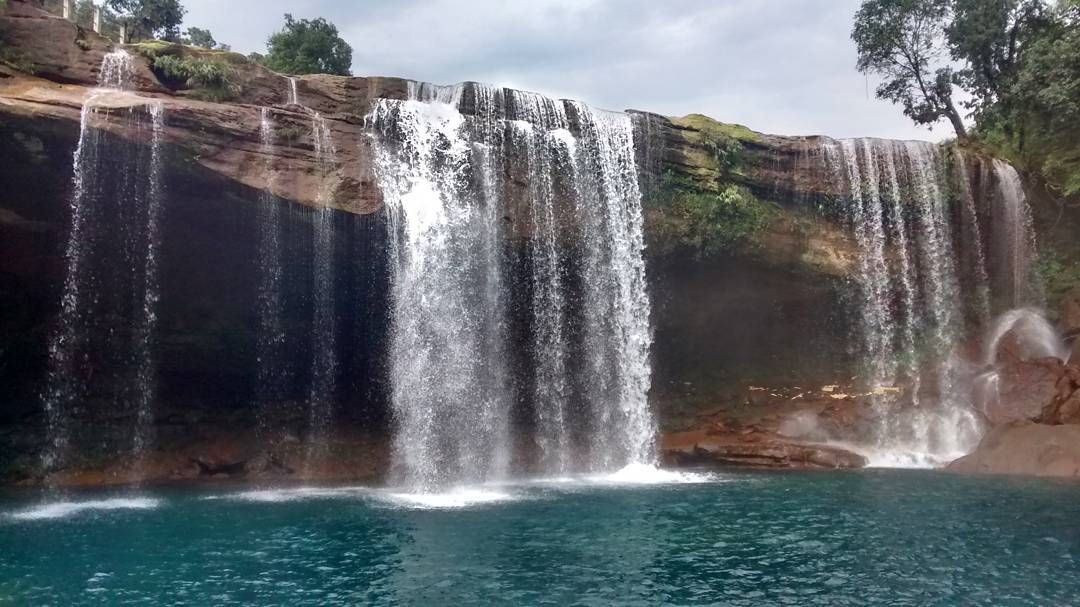
About 100 km from Shillong in the Jaintia Hills, Krang Suri is what happens when a turquoise river drops over dark limestone into a wide pool surrounded by forest and rock. The water colour — a specific shade of greenish-blue caused by mineral content — is the most vivid I saw in Meghalaya, including Dawki. Entry ₹30. You can swim in the pool below the falls, which I did for about an hour while the sun moved through the trees above.
The route to Krang Suri passes through rubber and areca nut plantations, small Jaintia villages, and landscape that looks completely different from the Khasi Hills — more open, more agricultural. This contrast is one of the rewards of going further than most tourists do.
Honest warning: The road to Krang Suri is rough in sections. High clearance is recommended. Weekday mornings are dramatically less crowded than weekends — this one is gaining Instagram attention fast.
Dawki and Shnongpdeng — The Transparent River, Done Right (Day 4)

Rather than the day-tripper’s rush to Dawki, take the boat in the morning, then drive the 7 km to Shnongpdeng for the afternoon. Shnongpdeng sits on the same Umngot River but with fewer visitors and a riverbank you can actually sit on, swim from, and camp beside. The transparency of the water here, in the afternoon light, is if anything more striking than at Dawki — the riverbed patterns of stone and sand are visible in complete detail 4–5 metres down.
Cliff jumping (₹100) and kayaking (₹200–300/hour) are available from operators at Shnongpdeng. I did both and the cliff jump — from about 7 metres into completely clear water where you can see the bottom coming up at you — is an experience I cannot quite recommend strongly enough.
Balpakram National Park — The Garo Hills’ Wildest Place (Day 6)

Balpakram is Meghalaya’s most remote and least-visited national park — a plateau of grassland and forest in the Garo Hills, near the Bangladesh border, containing significant populations of elephants, gaur, clouded leopards, and hornbills. Entry requires a Forest Department permit (₹200–500 depending on vehicle) and a local guide.
I spent a morning here and saw elephant footprints, a hornbill, and the extraordinary landscape of the plateau edge where the forest drops away into gorges that disappear into Bangladesh below. I didn’t see a big cat — I didn’t expect to. What I found was one of the quietest, most primordially forested places I’ve visited in India. Tourism infrastructure is minimal. Bring supplies.
Phe Phe Waterfall — Off Every List (Day 5 Morning)

About 15 km from Jowai in the Jaintia Hills, Phe Phe Falls requires a 2 km trek through forest and farmland from the roadhead. The falls are wide, powerful, and two-tiered — dropping into a bowl of dark stone that creates an enormous roar you hear before you see the water. Entry is free. There was one other group when I arrived, and they left after 20 minutes. I stayed for two hours.
This is exactly the kind of place that rewards the 7-day itinerary over the 5-day one — it requires the Jaintia Hills leg, which most people skip.
Mawlynnong and the Sky Walk (Day 4, Morning)
Asia’s cleanest village, 90 km from Shillong on the Bangladesh border, is a 30-minute wander of flower-lined paths, bamboo dustbins, and immaculate community spaces. The bamboo Sky Walk tower (₹30 entry) gives views across the plains of Bangladesh on a clear day. I visited on a Tuesday morning and had the village almost to myself — the contrast with the weekend crowds (which are real and growing) is dramatic.
Combined with Dawki (30 km away), Mawlynnong makes for a full and excellent Day 4.
Nokrek Biosphere Reserve — Garo Hills Forest (Day 6 Afternoon)
Adjacent to Balpakram, Nokrek is a UNESCO Biosphere Reserve and the original home of the wild citrus — the ancestor of all commercial citrus fruits is believed to originate here. The forest is dense, the birdlife is extraordinary (hornbills, sunbirds, barbets), and the red panda has been recorded here, though sightings are rare. Entry with guide required.
Shillong’s Café Culture and Local Food

Shillong has become one of Northeast India’s best café cities — influenced by its Khasi rock music scene, its large student population, and its Welsh Presbyterian cultural legacy (which produced, peculiarly, a strong coffee culture). Café Shillong Heritage and Ri Kynjai café are worth the time. For Khasi food: Jadoh with pork at any local dhaba (₹80–150), Doh Khleh (pork salad), and Tungrymbai (fermented soybean) are the essentials. The Police Bazaar night market has the best combination of street food and atmosphere.
- 💡 Practical Tips I Learned the Hard Way
Cash in large quantities before leaving Shillong. I ran out of cash on Day 5 in the Jaintia Hills. The nearest ATM was in Jowai, 45 minutes back. Interior Meghalaya — Garo Hills, Jaintia Hills, village areas — operates entirely on cash. Carry ₹8,000–12,000 for a 7-day interior trip.
BSNL SIM for the Garo Hills. Jio and Airtel have good coverage in Shillong and Cherrapunji. Beyond that, BSNL is often the only network with signal. Get a BSNL SIM in Shillong — the process takes 30–60 minutes and is worth every minute.
Your driver matters more than you think. A good local driver in Meghalaya isn’t just a transport provider. Donbok knew which waterfall track to take in wet conditions, which village homestays were clean and honest, and which routes to skip after rain. Ask your hostel in Shillong for a driver recommendation and negotiate a multi-day rate directly.
Physical fitness for the trek. The Nongriat return climb is 3–4 hours of strenuous uphill on stone steps. If you have knee issues or are not accustomed to sustained physical activity, factor this honestly into your planning.
Permits: Indian nationals don’t require Inner Line Permits for most of Meghalaya as of 2026. For Balpakram and Nokrek, Forest Department entry permits are required and must be arranged locally — do this from Tura the day before.
Safety: Meghalaya is safe. Petty crime is very rare. Road conditions are the main hazard — mountain roads can be slippery after rain and some tracks are genuinely rough. Travel during daylight hours on all interior routes.
- 📅 Best Time To Visit Meghalaya
| Month | Weather | Waterfalls | For Road Trips |
| January–February | Cool–Cold (8–18°C), dry | Reduced | Good — clear roads |
| March–April | Warm, pleasant (15–25°C) | Good | ✅ Excellent |
| May–June | Warming, pre-monsoon rain | Strong | Acceptable — some roads wet |
| July–September | Full monsoon, heavy rain | Spectacular | Difficult — landslides, closed roads |
| October | Post-monsoon lush (15–25°C) | Excellent | ✅ Best month overall |
| November | Clear, cool (12–22°C) | Good | ✅ Excellent |
| December | Cool–Cold (8–18°C) | Reduced | Good — quiet, clear |
7-day road trip sweet spot: October or March–April. October gives you the lushest post-monsoon green, still-strong waterfalls, and Dawki at near-peak clarity. March–April gives the clearest Dawki river and pleasant driving temperatures.
Avoid July–September for a road trip. Monsoon Meghalaya is visually extraordinary but practically difficult — roads close due to landslides, tracks become impassable, and planning becomes reactive rather than itinerary-driven. Experienced travellers can manage it; first-timers shouldn’t try.
- ⏳ My Exact 7-Day Road Trip Itinerary

Day 1: Arrive Shillong — Settle, Eat, Explore
- Arrive from Guwahati by sumo (~3 hours, ₹300).
- 3:00 PM: Umiam Lake drive (15 km). Lakeside walk, first Meghalaya landscape view.
- 5:30 PM: Police Bazaar evening walk.
- 7:00 PM: Jadoh and Doh Khleh dinner at a Khasi restaurant in Laitumkhrah.
- Daily spend: ₹2,500–4,000
Day 2: Shillong to Cherrapunji — Waterfall Day
- 8:00 AM: Driver picks up. Drive to Cherrapunji (1.5 hours).
- 10:00 AM: Nohkalikai Falls viewpoint — 45 minutes.
- 11:00 AM: Mawsmai Cave (₹20 entry, 20 minutes).
- 12:00 PM: Seven Sisters Falls viewpoint (seasonal).
- 2:00 PM: Lunch + check into Cherrapunji resort.
- 4:30 PM: Gorge edge sunset walk from resort.
- Daily spend: ₹2,500–5,000
Day 3: Nongriat Root Bridge Trek — Overnight in Gorge
- 7:00 AM: Drive to Tyrna (20 minutes).
- 7:30 AM–10:30 AM: Descend 3,500 steps to Nongriat.
- 10:30 AM: Double Decker Root Bridge.
- 12:00 PM: Continue to Rainbow Falls (45 min from bridge). Worth it.
- 2:00 PM: Return to bridge. Lunch from homestay kitchen.
- Check into Nongriat homestay (₹500–800 including meals).
- Daily spend: ₹1,500–2,500
Day 4: Bridge at Dawn — Drive to Mawlynnong & Dawki — Night at Shnongpdeng
- 6:00 AM: Double Decker Root Bridge in first light. This is why you stayed.
- 7:30 AM: Begin return climb (3–4 hours).
- 12:00 PM: Back at Tyrna. Driver waiting. Drive to Mawlynnong (1.5 hours).
- 2:00 PM: Mawlynnong village walk + Sky Walk tower.
- 4:00 PM: Drive to Dawki (30 min). Boat ride on Umngot River (₹400–600/boat).
- 5:30 PM: Drive to Shnongpdeng (7 km). Check into riverside guesthouse (₹800–1,500).
- Daily spend: ₹2,500–4,000
Day 5: Shnongpdeng Kayak/Cliff Jump — Drive to Jaintia Hills — Krang Suri & Phe Phe
- 7:00 AM: Morning on the river. Kayaking or cliff jumping at Shnongpdeng. ₹200–400.
- 9:30 AM: Drive toward Jaintia Hills (2.5 hours to Krang Suri area).
- 12:00 PM: Phe Phe Waterfall trek (2 km each way, 1.5 hours total). Free.
- 2:30 PM: Drive to Krang Suri Falls (30 min). Entry ₹30. Swim in the pool.
- 5:00 PM: Drive to Jowai. Check into local guesthouse (₹800–1,200).
- Daily spend: ₹2,000–3,500
Day 6: Garo Hills — Balpakram + Nokrek — Overnight in Tura
- Early start — 5:30 AM: Long drive to Tura (~200 km, 5–6 hours through varying roads).
- 12:00 PM: Arrive Tura. Lunch.
- 2:00 PM: Permit collection for Balpakram / Nokrek from Forest Department office.
- 3:30 PM: Balpakram National Park — 2-hour guided entry (₹200–500 + guide fee).
- Evening: Check into Orchid Tourist Lodge or local guesthouse in Tura (₹1,200–2,000).
- Daily spend: ₹2,500–4,500 (long-distance travel day)
Day 7: Nokrek Biosphere + Return to Shillong via Guwahati
- 7:00 AM: Nokrek Biosphere morning walk (2 hours with guide). Birdlife, forest, wild citrus.
- 10:00 AM: Drive from Tura back toward Guwahati (3.5–4 hours) for onward flight/train, OR long drive back to Shillong (~6 hours) for accommodation.
- Evening: Celebrate the end of the road trip in Shillong — café, Khasi food, cold beer at a Police Bazaar bar.
- Daily spend: ₹2,000–3,500
For those wanting a more structured version of the Shillong–Dawki–Cherrapunji stretch without the logistical planning, the Tripyverse Meghalaya-Shillong-Dawki package handles the core itinerary well — you can extend independently for the Jaintia and Garo legs.
And if you’re comparing Meghalaya to other outstanding Indian nature destinations, the Kerala travel guide 2026 and the Andaman guide offer completely different but equally extraordinary experiences — no comparison needed, all three deserve their own trip.
- 💰 Complete Honest Budget Breakdown
| Category | Budget Traveller | Mid-Range | Luxury |
| Accommodation (7 nights) | ₹4,500–8,500 | ₹18,000–35,000 | ₹55,000–90,000 |
| Food (7 days) | ₹2,100–3,500 | ₹4,000–7,000 | ₹8,000–15,000 |
| Private driver/vehicle (7 days) | ₹21,000 (split 3 ways = ₹7,000 pp) | ₹24,500 (split 2 = ₹12,250 pp) | ₹35,000 solo |
| Guwahati flights (return) | ₹4,000–8,000 | ₹6,000–12,000 | ₹12,000–20,000 |
| Treks/entry fees | ₹500–1,000 | ₹1,000–2,000 | ₹2,000–4,000 |
| Adventure activities | ₹500–1,000 | ₹1,000–2,000 | ₹2,000–4,000 |
| Guide fees | ₹800–1,500 | ₹1,500–3,000 | ₹3,000–5,000 |
| Misc (cash for remote areas) | ₹1,000–2,000 | ₹2,000–3,500 | ₹4,000–8,000 |
| Total 7-Day Trip (per person) | ₹20,400–32,500 | ₹54,000–76,500 | ₹1,21,000–1,81,000 |
Where to save: Village homestays in Nongriat and Shnongpdeng are both the cheapest and the best accommodation on the trip. Shared driver costs split across 3–4 people dramatically reduces the biggest expense. Waterfall entries and trek routes are mostly free.
Where to splurge: One night at Ri Kynjai Resort on the final night in Shillong — after seven days of rough roads and village homestays, the lake cottage experience is a reward that lands differently than it would at the start of a trip.

- 🤔 Final Verdict — 7 Days Well Spent?
Without qualification: yes. The 7-day version of Meghalaya is categorically better than the 5-day version because it takes you to places where the tourist infrastructure hasn’t arrived yet. Phe Phe Waterfall. Balpakram. Nokrek. Shnongpdeng at sunset. The early morning cliff jump into the Umngot River with the river running clear beneath you. These are experiences that require the extra two days, and they’re the ones I think about most months later.
What genuinely surprised me: The Garo Hills. I went in with low expectations — tourism infrastructure is minimal, roads are rough, accommodation is basic — and found a landscape and a people (the Garo community, matrilineal like the Khasi, but culturally distinct) that were genuinely worth the effort. Balpakram National Park is one of the wildest, least-visited protected areas in India. If you have seven days and you spend all of them in the Khasi Hills, you’re missing half the state.
The honest drawback: Seven days in Meghalaya on a road trip is physically demanding. The Nongriat trek alone is a full physical effort. Combined with long driving days (Day 6 is 5–6 hours in a car on mountain roads) and basic accommodation for several nights, it asks something of you. Travellers who need reliable comfort, consistent internet, and low physical exertion will find this itinerary challenging. If that’s you, the 5-day Khasi Hills version — or the fully serviced Tripyverse Meghalaya package — is the better fit.
Perfect for: Adventure travellers, nature photographers, road-trip enthusiasts, solo adventurers, physically fit couples, anyone who has explored the Rishikesh adventure circuit (see the Rishikesh guide for comparison) and wants a completely different register of Indian adventure, and travellers who specifically want to go where the crowds aren’t.
Might skip the 7-day version if: You have limited physical fitness, you require reliable internet throughout, you’re travelling with young children, or you’re visiting July–September without experience of monsoon travel conditions.
For a concise overview of Meghalaya’s key sites before planning the full route, the complete Meghalaya travel guide 2026 covers everything in detail.
Go. Stay seven days. Go further than you planned to.