

📋 TABLE OF CONTENTS
- Something Shifted in Varanasi — And Everyone Can Feel It
- Where Is Varanasi?
- How To Get To Varanasi in 2026
- Getting Around the City
- Where To Stay — All Budgets
- Secret Places & Unmissable Experiences
- Practical Travel Tips for 2026
- Best Time To Visit Varanasi
- Perfect 3-Day Itinerary
- Complete Budget Breakdown
- Final Honest Verdict
- 🕯️ Something Shifted in Varanasi — And Everyone Can Feel It
I first visited Varanasi six years ago. I went back in early 2026, and the city I found was the same ancient, chaotic, sacred maze it has always been — and also somehow more visited than ever, by a wider, more diverse range of travellers than I’d seen there before.
At the Assi Ghat chai stall one morning, I sat next to a couple from Pune on their first solo trip, a solo woman from Bengaluru who’d specifically come for the Dev Deepawali festival, a family from Rajasthan doing the UP pilgrimage circuit, and two foreign travellers who’d come directly from seeing the Rishikesh rafting and café scene and wanted something completely different. Varanasi gave them all exactly that.
So what’s driving this? Why is 2026 specifically the year that Varanasi is seeing record domestic tourism numbers, a surge in younger Indian travellers, and growing international recognition beyond the usual backpacker circuit? The answers are more interesting than you’d expect — and they all point to the same conclusion: if you haven’t been yet, this is the year to go.
Here’s everything you actually need to know.
- 📍 Where Is Varanasi?
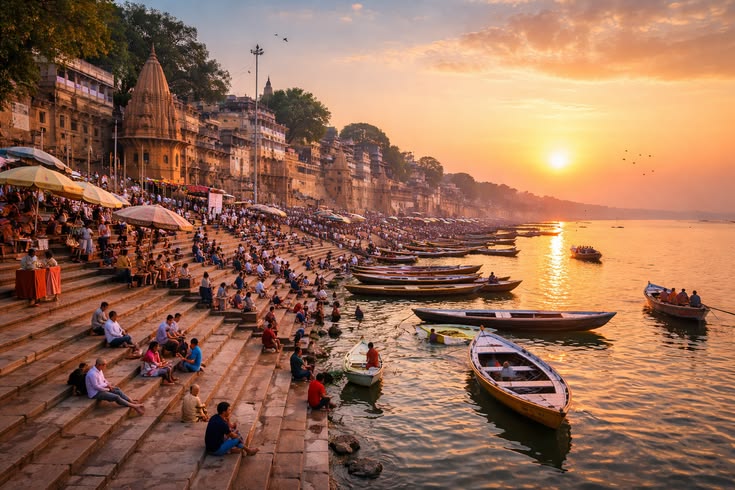
Varanasi sits on the western bank of the Ganga in Uttar Pradesh, about 320 km southeast of Lucknow, 800 km from Delhi, and 280 km from Prayagraj. It occupies a crescent-shaped bend of the river that creates a natural amphitheatre of ghats — the city rises in layers of stone, temple, and colour on the western bank while the opposite eastern bank remains flat, open, and forested, which is why sunrise from the Ganga here is so visually extraordinary. It’s been continuously inhabited for at least 3,000 years and is widely considered one of the oldest living cities on earth, which is a fact that doesn’t fully land until you’re standing in a 12th-century galli that hasn’t changed its essential character in centuries.
- ✈️ How To Get To Varanasi in 2026
By Air: Lal Bahadur Shastri International Airport (VNS) is 25 km from the old city. Direct flights from Delhi (1.5 hours), Mumbai (2 hours), and Bangalore (2.5 hours) run daily with IndiGo, Air India, and SpiceJet. Prices range from ₹2,500–8,000 depending on advance booking. Prepaid taxi to the ghats: ₹500–700.
By Train (Best Value Option): Varanasi Junction (BSB) connects to Delhi (Kashi Vishwanath Express: 11–13 hours, ₹400–1,400 depending on class), Mumbai (~26 hours), Kolkata (~12 hours), and all major UP cities. The overnight train from Delhi is by far the best combination of cost and practicality — you leave in the evening, arrive by morning, and save a night’s accommodation in the process.
By Road: Lucknow to Varanasi is approximately 4.5–5 hours by NH31 (Volvo bus: ₹600–900). Delhi by road is 13–15 hours and not recommended unless you’re doing a road trip. From Prayagraj, it’s a clean 3.5-hour drive.
| Mode | Cost (from Delhi) | Time |
| Flight + taxi | ₹3,000–8,500 | ~2.5 hours total |
| Overnight train (Sleeper) | ₹400–700 | 11–13 hours |
| Overnight train (3AC) | ₹900–1,500 | 11–13 hours |
| Bus (from Lucknow) | ₹600–900 | ~5 hours |
- 🚗 Getting Around Varanasi
Varanasi splits into two practical zones. The first is the old city and ghats area — a dense, ancient quarter of gallis (lanes often less than a metre wide) that no motorised vehicle can navigate. Everything here is done on foot, and that’s exactly the right way to do it. You’ll get lost. That’s not a problem; it’s the point.
The second zone is the broader city — Godowlia market, the train station, Sarnath (10 km away), BHU (4 km), the airport. For these, your options are:
Cycle rickshaws: ₹50–100 for most short trips within the older neighbourhoods. Slow, atmospheric, and appropriate.
Auto-rickshaws: ₹100–250 for most routes. Fixed rates from Godowlia to Assi Ghat (₹80–100), Sarnath (₹250–350 one way). Always negotiate before boarding.
Ola/Uber: Work reliably for airport runs, Sarnath, and BHU. Less useful inside the old city where roads don’t accommodate cars.
Boats: Non-optional. A private rowing boat runs ₹200–400/hour. Shared boats between ghats: ₹50–80 per person. The sunrise boat ride is ₹250–350 per person if pre-booked from your nearest ghat the evening before.
Difficulty for first-timers: The galli navigation is genuinely disorienting — Google Maps loses confidence inside the oldest lanes. Download an offline map before you arrive and embrace the confusion.
- 🏨 Where To Stay in Varanasi
Best area: Anywhere within walking distance of the main ghat strip. The neighbourhood behind Assi Ghat is the most relaxed base — quieter, good cafés, younger crowd. The lanes behind Dasaswamedh Ghat are more central and chaotic. Both work well depending on your temperament.
Budget (₹500–1,500/night)
Stops Hostel (Assi Ghat area): The best hostel in Varanasi by reputation and by experience. Clean dorms from ₹600, reliable Wi-Fi, excellent rooftop, and a social atmosphere that makes it easy to find boat-ride companions. The staff know the city well and give genuinely useful recommendations.
Shanti Guest House (Assi Ghat): A classic Varanasi guesthouse — nothing fancy, everything functional. ₹800–1,200 for a private double. Rooftop with partial river views and a reliable breakfast of parathas and chai.
Mid-Range (₹3,000–7,000/night)
Suryauday Haveli (Shivala Ghat): A restored heritage haveli directly on the ghats. Rooms are atmospheric and individually decorated. From ₹3,500/night — the rooftop breakfast overlooking the river is the reason people book this over and over.
Brijrama Palace (Darbhanga Ghat): A 250-year-old converted palace, now one of Varanasi’s best boutique hotels. From ₹5,000, river-facing rooms command more. The architecture and location are extraordinary — arriving here by boat at sunset is a legitimate travel moment.
Luxury (₹12,000+/night)
Taj Ganges (Nadesar): Set in 40 acres of lawns and gardens about 4 km from the ghats. Full Taj experience — pool, spa, impeccable service. From ₹12,000/night. The ideal base if you want to retreat from the city’s intensity without leaving Varanasi.
- 🗺️ Secret Places & Unmissable Experiences in Varanasi
The Ganga Aarti — But From a Boat

Everyone knows about the Dasaswamedh Ghat Aarti. What fewer people know is that watching it from the water instead of the crowded ghat steps transforms the experience entirely. You’re floating 20 metres from the action, with an unobstructed view of all seven priests performing in synchronised choreography, their fire lamps creating long arcs of light, the smoke from incense rising straight up into the darkening sky. The reflections of the lamps on the river beneath you move and shimmer. You can breathe.
Arrange a boat from your nearest ghat the evening before — agree on ₹250–350 per person, confirm the meeting time (6:00 PM departure for a ~6:30 PM ceremony start, varying slightly by season). This is the single most worth-it upgrade you can make to your Varanasi experience.
The Dawn Boat Ride — ₹300 That Changes Things

Pre-book a sunrise boat from your ghat for 5:00–5:30 AM. In the dark, you push out onto the river. In the next 45 minutes, Varanasi wakes up in front of you — bathers descending the steps, priests performing their morning rituals, the sky shifting through pink and amber and gold, the pyres at Manikarnika glowing in the half-dark. The city sounds arrive in sequence: a temple bell, then chanting, then the noise of the markets starting behind the ghats.
There is no better way to understand why Varanasi has mattered to people for three millennia than watching it from the river at dawn. ₹300 per person if you share a boat, ₹600–800 for a private boat. The best spend of your trip.
Assi Ghat at Dawn — The Quieter Alternative to Dasaswamedh
Most tourists cluster at Dasaswamedh. Walk 15 minutes south and you reach Assi Ghat, where the daily routine is smaller-scale and far more intimate. A single morning aarti ceremony. Regular bathers doing their morning rituals without an audience. A chai stall at the top of the steps whose ₹15 ginger tea is the best value sensory experience in the city. Sit on the steps. Watch the light arrive over the opposite bank. This is free, it is uncrowded, and it is something you will think about for a long time.
The Genuinely Hidden Ghats: Chet Singh, Kedar, Shivala, Mir

Walk north or south from the main clusters and the crowd drops dramatically. Chet Singh Ghat has an 18th-century fort ruin at its crest. Kedar Ghat has a red-and-white South Indian temple that looks completely out of architectural context — and is beautiful for exactly that reason. Shivala has an ornate palace. Mir Ghat is quieter still, with washing spread on the steps to dry in the morning sun and virtually no tourists.
These ghats are where Varanasi operates as a city for its residents rather than a spectacle for visitors, and they’re accessible to anyone willing to walk 20 minutes in either direction from Dasaswamedh.
Manikarnika Ghat — With Respect, Not a Camera
Varanasi’s main cremation ghat burns 24 hours a day, 365 days a year. The pyres are constantly lit. Families carry their dead through the narrow gallis to the river. The Doms — the hereditary caste who manage the cremations — have done this work for generations. Sacred wood is stacked in precise piles by weight and type.
I’m including it here not because it’s a tourist attraction, but because walking past it — quietly, not stopping, absolutely not photographing — is an encounter with something most of us have never seen: death as a public, sacred, matter-of-fact part of daily life. Varanasi’s relationship with death is part of its identity and part of what makes the city so impossible to reduce to a list of sights.
Non-negotiable rule: No photographs. No videos. No selfies. This is a sincere religious ritual and a family’s moment of grief. Approach with complete respect and keep moving.
Kashi Vishwanath Temple and Its Surrounding Gallis

The newly expanded Kashi Vishwanath corridor — gleaming stone, multiple shrines, views to the Ganga — is the most significant recent development at Varanasi’s most sacred site. The inner sanctum remains small and intense and worth the security queue. But allow at least 2 hours total, because the experience you’ll remember most is getting lost in the gallis immediately surrounding the temple — lanes of silver shops, flower sellers, crumbling shrines, and milk stalls that have been in continuous operation here for longer than most countries have existed.
Sarnath — The Day Trip That Completes the Picture

Seven kilometres and a ₹300 auto ride from the old city is Sarnath, where the Buddha gave his first sermon after attaining enlightenment. The Dhamek Stupa — a massive, ancient cylindrical stone monument — still stands in a park of manicured gardens. The Sarnath Museum holds the original Lion Capital of Ashoka. It’s quiet, scholarly, and historically extraordinary, and it provides a completely different register from the intense Hindu city you’ve been walking through.
Half a day is enough. Go on a weekday morning for best light and fewest crowds. Book your auto return time before entering — some drivers wait; others don’t.
Banarasi Street Food: The Real Reason to Wake Up Early

The kachori-sabzi stalls near the ghats appear between 7–10 AM and sell out completely. Crispy fried pastry shells with a dry, heavily spiced potato-and-pea filling, green chutney on the side, served on a leaf plate. ₹40–60. Then, mid-morning: a glass of Banarasi thandai — cold milk, almonds, rose petals, fennel, spices — from any of the stalls on Dasaswamedh Road. ₹50–80. And at 5 PM, before the aarti, a slow circuit of the chaat stalls at Chowk — tamatar chaat, aloo tikki, pani puri. ₹40–80 per item.
Eating well in Varanasi on a budget is easy if you eat the right things at the right times. The right things are always at street stalls, and the right time is when the locals are eating.
The Gallis at Dusk — Planned Lostness

Late afternoon, when the worst of the heat breaks, is the time to enter the gallis with no specific destination. The lanes behind Vishwanath temple are the deepest and most disorienting. You’ll turn a corner and find a silk-weaving workshop operating on a hand loom. Turn another corner and encounter a temple so old its stone has rounded edges. Follow the smell of incense down a lane barely wider than your shoulders and emerge, somehow, at the river.
This is Varanasi at its truest, and no guided tour can simulate what happens when you simply let yourself get lost in it.
- 💡 Practical Travel Tips for 2026
Cash: The old city runs almost entirely on cash. ATMs are available near Godowlia Chowk and Dasaswamedh Road. Carry ₹2,000–3,000 at all times. Most guesthouses and some restaurants accept UPI, but don’t rely on it for the ghats and gallis.
SIM and data: Jio and Airtel both work well throughout the city. Signal can drop inside the deepest gallis. Download an offline Varanasi old city map before arrival — Google Maps is useful but sometimes loses confidence in the narrowest lanes.
Safety: Varanasi is safe by Indian travel standards. The main concern for most travellers is persistent touts near Dasaswamedh — a firm, friendly no is all that’s needed. Solo female travellers visit regularly; the ghat area is well-trafficked and generally safe. Keep your belongings close in crowded ghat areas, especially around the aarti.
Dress code: Near temples and ghats, covered shoulders and knees are expected. Carry a light scarf or dupatta for flexibility — useful for temple entry and ghat sitting.
Bhang products: Available legally at government shops in Varanasi. If you choose to try them, be extremely cautious about dosage — street sellers are known to give far stronger products than labelled. Multiple travellers per season end up in very difficult situations. This is a genuine safety advisory, not moral commentary.
Useful apps: IRCTC (train bookings), Ola (airport and Sarnath runs), RedBus (intercity connections), Google Maps offline for the old city.
- 📅 Best Time To Visit Varanasi in 2026
| Month | Temperature | Crowds | Highlight |
| January–February | 8–22°C | Medium | Clear skies, comfortable |
| March | 20–32°C | Medium-High | Holi in Varanasi — extraordinary |
| April–June | 32–45°C | High | Very hot; avoid May–June |
| July–September | Monsoon, 28–35°C | Low | Ghats can flood |
| October–November | 18–28°C | Medium-High | Dev Deepawali (November) — unmissable |
| December | 10–20°C | Medium | Cool, clear, festive |
Best months overall: October–November and February–March. Dev Deepawali — when 100,000+ earthen lamps are lit along the ghats — is the single most visually spectacular event in India, and it happens in Varanasi every November. If you can align your trip with it, do.
Avoid: May and June without exception if you’re heat-sensitive. The stone city absorbs heat and the gallis become genuinely oppressive at 42–45°C.
- ⏳ Perfect 3-Day Varanasi Itinerary
Day 1: Arrival + First Ghat Walk + Aarti by Boat
- Afternoon: Arrive, check in, rest briefly.
- 4:00 PM: Walk to your nearest ghat. Sit. Arrive nowhere specific. The city does the rest.
- 5:00 PM: Arrange a boat for the aarti (₹250–300 per person, agree the night rate).
- 6:00 PM: Board your boat. Watch the Dasaswamedh Aarti from the water.
- 7:30 PM: Dinner at a rooftop near Assi Ghat — dal, sabzi, roti. ₹200–300.
- Night: Walk back along the ghats. They look and sound entirely different after dark.
- Daily spend: ₹1,500–2,500 (including hostel dorm ₹700)
Day 2: Dawn Boat + Temples + Gallis + Street Food
- 5:00 AM: Pre-booked dawn boat. Mandatory. ₹300/person.
- 7:00 AM: Kachori-sabzi breakfast at a ghat stall. ₹50.
- 9:00 AM: Kashi Vishwanath Temple complex — allow 2 hours including the surrounding gallis.
- 11:30 AM: Walk toward Manikarnika Ghat — observe respectfully, don’t photograph.
- 1:00 PM: Thandai on Dasaswamedh Road. Thali lunch. ₹200.
- 3:00 PM: Rest during peak afternoon heat.
- 5:00 PM: Chaat crawl — Chowk market, tamatar chaat, aloo tikki. ₹150.
- 7:00 PM: Wander the gallis behind Vishwanath temple until you’ve genuinely lost your bearings.
- Daily spend: ₹1,200–2,000
Day 3: Sarnath + Hidden Ghats + Banarasi Paan Farewell
- 8:00 AM: Auto to Sarnath (₹300–400 return, ask driver to wait). Dhamek Stupa + Sarnath Museum. 2.5 hours.
- 11:30 AM: Return to Varanasi, lunch.
- 1:30 PM: Walk the southern ghats — Chet Singh, Shivala, Kedar. No crowds, no touts.
- 4:30 PM: Return to Assi Ghat. Sit with chai and watch the late afternoon light on the river.
- 6:30 PM: Banarasi paan as your farewell to the city. ₹40–80.
- Evening: Depart or stay for a bonus morning.
- Daily spend: ₹1,200–2,000
- 💰 Complete Budget Breakdown
| Category | Budget Traveller | Mid-Range | Luxury |
| Accommodation (3 nights) | ₹1,800–3,000 | ₹9,000–18,000 | ₹36,000–60,000 |
| Food (3 days) | ₹900–1,500 | ₹2,500–4,500 | ₹6,000–12,000 |
| Transport to Varanasi | ₹500–1,500 | ₹1,500–4,000 | ₹5,000–10,000 |
| Local transport (3 days) | ₹600–900 | ₹1,000–2,000 | ₹3,000–6,000 |
| Boat rides (3 sessions) | ₹600–900 | ₹900–1,500 | ₹2,000–4,000 |
| Sarnath day trip | ₹450–600 | ₹600–1,000 | ₹1,500–3,000 |
| Entry fees (Sarnath museum etc.) | ₹200–400 | ₹400–600 | ₹600–1,000 |
| Street food + thandai + paan | ₹400–700 | ₹700–1,200 | ₹1,500–3,000 |
| Shopping / silk / souvenirs | ₹500–1,000 | ₹2,000–6,000 | ₹10,000–50,000 |
| Total 3-Day Trip | ₹6,050–10,500 | ₹18,600–38,800 | ₹65,600–1,49,000 |
Where to save: Hostel dorms near Assi Ghat, ghat-side dhaba thalis, shared boats, walking the gallis rather than taking autos.
Where to splurge: A one-night upgrade to a river-facing room at Brijrama Palace or Suryauday Haveli, and a genuine Banarasi silk saree from a certified Government Silk Weaving Centre if you know what you’re looking for.
For travellers planning a wider Uttar Pradesh pilgrimage — combining Varanasi with Ayodhya, Prayagraj, or Mathura — the Tripyverse UP Spiritual package handles the logistics across cities, which is worth it for the time saved on intercity connections alone.

- 🤔 Final Honest Verdict
What genuinely surprised me on my 2026 return: The mix of people visiting. Varanasi has always drawn foreign backpackers and domestic pilgrims, but what I saw in 2026 was a significant surge in young urban Indian travellers — people in their twenties and thirties from metros who’ve done Goa and Manali and Rishikesh and now want something that actually moves them. Varanasi is answering that need in a way that few places in India can.
The broader Kashi Vishwanath corridor expansion, better road access, more quality accommodation options across budget ranges, and growing social media coverage of the Dev Deepawali festival have all contributed to this. But the city itself hasn’t changed. It’s still the same ancient, unfiltered, occasionally overwhelming place it has always been.
The honest drawback you need to know: Varanasi near Dasaswamedh Ghat in peak season — particularly October and the run-up to Dev Deepawali — is intensely, exhaustingly crowded. The tout pressure near the main ghats is among the worst in India. If you want a more peaceful experience, stay near Assi Ghat, do your main ghat visits before 8 AM, and build afternoon rest into your schedule. Trying to push through Dasaswamedh on a Saturday afternoon in October without a strategy will leave you frayed.
Perfect for: Solo travellers seeking genuine depth, couples who want to share something meaningful, young Indian travellers doing their first “serious” cultural trip, photographers, writers, anyone interested in Hindu philosophy or Buddhist history, and anyone who has been to Rishikesh and wonders what the spiritual tradition that inspired it looks like at its oldest and most concentrated. The full Rishikesh guide and the Varanasi experience complement each other beautifully as a combined Uttarakhand–UP itinerary.
Might want to skip: Travellers who need a clean, comfortable, quiet environment. Varanasi is none of those things in the conventional sense. It offers something else entirely — but it is not for everyone, and that’s completely fine.
For the deepest dive into exactly what ghats to visit, what to eat and where, and how to navigate the old city, the complete Varanasi travel guide 2026 has every detail covered.
Go. Stay three days minimum. Wake up before sunrise on at least one morning. Everything else can be figured out when you get there.