


I’ve traveled to a lot of places in India. Rajasthan’s desert forts, Himachal’s snow-covered valleys, Goa’s beaches at golden hour. But nothing — and I mean absolutely nothing — prepared me for the first morning I woke up on a houseboat in Alleppey.
The backwaters were completely still. A thin layer of mist sat about a foot above the water’s surface, coconut palms on either bank reflected so perfectly below that the world appeared to be doubled. A cormorant stood absolutely motionless on a wooden post, drying its wings in the first light. The only sound was a fisherman’s paddle breaking the surface somewhere around the bend — impossibly gentle, impossibly far away.
I lay there for an hour without touching my phone. I can count on one hand the number of times travel has done that to me.
Kerala is different from every other destination in India in a way that’s genuinely difficult to articulate before you experience it. It’s greener, slower, more deeply itself. The food is extraordinary. The landscape shifts from high mountain tea estates to tiger reserves to backwater networks to Arabian Sea beaches within a few hours of driving. And it does all of this with a quiet confidence that never feels like it’s performing for tourists.
If you want everything arranged seamlessly — accommodation, transfers, houseboat bookings, and sightseeing — the Tripyverse Kerala Escape 2026 (4N/5D Package) covers the state’s best destinations in one transparent, well-structured booking. For couples specifically, the Tripyverse Kerala Honeymoon Package is designed around the most romantic experiences the state offers — from private houseboat nights to clifftop sunsets at Varkala.
Here are the eight destinations that made me understand why they call it God’s Own Country — and why I’ve already planned to go back.

📍 Where Is Kerala Located?
Kerala stretches along India’s southwestern tip — a long, narrow state sandwiched between the Western Ghats mountain range to the east and the Arabian Sea to the west, spanning approximately 580 kilometres from north to south. It shares borders with Karnataka to the north and Tamil Nadu to the east, and sits roughly 2,000 kilometres south of Delhi and about 1,200 kilometres south of Mumbai.
The state’s unique geography — mountains, forests, plains, backwaters, and coastline all within a relatively compact area — is what makes it one of the most geographically diverse travel destinations in all of Asia. You can genuinely wake up in a tea estate at 2,000 metres above sea level and be swimming in the Arabian Sea by evening. That range, compressed into a single state, is Kerala’s most extraordinary geographic gift to the traveler.

✈️ How To Get To Kerala
By Air: Kerala has three major international airports — Cochin International Airport (COK), Thiruvananthapuram International Airport (TRV), and Calicut International Airport (CCJ). Cochin is the most well-connected and serves as the natural entry point for most Kerala itineraries. Direct flights operate from Mumbai (1.5 hours), Delhi (3 hours), Bangalore (1 hour), and virtually every major Indian city. International connections link directly from the Gulf, Southeast Asia, and the UK.
Budget carriers like IndiGo, SpiceJet, and Air India Express offer Mumbai–Cochin return fares from ₹4,000–₹8,000 booked 4–6 weeks ahead. Delhi–Cochin runs ₹6,000–₹12,000 in the same booking window.
By Train: Kerala’s rail network is excellent and scenic. The Thiruvananthapuram–Mumbai Rajdhani, the Kerala Express from Delhi, and numerous Superfast trains connect major Kerala cities to the rest of India. The coastal rail route from Thiruvananthapuram to Thrissur is one of the most beautiful railway journeys in the subcontinent.
By Road: Kerala connects smoothly by road to Tamil Nadu (via Coimbatore or Madurai) and Karnataka (via Mysore or Mangalore). Long-distance buses operate between major cities. Kerala’s own road network is well-maintained by Indian standards, making self-drive or taxi travel within the state genuinely comfortable and scenically rewarding.
Pro Tip for Hassle-Free Travel: If you’re flying into Cochin and want everything arranged from the moment you land — airport pickup, hotel check-ins, houseboat bookings, and guided day trips — the Tripyverse Kerala Escape 4N/5D Package handles the entire logistics chain so you arrive focused entirely on experiencing the state rather than managing it.
🚗 Getting Around Kerala
Kerala rewards slow travel more than almost any Indian destination — and the transport options reflect this beautifully.
Taxi and Outstation Cabs: The most practical way to move between Kerala’s destinations. A full-day taxi (8 hours, 80 km) costs approximately ₹2,500–₹3,500 depending on the vehicle. For longer inter-city transfers — Cochin to Munnar, Munnar to Thekkady — expect ₹3,000–₹5,000 per leg. Ola and Uber operate in Kochi and Thiruvananthapuram. For hill and forest routes, local taxi drivers with knowledge of the roads are significantly better value and safer than app-based options.
KSRTC Buses: Kerala State Road Transport Corporation runs comfortable, punctual buses between all major destinations at remarkably low prices. Kochi to Munnar costs approximately ₹120–₹180 by KSRTC. Ideal for budget travelers with timing flexibility.
Auto-rickshaws: Available across all towns and cities. Meter autos operate in Kochi. Fixed-rate negotiation required elsewhere. Short trips cost ₹30–₹100.
Ferries and Boats: For the backwater regions around Alleppey and Kumarakom, government ferry services run regular routes at ₹10–₹20 per trip. The government ferry from Alleppey to Kottayam (₹15, 2.5 hours) is one of the most scenic and underrated transit experiences in all of India.
Difficulty level for first-timers: Moderate between destinations, low within each. Google Maps works reliably including hill and forest routes.
🏨 Where To Stay in Kerala
Kerala’s accommodation spans three very distinct tiers — and genuinely delivers on its promises at each level.
Budget (₹800–₹2,500/night): Zostel Kochi — Social, well-located, consistently one of the best budget stays in Fort Kochi. Rooftop common area with harbour views. Dreamland Tourist Home, Munnar — Simple, clean, positioned perfectly for early morning mountain fog photography. Government Tourist Bungalows — Kerala Tourism operates well-maintained budget properties across the state at ₹800–₹1,500 per night. Underused and genuinely underrated.
Mid-Range (₹3,000–₹8,000/night): Fragrant Nature, Alleppey — Backwater-view rooms, excellent breakfast, helpful staff who arrange houseboat bookings at fair rates. Spice Tree, Munnar — Hillside property with panoramic tea estate views, exceptional food, and the kind of peaceful atmosphere that makes you cancel your other bookings and stay longer. Brunton Boatyard, Kochi — Heritage hotel in Fort Kochi with harbour views, period architecture, and the best Kerala seafood I’ve eaten indoors anywhere.
Luxury (₹12,000+/night): Kumarakom Lake Resort — The benchmark for luxury backwater accommodation. Private plunge pools overlooking the lake, traditional Kerala architecture scaled to elegant excess. Taj Bekal Resort & Spa — On an almost entirely undeveloped stretch of north Kerala coastline. The most beautiful resort location I’ve encountered anywhere in India.
For couples specifically: The Tripyverse Kerala Honeymoon Package curates the most romantic stay combinations across the state — private houseboat nights, heritage hotel rooms with backwater views, and clifftop accommodation at Varkala — arranged as a seamless itinerary that removes every logistical friction from a honeymoon trip.
🌊 8 Beautiful Destinations in Kerala You Must Visit
1. 🏮 Fort Kochi — The Port City That Absorbed the World
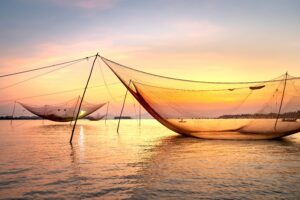
Fort Kochi is where Kerala’s layered history walks beside you on the pavement. The old port town has absorbed centuries of Portuguese, Dutch, British, Jewish, Chinese, and Arab influence and synthesized them into something that feels entirely, uniquely itself — narrow lanes lined with colonial-era buildings in various stages of elegant decay, Chinese fishing nets silhouetted against sunset skies, a Jewish synagogue active for 450 years, art galleries in converted warehouses, and coffee shops in Portuguese-era courtyards where bougainvillea spills over the walls.
I arrived in Fort Kochi on a January evening and walked for three hours without a destination, turning into lanes at random, following the smell of fish being smoked somewhere nearby, stopping at a chai stall where the owner spoke four languages with equal comfort. The Chinese fishing nets at sunset — massive cantilevered structures operated by teams using counterweights, dipping into the harbour in a slow, hypnotic rhythm — produced the most naturally beautiful photographs of my entire Kerala trip without any effort or planning on my part.
Getting there: Ernakulam Junction (mainland Kochi) connects to the rest of India by rail. A ferry from Ernakulam to Fort Kochi costs ₹5 and takes 10 minutes. Auto from Cochin airport costs ₹500–₹700.
Insider tip: Stay in Fort Kochi itself rather than mainland Ernakulam. The old town’s atmospheric quality disappears almost completely after dark on the mainland side — and the early morning light in the heritage lanes before the tour groups arrive is worth waking up for specifically.
2. 🍵 Munnar — Tea Estates, Mountain Mist & Restorative Silence

Munnar sits at approximately 1,600 metres above sea level in the Western Ghats, and the drive up to it — through tea estates that carpet every hillside in an unbroken deep green that looks almost artificial in its perfection, through mist that rolls across mountain roads in slow, unhurried waves — is itself one of Kerala’s most extraordinary experiences before you’ve even arrived at your destination.
The town of Munnar itself is unremarkable. The landscape surrounding it is anything but. Every direction you face from Munnar shows a different configuration of the same green-and-mist landscape — and the quality of silence at dawn, broken only by birds and the distant sound of tea pickers beginning their morning in the estate below — is the kind of silence that actively restores something in you that city life has quietly depleted.
The Eravikulam National Park, 15 kilometres from Munnar, hosts the Nilgiri Tahr — an endangered mountain goat found nowhere else on earth — and the Neelakurinji flower that blooms only once every twelve years, transforming entire hillsides into a blue-purple landscape that travelers plan trips years in advance to witness. Book park entry (₹115) online in advance during peak season.
Getting there: 130 kilometres from Kochi airport — 4 hours by road through increasingly beautiful mountain terrain. Shared jeeps from Kochi’s KSRTC stand cost ₹150–₹200.
Insider tip: Book a dawn tea estate walk with a local guide (₹300–₹500 per person) for a fundamentally different experience of Munnar’s landscape than any self-drive viewpoint visit can deliver.
3. 🛶 Alleppey (Alappuzha) — The Backwaters That Define Kerala

If Kerala has one image that defines it globally, it is the Alleppey houseboat — a traditional kettuvallam converted into a floating home, drifting through a network of canals, lagoons, and lakes that stretches across the low-lying coastal belt between Kochi and Kollam. The experience is real and genuinely extraordinary — but it requires navigation to do well.
The tourist houseboat industry in Alleppey is substantial, and the difference between a well-maintained houseboat with a skilled cook and an overpriced boat with mediocre food sharing a crowded canal with forty identical vessels is significant and worth understanding before you book.
The formula for a genuinely good houseboat experience: Book directly with an operator rather than through an aggregator. Choose a route that ventures into smaller canals rather than staying on the main Vembanad Lake. Request a dawn start to catch the mist before other boats emerge. The food on board — Kerala fish curry, rice, avial, and fresh coconut-based dishes cooked to order — is typically one of the best meals your entire Kerala trip produces.
A one-night houseboat for two costs ₹6,000–₹15,000 depending on boat standard and season. The Tripyverse Kerala Honeymoon Package includes a private houseboat night as part of its curated itinerary — with pre-vetted boat quality and route selection that removes the booking uncertainty entirely. For the Kerala Escape package covering Alleppey alongside Munnar and other key destinations, the Tripyverse Kerala Escape 4N/5D builds the backwater experience into a complete state itinerary.
Getting there: 85 kilometres south of Kochi — 1.5–2 hours by road or the scenic government ferry from Ernakulam (₹20, 2.5 hours).
Honest drawback: The main Alleppey canals near town can be crowded and occasionally smell of algae during summer months. The further into smaller canal networks your boat travels, the better the experience becomes.
4. 🐘 Thekkady & Periyar — Wildlife in the Spice Heartland

Thekkady sits at the edge of the Periyar Tiger Reserve — one of India’s most well-managed wildlife sanctuaries — in Kerala’s spice-growing heartland, where cardamom, pepper, clove, and cinnamon plantations cover the hillsides in aromatic layers that make the air itself smell like the inside of a centuries-old trading house.
The Periyar Lake boat safari (₹150–₹300 per person for a 2-hour cruise) offers the most peaceful wildlife viewing I’ve experienced anywhere in India — no jeep engines, no dust, just a quiet boat moving across still water while elephants graze along the shore, otters surface briefly near the bank, and sambar deer stand in the shallows watching you with magnificent indifference.
The bamboo rafting experience (₹1,000 per person, book through Kerala Forest Department) takes you deeper into the reserve with a naturalist guide for a half-day that consistently produces the most wildlife sightings of any Periyar activity. Book at least two days in advance.
Getting there: 4 hours from Munnar by spectacular mountain road, or 4.5 hours from Kochi.
Spice plantation walk: Every hotel in Thekkady arranges spice plantation walks (₹200–₹500 per person). The smell of freshly cracked cardamom pods at the source — the real thing, not the dried packet version — is something you’ll remember for years after returning home.
5. 🏖️ Varkala — The Cliff Beach That Changes Everything

Varkala is where Kerala’s beach experience reaches its most dramatically beautiful geographical expression. The beach sits at the base of red laterite cliffs that drop directly to the Arabian Sea — a configuration you simply don’t encounter at any other beach in India — and the clifftop path running above is lined with cafés, yoga studios, and guesthouses looking out over a perfectly uninterrupted ocean horizon.
The water at Varkala is clean and strong — this is not a calm swimming beach but a wave beach with genuine energy. The black sand southern section (Papanasam Beach, technically a Hindu pilgrim site) sits adjacent to the tourist section and offers a fascinating juxtaposition of local ritual and international travel culture that Varkala somehow makes feel entirely natural rather than awkward.
I arrived at Varkala at sunset on my fourth Kerala day and sat on the clifftop for two hours watching the light change over the sea through about fourteen different shades of orange, pink, and deep purple. A fisherman below was repairing his net in the last light. A group of local children were swimming in the waves with complete fearlessness. It was one of those travel moments that costs nothing and stays with you permanently. The Tripyverse Kerala Honeymoon Package specifically includes Varkala for couples — the clifftop sunset experience here is one of the most naturally romantic settings the country offers.
Getting there: 55 kilometres north of Thiruvananthapuram — 1.5 hours by train (₹30–₹60) or ₹800–₹1,000 by taxi.
Honest note: Varkala’s clifftop strip can feel touristy during peak season (December–January). Arrive in October, November, or February for the most relaxed atmosphere.
6. 🌿 Wayanad — The Highland District Most Tourists Underestimate

Wayanad sits in Kerala’s far north, tucked into the Western Ghats at elevations between 700 and 2,100 metres, and represents the state’s most quietly spectacular destination — a landscape of tribal communities, coffee and tea plantations, bamboo forests, seasonal waterfalls, and wildlife that has managed to stay significantly less crowded than Munnar despite being arguably more diverse in its offerings.
Chembra Peak (2,100 metres) — a half-day trek through grassland and shola forest — has a heart-shaped lake near the summit that has become well-photographed but remains genuinely beautiful in person. Edakkal Caves preserve prehistoric rock carvings in a natural rock cleft dating back 6,000 years — one of India’s most underappreciated historical sites, visited by a fraction of the people who should be making the trip. Banasura Sagar Dam — India’s largest earth dam — creates a landscape of submerged hilltops poking through still water that looks almost Scandinavian in its quiet, contemplative drama.
Getting there: 4 hours from Kozhikut (Calicut) or 5–6 hours from Kochi by road. Calicut airport is the most convenient entry point for Wayanad-first itineraries.
Insider tip: Stay in a family-run homestay rather than a resort for the most authentic Wayanad experience. Prices start at ₹1,500 per night including home-cooked meals that will genuinely redefine your understanding of what Kerala breakfast is capable of producing.
7. 🌊 Kovalam — Kerala’s Most Famous Beach, Honestly Reviewed

Kovalam is Kerala’s most internationally recognized beach — a crescent of golden sand 16 kilometres south of Thiruvananthapuram, backed by coconut palms and a lighthouse on the southern headland, facing a warm Arabian Sea that is noticeably calmer than Varkala’s energetic waves.
The honest assessment: Kovalam is beautiful, well-serviced, and slightly over-touristed relative to Kerala’s other coastal options. The Lighthouse Beach section is the most photogenic — the red-and-white striped lighthouse (₹15 to climb for panoramic views) framing a curved beach is genuinely lovely. But the hawker presence on the sand and the density of similar seafood restaurants along the beachfront road can dilute the atmosphere during the December–January peak.
Visit Kovalam for the lighthouse view and the genuinely excellent seafood restaurants — both Fusion Restaurant and Sea Face serve exceptional grilled fish at ₹400–₹700 per main course. Stay one or two nights rather than making it your primary Kerala base.
Getting there: 16 kilometres from Thiruvananthapuram airport — 30–40 minutes by taxi (₹400–₹600).
8. 🏛️ Thrissur — Kerala’s Cultural Capital That Most Tourists Skip Entirely

Thrissur is Kerala’s cultural heartbeat — the city where the state’s classical arts, temple festivals, and performing traditions are most concentrated and most alive — and it appears on almost no mainstream Kerala tourist itinerary. Which makes it, for the genuinely curious traveler, one of the state’s most rewarding and undervisited destinations.
The Thrissur Pooram (typically held in April or May) is Kerala’s most spectacular temple festival — a gathering of ten temple processions, each with caparisoned elephants, percussion orchestras, and parasol displays, converging at the Vadakkumnathan Temple in a twelve-hour celebration of extraordinary visual and sonic intensity. By any honest measure, it is one of the most spectacular cultural events anywhere in Asia. Attending requires advance planning — accommodation books out 6+ months ahead — but delivers an experience that no amount of description adequately prepares you for.
Outside festival season, Thrissur offers Kerala Kalamandalam (the state’s foremost classical arts institution where Kathakali, Mohiniyattam, and Koodiyattam are taught and performed), and a breakfast food culture — banana-leaf meals at traditional Kerala hotels — that rivals anything Kochi offers at a fraction of the price.
Getting there: 80 kilometres north of Kochi — 2 hours by road or train (₹50–₹150).

💡 Practical Travel Tips for Kerala
Cash vs Card: Kerala is considerably more cash-dependent than major metros. Keep ₹3,000–₹5,000 cash at all times for houseboat operators, local restaurants, auto-rickshaws, forest entry fees, and homestays. ATMs are available in all towns but sparse in remote hill and forest areas. Major hotels and restaurants accept cards.
SIM and Internet: BSNL has the best coverage in Kerala’s hill and forest areas where Jio and Airtel can be patchy. If spending time in Wayanad or remote Munnar, a BSNL SIM is worth picking up at Kochi airport before heading into the hills.
Google Maps: Works reliably across Kerala including hill routes. Download offline maps for each region before leaving mobile network coverage.
Mosquitoes: Kerala’s backwater and forest regions have mosquitoes, particularly during and after monsoon. Pack DEET-based repellent for forest areas. Houseboat operators typically provide mosquito nets.
Monsoon awareness: Kerala’s monsoon (June–September) is genuine and sustained. Check specific destination conditions before traveling during this period — some mountain roads become challenging and certain activities are unavailable.
Dress code at temples: Cover up. Dhoti or lungi rental is typically available at major temple entrances for ₹20–₹50.
Safety: Kerala consistently ranks among India’s safest states for solo travel including solo female travel. Standard urban awareness applies in tourist areas.
📅 Best Time To Visit Kerala

October to February — Peak Season: The ideal window. Post-monsoon Kerala is at its greenest and most lush, the weather is cool and dry, the backwaters are full, and all outdoor activities are running at full capacity. December and January are peak months — accommodation prices spike 40–60% and Alleppey houseboats need booking weeks in advance. The Tripyverse Kerala Escape Package is particularly popular in this window — book early for the best availability.
March to May — Shoulder Season: Temperatures rise in coastal areas (35–40°C) but remain pleasant in the hills. Munnar, Wayanad, and Thekkady are perfectly comfortable. Thrissur Pooram falls in this period — worth planning around specifically if cultural travel interests you.
June to September — Monsoon: Kerala receives India’s heaviest rainfall. The landscape becomes extraordinarily lush. Tourism drops dramatically, prices fall 40–50%, and the state feels genuinely local and unhurried. Ayurvedic treatment centres specifically recommend monsoon as the optimal season for Panchakarma treatments — the humidity is considered therapeutically ideal.
Recommended: October, November, or February for the best balance of good weather, green landscape, and pre or post-peak pricing.
⏳ Complete 8-Day Kerala Itinerary

Day 1–2 — Fort Kochi Arrive at Cochin airport. Fort Kochi exploration — Chinese fishing nets at sunset, Mattancherry Palace, Jewish Synagogue, evening Kathakali performance (₹300–₹500). Day 2: Cherai Beach day trip (30 km from Fort Kochi) — Kerala’s cleanest accessible beach with visible Chinese nets from the shoreline. Daily spend: ₹2,500–₹4,000
Day 3–4 — Munnar Drive to Munnar (4 hours through tea estates). Check in, afternoon tea estate walk. Day 4: Eravikulam National Park at dawn, Top Station viewpoint, Mattupetty Dam. Daily spend: ₹3,000–₹5,000
Day 5 — Thekkady Drive Munnar to Thekkady (4 hours spectacular mountain road). Periyar Lake boat safari at 7 AM. Spice plantation walk in the afternoon. Daily spend: ₹2,500–₹4,000
Day 6 — Alleppey Houseboat Drive to Alleppey (3 hours). Board houseboat at noon. One night on the backwaters — sunset from the deck, Kerala fish curry dinner on board, dawn mist over perfectly still water. Daily spend: ₹5,000–₹10,000 including houseboat
Day 7 — Varkala Train or taxi from Alleppey to Varkala (3 hours). Clifftop sunset. Fresh seafood dinner on the cliff. Daily spend: ₹2,000–₹3,500
Day 8 — Departure Train or taxi to Thiruvananthapuram airport (1.5 hours). Depart with a full memory card and the quiet certainty that you’ll be back. Daily spend: ₹1,000–₹1,500
Want this entire itinerary handled for you? The Tripyverse Kerala Escape 4N/5D Package covers the essential Kerala circuit — Fort Kochi, Munnar, Thekkady, and Alleppey backwaters — with accommodation, transfers, and guided activities arranged in one transparent booking. For couples, the Tripyverse Kerala Honeymoon Package builds the most romantic version of this itinerary with private houseboat nights, clifftop stays at Varkala, and experiences specifically curated for two.
💰 Kerala Budget Breakdown
| Traveler Type | Daily Budget | What It Gets You |
| Budget Traveler | ₹1,500–₹2,500 | Homestays, KSRTC buses, local restaurants, shared houseboats |
| Mid-Range | ₹4,000–₹8,000 | Good hotels, private taxis, private houseboat, restaurant dining |
| Luxury | ₹15,000–₹40,000+ | Resort stays, private vehicles, premium houseboat, Ayurvedic packages |
Where to save: KSRTC buses between destinations, government ferry on the backwaters, homestays over resorts in Wayanad, shared houseboat over private for solo or budget travelers
Where to splurge: At least one night on a private houseboat — this is the Kerala experience that justifies the entire trip, and the price difference between shared and private is meaningful for the quality of what you experience

🤔 Final Verdict — My Completely Honest Assessment of Kerala
Kerala is the most complete travel destination in India. I don’t say that casually or without comparison. It has the mountains (Munnar, Wayanad), the wildlife (Periyar, Silent Valley), the beaches (Varkala, Kovalam, Cherai), the cultural heritage (Fort Kochi, Thrissur), the unique ecosystem (the backwaters), and the food — Kerala cuisine is, in my honest opinion, the finest regional cuisine in India. All of this is packed into a state you can drive across in four hours and travel end-to-end in a comfortable eight days.
One honest drawback worth naming clearly: Kerala’s peak season (December–January) brings significant tourist density to the main destinations. Alleppey’s canals can feel crowded with houseboats, Fort Kochi’s lanes with tour groups, and Munnar’s viewpoints with selfie crowds. Traveling in October, November, or February resolves most of this. And the further you venture beyond the main tourist circuit — into Wayanad, into Thrissur, into smaller backwater villages — the more the real Kerala reveals itself without performance or crowd.
Kerala is perfect for: Honeymooners, nature lovers, food travelers, history enthusiasts, solo travelers, families with older children, Ayurveda seekers, anyone recovering from a difficult year, and every Indian who hasn’t visited yet.
You might find it challenging if: You’re on an extremely tight time schedule (Kerala rewards slowness and punishes rushing severely), or if you’re visiting during peak monsoon without researching specific destination conditions in advance.
Planning to contrast Kerala’s lush tropical landscape with India’s dramatic mountain north? Our Manali Travel Guide — 7 Best Places + Hidden Gems (2026) and our curated Secret Places in Manali — 7 Hidden Gems You Must Visit in 2026 make the perfect northern counterpart to everything Kerala offers in the south — high Himalayan passes where Kerala’s coconut palms feel like a different planet entirely.
And if you’re extending your trip internationally — Cochin to Dubai is just a 3-hour flight — our Dubai Travel Guide 2026: 10 Must-Visit Places & Hidden Gems and our complete Dubai Travel Tips 2026: Save Money, Time & Mistakes cover everything you need for a seamless extension. The contrast between Kerala’s backwater silence and Dubai’s lit-up skyline is one of the most striking geographical juxtapositions a single trip can produce — and both destinations are, from India, more accessible and more affordable than most people assume.