


The best thing I ate in Dubai cost AED 6.
It wasn’t at a rooftop restaurant with a Burj Khalifa view. It wasn’t at a celebrity chef establishment in the Dubai Mall. It was a lamb shawarma — carved fresh from a slowly rotating vertical spit, wrapped in warm flatbread with garlic sauce and pickled turnips that stained everything a vivid magenta — eaten standing on a pavement in Deira at 11 PM, with the smell of oud drifting from a nearby perfume shop and the sounds of three different languages overlapping in the lane behind me.
That shawarma was better than meals I’ve paid twenty times more for in other cities. And it represents something about Dubai’s food scene that the glossy travel content almost never captures: this city feeds people extraordinarily well at every price point, from AED 5 street food to AED 500 tasting menus, and the gap in quality between the two is much smaller than the gap in price.
Dubai’s food scene is one of the most genuinely diverse on earth — a product of a city where over 200 nationalities live and cook and eat together. Emirati heritage food, South Asian street food, Middle Eastern classics, Lebanese mezze, Yemeni lamb mandi, Iranian kebabs, Filipino comfort food, Japanese omakase — all of it exists within a few kilometres of each other, at prices that range from jaw-droppingly cheap to eye-wateringly expensive.
This guide covers the full spectrum. Let’s eat.
📍 Dubai’s Food Geography — Where The Best Eating Happens

Understanding Dubai’s food landscape requires understanding its neighbourhoods. The city’s best and most affordable food is concentrated in Deira and Bur Dubai — the older commercial districts on the eastern side of the Creek — where a working population of millions has created a dense, competitive, genuinely excellent street food and casual dining ecosystem.
Downtown Dubai and the Marina offer the city’s most theatrical dining experiences — rooftop restaurants, Burj Khalifa-view terraces, celebrity chef outposts — at prices that reflect the real estate they occupy rather than the food alone.
Al Quoz and Jumeirah sit in between — neighbourhood cafés, independent restaurants, and the growing specialty coffee scene that Dubai’s younger residents have built over the last decade.
Knowing which neighbourhood to eat in for which occasion is the single most useful piece of food knowledge you can carry into a Dubai trip.
✈️ Getting To Dubai — Starting Your Food Journey Right
Dubai International Airport (DXB) connects directly from virtually every major Indian city — Mumbai (3 hours), Delhi (3.5–4 hours), Bangalore, Hyderabad, Chennai, Kochi, and more. Budget carriers like IndiGo, flydubai, and Air Arabia offer return fares from ₹9,000–₹18,000 depending on booking timing and season.
For Indian travelers, the 30-day UAE tourist visa costs approximately AED 250–300 (₹5,500–₹6,500) and can be arranged through your airline or a travel agent. If you want the entire trip — flights, visa, accommodation, and transfers — arranged in one place, the Tripyverse Dubai 4N/5D Package handles everything comprehensively and leaves you free to focus entirely on the important business of eating your way through the city.
For broader trip planning beyond food — attractions, transport, hidden gems, and money-saving strategies — our Dubai Travel Tips 2026: Save Money, Time & Mistakes covers every practical detail you’ll need.
🚗 Getting To Dubai’s Best Food Neighbourhoods
Dubai Metro covers Deira, Bur Dubai, Downtown, and the Marina corridor perfectly. The Union and BurJuman stations drop you directly into the heart of Deira’s food district. Al Fahidi station is your entry point for Bur Dubai’s restaurant strips.
Careem and Uber are essential for reaching Jumeirah neighbourhood cafés and Al Quoz restaurants that the metro doesn’t serve directly. A typical cross-city food trip costs AED 20–40.
Walking is genuinely the best way to navigate Deira’s food streets — the density of options in a small area means wandering and following your nose consistently produces the best results. Do this before 10 AM or after 5 PM to avoid the heat making the experience miserable.
Cost of getting to food areas: AED 6–15 by metro, AED 20–40 by Careem, depending on starting point and destination.
🏨 Best Areas To Stay For Food Access
Where you stay determines how easily you access Dubai’s best eating. My honest recommendation for food-focused travelers is Deira or Bur Dubai — you’ll wake up with the city’s best affordable food within a five-minute walk in every direction.
Budget (AED 150–300/night): Rove City Centre Deira — Metro-connected, clean, modern, and positioned inside Deira’s food universe. Walk out the door and you’re already surrounded by options. Zabeel House by Jumeirah, Al Seef — On the Creek waterfront, walking distance to the Spice Souk area and the Bur Dubai restaurant corridor.
Mid-Range (AED 400–800/night): Hyatt Place Dubai Baniyas Square — Right in Deira’s commercial heart, surrounded by the city’s best casual dining at every turn. Vida Downtown Dubai — Ideal if you want convenient access to both Downtown dining and easy metro access to Deira for budget eating.
Luxury (AED 1,500+/night): Address Downtown Dubai — For rooftop dining with Burj Khalifa views and the full theatrical Dubai restaurant experience within walking distance. Atlantis The Palm — Multiple celebrity chef restaurants on property; the food experience here is genuinely extraordinary if budget is not a constraint.
🍽️ Dubai’s Best Street Food & Restaurants — Complete Food Guide
🥙 1. Shawarma — The King of Dubai Street Food

If Dubai has a defining street food, it’s the shawarma — and the city’s version of this Levantine classic is, I would argue without much hesitation, among the finest you’ll find anywhere in the world. The lamb or chicken is slow-roasted on a vertical spit for hours, developing a caramelized outer crust that gets shaved off in thin strips and wrapped in warm Arabic flatbread with garlic sauce, tahini, fresh vegetables, and pickled turnips.
The price: AED 5–8. The experience: completely unforgettable.
Where to find the best shawarma in Dubai:
Al Safadi, Deira — A Dubai institution with a following so loyal that locals drive across the city for their garlic chicken shawarma. The lamb version with extra garlic sauce is what I dream about at inappropriate moments. Open until 2 AM.

Automatic Restaurant, Bur Dubai — A Lebanese chain that has operated in Dubai for decades and maintains quality with the consistency of a restaurant that genuinely takes its reputation seriously. The shawarma here is particularly good at midnight.
Any street counter in Deira with a rotating spit visible from the pavement — This is my genuine recommendation. If you can see the meat rotating in the window and there are local workers eating at the counter, you’ve found the right place. Trust the queue.
Insider tip: Ask for “extra toum” — the Lebanese garlic sauce. It elevates everything. If they look at you like you know what you’re ordering, you’ve already won.
☕ 2. Karak Chai — Dubai’s Soul in a Glass

Karak chai is the beverage equivalent of a warm hug from a city that doesn’t always show its softer side to tourists. It’s a intensely spiced, condensed-milk-enriched tea — a fusion of South Asian masala chai and Gulf tea traditions — that costs AED 1–3 from street stalls and small cafés across Deira and Bur Dubai, and that Dubai residents consume in quantities that explain the city’s general energy levels.
The smell of karak brewing in a small shop — cardamom, condensed milk, black tea, the faint sweetness of saffron if you’re lucky — is one of those olfactory experiences that immediately relocates you somewhere specific every time you encounter it afterwards.
Where to drink the best karak in Dubai:
Karak House, multiple locations — A small chain that has elevated karak into something approaching an art form without making it pretentious or expensive. AED 5–8 per glass with excellent saffron versions.
Any street chai stall in Deira’s textile souk area — AED 1–2. Served in small glasses. Drunk standing up or sitting on a plastic chair outside. This is karak in its natural habitat.
Cha Cha Chai, Al Seef — A more boutique karak experience in the Creek waterfront setting, with interesting variations including cardamom-heavy and ginger versions. AED 12–18 but the location at sunset makes it worth the premium.
🍖 3. Mandi — Yemen’s Gift to Dubai’s Food Scene

Mandi is slow-cooked lamb or chicken — marinated in a complex spice blend, then cooked in a tandoor underground for hours until the meat falls from the bone with the gentlest encouragement — served over fragrant long-grain rice and accompanied by a thin, intensely flavoured broth on the side. It is one of the most satisfying, deeply flavoured things I have eaten in any country, and Dubai’s Yemeni restaurants serve it extraordinarily well for AED 20–35 per person.
The best mandi restaurants are concentrated in Deira and Al Qusais, in the kind of no-frills spaces where the food does absolutely all the talking — plastic chairs, communal tables, rice served on large metal trays shared between the table.
Where to eat the best mandi in Dubai:
Al Ustad Special Kabab, Deira — Has been serving exceptional mandi and kebabs in Dubai for over 40 years. The lamb mandi here is definitively the standard against which I now measure all other versions. AED 25–35 for a full portion.
Bait Al Mandi, Al Qusais — Consistently praised by Dubai’s Yemeni community as the most authentic mandi experience in the city. The broth served alongside the rice is something you will drink entirely and wish there was more of.
🫓 4. Manakish — The Lebanese Breakfast Worth Waking Up For

Manakish is the breakfast food Dubai does best and most tourists miss entirely. A flatbread baked fresh in a wood-fired oven, topped with za’atar (a dried herb and sesame blend mixed with olive oil), cheese, or minced spiced meat — it comes out of the oven crackling at the edges with a soft, airy center and an aroma that is genuinely difficult to walk past without stopping.
Price: AED 5–12. Available from early morning at bakeries across Deira and Bur Dubai.
Where to eat the best manakish in Dubai:
Saj Express, multiple locations — Fresh manakish made to order, rapidly, from a large saj (convex griddle). The za’atar and cheese combination is the one to start with. AED 8–12.
Al Reef Lebanese Bakery, multiple Deira locations — Operating 24 hours. The cheese manakish here at 7 AM with a glass of fresh laban (salted buttermilk) is the breakfast that Dubai’s Lebanese community has been eating for decades, and it remains the best way to start a morning in Deira.
🍛 5. Indian Food in Deira — Better Than You’d Expect, Cheaper Than Anywhere
With over 3 million Indians living in the UAE, Dubai’s Indian food scene is not an approximation of home cooking — it is home cooking, executed by people who learned these recipes from their mothers and grandmothers and have spent decades perfecting them for communities who would immediately notice if something was wrong.
The concentration of South Indian, North Indian, and Kerala restaurants in Deira and Bur Dubai is extraordinary. A complete Kerala fish curry thali — rice, fish curry, dal, vegetable stir-fry, papad, pickle, and buttermilk — costs AED 18–25. A full North Indian thali costs AED 20–30. This is genuinely among the most affordable sit-down dining in the city.

Where to eat the best Indian food in Dubai:
Calicut Paragon, Bur Dubai — Exceptional Kerala food with a fish curry that residents from Kochi debate the accuracy of enthusiastically. The parotta with Kerala chicken curry is a combination I specifically planned my second Dubai trip around.
Gazebo Restaurant, multiple locations — North Indian food with exceptional dal makhani and butter chicken that has been refined over decades of feeding a homesick diaspora. AED 25–45 per person.
Saravana Bhavan, multiple locations — The global South Indian chain that Dubai’s Tamil community trusts implicitly for their idli, dosa, and thali. Consistent, reliable, and comforting in the specific way that familiar food in a foreign city always is.
🥘 6. Emirati Food — The Cuisine Most Tourists Never Try

This is Dubai’s best-kept culinary secret and its most significant food gap in most tourist itineraries: Emirati food — the indigenous cuisine of the UAE — is extraordinary, deeply spiced, historically rich, and almost entirely absent from the tourist dining conversation.
The flavours draw from Bedouin desert traditions, Persian Gulf fishing culture, and centuries of spice trade influence — saffron, cardamom, dried limes, rose water, and slow cooking techniques that produce dishes of extraordinary depth and complexity.
Must-try Emirati dishes:
Harees — Slow-cooked wheat and meat, beaten to a smooth, porridge-like consistency, flavoured with ghee and cinnamon. Sounds simple. Tastes like a thousand years of cooking knowledge.
Machboos — Spiced rice cooked with meat or fish, similar to biryani but distinctly Emirati in its spice profile — heavier on dried limes and rose water, lighter on chilli.
Luqaimat — Small deep-fried dough balls drizzled with date syrup and sesame. Dubai’s most beloved street dessert. AED 5–10 for a generous portion.

Where to eat authentic Emirati food:
Arabian Tea House, Al Fahidi — Courtyard restaurant inside the historical neighbourhood with an outdoor terrace and a menu dedicated to genuine Emirati cooking. The machboos here is the standard recommendation for first-timers. AED 50–80 per person.
Logma, Boxpark — Modern Emirati café that makes the traditional cuisine accessible without diluting it. The luqaimat here are the best I’ve eaten anywhere and cost AED 20 for a full bowl.
Sheikh Mohammed Centre for Cultural Understanding, Al Fahidi — The Centre hosts regular Emirati cultural meals where you eat traditional food with local hosts who explain the dishes, the traditions, and the stories behind them. One of the most genuinely valuable food experiences in the city. AED 150–200 per person including the cultural program.
🍱 7. Dubai’s Global Food Court Scene — Underrated and Excellent
Dubai Mall’s food court is genuinely remarkable in a way that the phrase “mall food court” has absolutely no right to imply. With over 100 food outlets across multiple floors, it covers cuisines ranging from Japanese ramen to Brazilian churascaria to Pakistani karahi — with quality that consistently exceeds what the food court format usually delivers, at prices (AED 25–50 per meal) that are dramatically lower than the surrounding restaurants with Fountain views.

Best food court picks in Dubai Mall:
Operation: Falafel — Levantine street food done with care and consistency. The falafel wrap with tahini and pickles for AED 22 is one of the best-value meals in Downtown Dubai.
Comptoir 102, Jumeirah — Technically not a food court but a neighbourhood café worth mentioning: organic, plant-forward, genuinely thoughtful food in a beautiful space at AED 45–80 per meal. The brunch here on a Friday morning is a Dubai ritual for the Jumeirah crowd.
🍰 8. Dubai’s Café Scene — Specialty Coffee and Spectacular Interiors
Dubai’s specialty coffee scene has exploded over the last five years and now rivals cities that have been building coffee culture for decades. The concentration of beautifully designed, seriously coffee-focused cafés in Al Quoz, Jumeirah, and the Design District (d3) is genuinely impressive.
Best cafés in Dubai:
% Arabica, multiple locations — Japanese specialty coffee chain with extraordinary minimalist design and genuinely excellent single-origin espresso. AED 20–35 per coffee. The Dubai Mall location has a Fountain view that makes a flat white feel disproportionately cinematic.
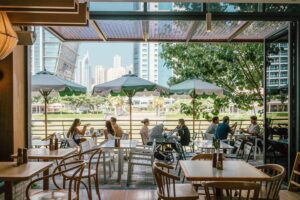
Tom & Serg, Al Quoz — An Al Quoz institution. Huge warehouse space, excellent brunch menu, specialty coffee taken seriously without being precious about it. AED 40–80 for brunch. Popular with the city’s creative community and worth the Careem ride.
Nightjar Coffee, Al Serkal Avenue — Specialty coffee inside the art district. The filter coffee program here is exceptional and the space itself — high industrial ceilings, natural light, art on every wall — is one of the most pleasant places to spend two hours in Dubai.
💡 Dubai Food — Practical Tips
Halal is universal: All food served in Dubai’s restaurants and street food stalls is halal by regulation. You will never need to ask or check. Pork is available in hotel restaurants and some licensed venues but nowhere on the street or in casual dining.
Ramadan dining: If you visit during Ramadan, street food and casual restaurants operate on adjusted hours — typically closed during daylight with iftar setups opening at sunset. This is actually one of the most atmospheric times to eat in Dubai — the communal iftar energy in Deira is extraordinary.
Cash for street food: Keep AED 50–100 cash for street food stalls, small chai shops, and market food counters. All restaurants accept cards. Streetside counters vary.
Food delivery: Talabat is Dubai’s dominant food delivery app — download it before you arrive. Coverage is excellent across the entire city and delivery times from Deira restaurants to Marina hotels are typically 30–45 minutes.
Tipping: Not mandatory but appreciated. AED 5–10 for street food is generous. 10% at sit-down restaurants is the standard. Many upscale restaurants include a service charge.
Hygiene: Dubai’s food safety standards are genuinely high and consistently enforced. Street food here is safe to eat without the hesitation you might carry from other destinations. The municipality inspects food stalls regularly and takes violations seriously.
📅 Best Time To Visit For Food Experiences
October to April: The ideal window for outdoor food experiences — pavement shawarma stalls, Creek-side restaurant terraces, Kite Beach food trucks at golden hour, Global Village international food pavilions. All of this requires pleasant outdoor temperatures to fully enjoy.
November and March: The sweet spot — perfect weather, Global Village in full swing, Deira’s outdoor food culture at its most accessible, and the city’s food festival calendar typically includes several events worth building a visit around.
Ramadan (dates vary yearly): Controversial recommendation but genuinely worth considering for food-focused travelers. The iftar spread — the meal that breaks the fast at sunset — is Dubai’s most communal, generous, and culturally significant food experience. Many hotels and restaurants offer elaborate iftar buffets at AED 80–150 per person that represent both extraordinary value and genuine cultural immersion.

December to January: Dubai Food Festival typically runs in this period with special menus, chef collaborations, and pop-up dining experiences across the city. Worth checking the calendar before booking.
⏳ 5-Day Dubai Food Itinerary
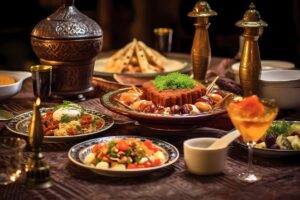
Day 1 — Deira Food Immersion Morning manakish from Al Reef Lebanese Bakery (AED 8). Karak chai from a street stall (AED 2). Spice Souk wander — smell everything, buy saffron and cardamom (AED 20–40). Lamb mandi lunch at Al Ustad (AED 30). Evening shawarma from Deira street counter (AED 6). Al Seef waterfront karak at sunset (AED 12). Daily food spend: AED 80–110
Day 2 — Emirati Food Day Breakfast at Arabian Tea House Al Fahidi (AED 40). Explore Al Fahidi Historical Neighbourhood. Emirati cultural lunch at Sheikh Mohammed Centre (AED 150). Evening luqaimat from Logma (AED 20). Daily food spend: AED 210–240
Day 3 — International Dubai % Arabica coffee morning (AED 25). Dubai Mall food court Operation: Falafel lunch (AED 22). Burj Khalifa view dinner at a lakeside restaurant — one splurge meal (AED 150–200). Dubai Fountain from the boardwalk after dinner — free. Daily food spend: AED 200–250
Day 4 — Desert + Local Evening Desert safari with Bedouin camp dinner included (AED 150–180). This counts as your main meal. Karak at the camp or back in Deira on return. Daily food spend: AED 150–180
Day 5 — Neighbourhood Cafés + Indian Food Tom & Serg brunch in Al Quoz (AED 60–80). Careem back to Bur Dubai. Kerala fish curry thali at Calicut Paragon (AED 25). Kite Beach food trucks for evening snacks (AED 30–40). Daily food spend: AED 120–150
💰 Dubai Food Budget Breakdown
| Eating Style | Daily Food Budget | What You Get |
| Street Food Only | AED 30–50 | Shawarma, karak, manakish, mandi — all excellent |
| Mix of Street + Casual | AED 60–100 | Add thali meals, food court, neighbourhood cafés |
| One Splurge Per Day | AED 150–250 | Add one sit-down restaurant or Burj Khalifa view meal |
| Full Foodie Experience | AED 300–500 | Celebrity chef, rooftop dining, Emirati cultural meals |
The extraordinary reality of Dubai’s food scene: the AED 30–50 per day street food strategy delivers genuinely world-class eating. The gap between the cheapest and most expensive food experiences in this city is primarily about location, view, and atmosphere — not fundamental food quality.
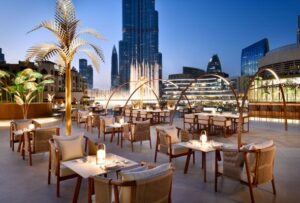
🤔 Final Verdict — Honest Assessment of Dubai’s Food Scene
Dubai’s food scene is one of the genuine, underappreciated wonders of the city — and it’s consistently overlooked in favour of the architectural spectacle that dominates travel content about the emirate.
The diversity is real and remarkable. The quality at every price point is higher than you’d expect. The street food in Deira is world-class by any honest standard. The Emirati food scene, while small and requiring deliberate seeking, is historically fascinating and culinarily extraordinary. The Indian food made by people who cook for an audience that would immediately notice inauthenticity is some of the most honest Indian cooking you’ll find outside India itself.
One honest drawback: Finding the best food in Dubai requires geographic knowledge that most first-time visitors don’t arrive with. The tourist infrastructure naturally pushes you toward Downtown and Marina restaurants that charge location premiums. The extraordinary eating in Deira — where the real food culture lives — requires a deliberate choice to take the metro northeast when every hotel concierge is pointing you toward the Fountain-view restaurants. This guide gives you that knowledge. Use it.
Dubai’s food scene is perfect for: Food-curious travelers, Indian diaspora visitors who want authentic familiar flavours abroad, budget travelers who want to eat extraordinarily well for very little, and anyone interested in how 200 nationalities eating alongside each other creates a food culture unlike anything else on earth.
You might find it challenging if: You have strict dietary restrictions beyond halal, you’re uncomfortable navigating non-English-menu environments in Deira, or you’re visiting purely for the luxury dining circuit — which, while genuinely excellent, tells you much less about Dubai than the AED 6 shawarma eaten standing on a pavement in the best possible way.
For the complete Dubai picture beyond food — the hidden neighbourhoods, money-saving strategies, and must-visit attractions — our Dubai Travel Guide 2026: 10 Must-Visit Places & Hidden Gems covers everything you need. And if you’re building a broader India trip around your Dubai visit — craving mountains after the desert heat — our Manali Travel Guide — 7 Best Places + Hidden Gems (2026) and our guide to the Secret Places in Manali — 7 Hidden Gems You Must Visit in 2026 make the perfect mountain counterpart to everything this desert city offers.