

📋 Table of Contents
- Why Thailand Keeps Pulling Travelers Back — Every Single Time
- Where Is Thailand Located
- How To Get To Thailand From India
- Getting Around Thailand
- Where To Stay in Thailand
- 10 Best Places to Visit in Thailand
- 1. Bangkok — The City That Never Lets You Down
- 2. Chiang Mai — The Cultural Capital of the North
- 3. Phuket — Thailand’s Most Famous Island
- 4. Krabi — Limestone Cliffs and Turquoise Perfection
- 5. Koh Samui — The Comfortable Island
- 6. Pai — The Mountain Town Nobody Wants to Leave
- 7. Ayutthaya — The Ancient Capital at Sunset
- 8. Koh Lanta — The Quiet Island for Slow Travelers
- 9. Chiang Rai — The White Temple and the Golden Triangle
- 10. Koh Phi Phi — The Island That Looks Unreal
- Practical Travel Tips for Thailand
- Best Time To Visit Thailand
- 7-Day Thailand Itinerary
- Budget Breakdown
- Final Verdict — Honest Assessment
Why Thailand Keeps Pulling Travelers Back — Every Single Time {#why-thailand}
I have visited Thailand four times. Each time I arrive at Suvarnabhumi Airport, collect my bags, and step into that specific wall of warm humid air that hits you the moment the automatic doors open, something happens that I can only describe as a physical reset — the travel fatigue evaporates and something close to excitement takes its place.
Thailand does this to people. It has been doing it reliably for decades, to millions of travelers from hundreds of countries, despite being one of the most visited destinations in Asia. Despite the crowds at Phi Phi Island. Despite the selfie queues at Wat Phra Kaew. Despite the aggressively marketed “authentic” experiences that are anything but. Despite all of it, the country consistently delivers — the beaches are genuinely as turquoise as they look in photographs, the temples are genuinely as elaborate and golden as any image suggests, the food is genuinely extraordinary at every price point from ₹50 street cart to ₹3,000 rooftop restaurant.
For Indian travelers specifically, Thailand is the gateway destination — the first international trip for many, the annual return for many more, and the benchmark against which most other Southeast Asian travel is measured. This guide covers the ten places that justify every return flight.
Where Is Thailand Located {#where-thailand}
Thailand occupies the center of mainland Southeast Asia — bordered by Myanmar to the northwest, Laos to the northeast, Cambodia to the east, and Malaysia to the south, with the Gulf of Thailand and the Andaman Sea providing its famous coastlines on either side of the narrow southern peninsula. The country spans approximately 1,600 kilometres from the mountainous northern border with Myanmar to the tropical southern tip near Malaysia.
This geographic range produces extraordinary diversity within a single country: the cool mountain highlands of Chiang Mai and Pai in the north, the ancient capital ruins of Ayutthaya in the central plains, the frenetic energy of Bangkok in the south-central zone, and the island archipelagos of Phuket, Krabi, Koh Samui, and Koh Phi Phi along the southern coasts. Understanding this north-south geography before planning your Thailand trip determines whether your itinerary makes geographic sense or wastes three days in transit between destinations that were never meant to be combined.
How To Get To Thailand From India {#how-to-get}
By Air — The Only Practical Option:
Thailand has two major international airports: Suvarnabhumi Airport (BKK) serving Bangkok — the primary hub for Southeast Asian connections — and Phuket International Airport (HKT) which receives direct flights from India specifically for beach-focused itineraries.
From India: Direct flights connect Mumbai, Delhi, Chennai, Kolkata, Bengaluru, Hyderabad, Ahmedabad, and Kochi to Bangkok. Mumbai to Bangkok takes 3.5–4 hours. Delhi to Bangkok takes 4–4.5 hours. IndiGo, Air India, Thai Airways, Thai Smile, AirAsia, and Vistara all operate this route with return fares ranging from ₹15,000–₹40,000 depending on season and booking timing.
Direct to Phuket from India: Mumbai, Delhi, Bengaluru, Chennai, and Kochi have direct or one-stop connections to Phuket International Airport — particularly useful if your Thailand trip is entirely beach-focused and Bangkok is not on the itinerary. Return fares from ₹18,000–₹45,000.
Budget booking strategy: Book 8–12 weeks ahead for the best combination of price and seat availability. November through January is peak season — fares spike significantly. May through September (monsoon season in the south, dry season in the north) offers the lowest fares and the fewest crowds at northern destinations like Chiang Mai and Pai.
Visa on Arrival / Visa-Free Entry: Thailand currently offers visa-free entry for Indian passport holders for stays up to 30 days — verify current policy before departure as this has changed multiple times and may have been updated since this guide was published.
For a complete Thailand Phuket and Krabi experience arranged in one seamless booking — accommodation, island transfers, and guided experiences — the Tripyverse Thailand Phuket Krabi Package covers the south Thailand beach circuit comprehensively. For group travel, the Tripyverse Thailand Highlights 4N/5D Group Tour handles the logistics of Thailand’s most popular destinations in one transparent booking. And for couples, the Tripyverse Thailand Honeymoon Package curates the most romantic Thailand experience — overwater villas, sunset dinners, and the specific islands and experiences that make Thailand one of Asia’s finest honeymoon destinations.
Getting Around Thailand {#getting-around}
Within Bangkok — BTS Skytrain: Bangkok’s BTS Skytrain and MRT Metro are the most efficient ways to navigate the city. Single journey fares range from THB 16–59 (₹40–₹150). A Rabbit Card (stored value card, ₹250 deposit) speeds up boarding. Grab operates extensively in Bangkok for destinations not on transit lines — typically THB 80–200 (₹200–₹500) for city journeys.
Between Cities — Domestic Flights: Thailand’s domestic flight network is efficient and affordable. Bangkok to Chiang Mai takes 1 hour on AirAsia or Thai Smile from ₹2,500–₹6,000 one way. Bangkok to Phuket takes 1.5 hours from ₹3,000–₹8,000. Book through Google Flights for price comparison across carriers.
Between Islands — Ferries: The island-hopping ferry system connects Phuket, Krabi, Koh Lanta, Koh Phi Phi, Koh Samui, and Koh Tao through a network of speed boats and slow ferries. Speed boats cost THB 300–800 (₹750–₹2,000) per journey. Book through 12Go.Asia for reliable schedules and advance booking.
Northern Thailand — Sleeper Trains: The Bangkok-Chiang Mai overnight sleeper train (THB 700–1,200, ₹1,750–₹3,000 for sleeper class) is one of Southeast Asia’s finest budget travel experiences — comfortable, scenic, and eliminates one night’s accommodation cost. Book at least 2 weeks ahead at seat61.com or the State Railway of Thailand website.
Island Transport — Songthaew and Motorbike: On most Thai islands, red songthaew shared pickup trucks serve as local buses for THB 30–50 (₹75–₹125) per journey. Motorbike rental is ₹300–₹500 per day on most islands — the most practical independent transport option on islands where songthaew routes don’t cover every beach.
Where To Stay in Thailand {#where-to-stay}
Thailand’s accommodation range is the widest in Southeast Asia — from ₹400 hostel dorms in Bangkok’s Khao San Road to ₹50,000 per night overwater villas in Koh Samui. The correct accommodation decision depends entirely on which zone of Thailand you’re in.
Budget Tier — THB 400–₹1,500 per night (₹1,000–₹3,750):
Lub d Bangkok Siam — Bangkok’s finest hostel. Rooftop pool, social atmosphere, central Siam location. Dorm beds from ₹900, private rooms from ₹2,500.
Deejai Backpackers Chiang Mai — Old city location, pool, social environment. Dorm from ₹600, private from ₹1,500. The best budget base in northern Thailand.
Airlie Beach Hostel Koh Samui equivalent — Budget guesthouses along Chaweng Beach from ₹1,200–₹2,000 per night for private rooms with air conditioning.
Mid-Range Tier — THB 1,500–₹5,000 per night (₹3,750–₹12,500):
The Salil Hotel Bangkok Riverside — Beautiful design hotel on the Chao Phraya riverfront, rooftop bar, excellent location. ₹6,000–₹9,000.
137 Pillars House Chiang Mai — Colonial teak mansion with pool and garden in the old city. ₹8,000–₹12,000. One of Asia’s finest boutique hotels.
Rayavadee, Krabi — Set between Railay Beach’s limestone cliffs and the sea. ₹15,000–₹25,000 but the location is incomparable.
Luxury Tier — THB 8,000+ per night (₹20,000+):
Mandarin Oriental Bangkok — Asia’s most historic luxury hotel, Chao Phraya riverside, since 1876.
Four Seasons Koh Samui — Overwater villas on the north coast with the Gulf of Thailand visible from the bathroom.
10 Best Places to Visit in Thailand {#best-places}
- Bangkok — The City That Never Lets You Down {#bangkok}
Bangkok is the entry point for most Thailand trips and one of the finest cities in Asia for travelers who want maximum experience per day — the density of extraordinary temples, world-class street food, rooftop bars, and cultural energy packed into a city that never slows down produces a travel experience that exhausts and delights in equal measure.
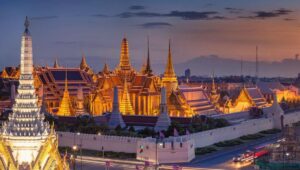
The Grand Palace complex — 218,000 square metres of gold-spired royal architecture including Wat Phra Kaew (the Temple of the Emerald Buddha) — is genuinely one of the finest architectural experiences in Asia. The Emerald Buddha inside is not green (it’s carved from jade) and not large (just 66 centimetres tall) — but the surrounding complex of gilded chedis, painted murals depicting the entire Ramakien epic, and the sheer density of ornamentation accumulated across two and a half centuries of royal patronage is extraordinary.
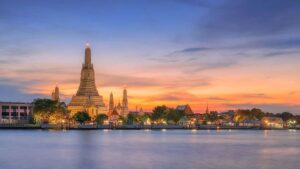
Wat Arun (Temple of Dawn) across the Chao Phraya River is Bangkok’s finest photography subject — the 82-metre prang tower covered in fragments of Chinese porcelain, seen at sunrise from the east bank, produces one of Bangkok’s most reproduced images and one of its most genuinely beautiful experiences.
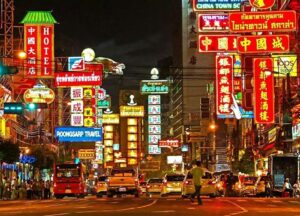
The street food circuit from Chinatown (Yaowarat Road) through the old city markets to the Victory Monument area is one of the finest street food experiences in Asia — pad thai, som tum, mango sticky rice, grilled satay, fresh spring rolls, and dozens of regional Thai dishes available from street carts for THB 50–150 (₹125–₹375) per dish.
Getting there: BTS Skytrain to Siam or Asok for central Bangkok. Chaophraya Express Boat for riverside temples.
Insider tip: The Grand Palace in the morning (opens 8:30 AM) has significantly fewer visitors than the 11 AM version. Dress modestly — shoulders and knees covered — or be turned away at the gate. Free sarong loans are available at the entrance but the queue is long. Bring your own.
Honest note: Bangkok’s tuk-tuk drivers operate an elaborate scam circuit directing tourists to gem shops and tailors in exchange for commission. Decline all unsolicited “temple is closed today” information from anyone who approaches you on the street — it is invariably a prelude to the gem shop circuit.
- Chiang Mai — The Cultural Capital of the North {#chiang-mai}
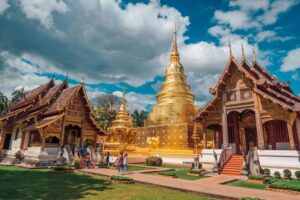
Chiang Mai is the most completely satisfying city in Thailand for cultural travel — a 700-year-old walled city of 300+ temples, surrounded by mountain jungle, producing a pace and atmosphere so different from Bangkok that arriving by overnight train feels like crossing into a different country.
The old city (moat-enclosed square, 1.5 km per side) contains Wat Chedi Luang — a 14th-century temple with a 60-metre chedi partially destroyed by an earthquake in 1545, its ruined profile more atmospheric than any intact structure — Wat Phra Singh with the city’s most revered Buddha image, and dozens of smaller temples where monks go about their daily routines in complete indifference to the small number of visitors who have found them.
The Sunday Night Walking Street (Wualai Road) and Saturday Night Walking Street (Tha Phae Gate area) are among Southeast Asia’s finest markets — locally made handicrafts, silver jewellery, textile products, food stalls, and the particular atmosphere of a Northern Thai market night that the tourist-facing night bazaar (Chiang Mai Night Bazaar) approximates but never quite achieves.
Doi Suthep temple — 15 kilometres from the old city at 1,676 metres elevation — provides the most spectacular city view in Thailand: Chiang Mai spreading across the valley below, the mountains of Myanmar on the distant horizon, the late afternoon light turning everything golden.
Getting there: Songthaew from old city to Doi Suthep (THB 50–80 shared, ₹125–₹200). Old city is walkable.
Insider tip: Rent a bicycle (THB 80–100 per day, ₹200–₹250) for old city temple exploration — the moat road circuit and the side streets are perfectly scaled for cycling at a pace that allows architectural details to register.
- Phuket — Thailand’s Most Famous Island {#phuket}
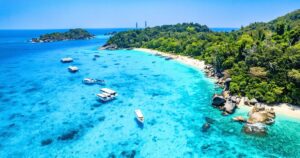
Phuket is simultaneously Thailand’s most visited island and one of its most consistently underestimated — the headline reputation (Bangla Road nightlife, Patong Beach crowds) obscures a much larger and more varied island that includes dramatic headlands, quiet east-coast fishing villages, Sino-Portuguese architecture in Phuket Town, and beaches that receive a fraction of the Patong visitor numbers.
Patong Beach is a choice — not a requirement. Most visitors who make it to Kata Beach, Karon Beach, or the northern beaches of Surin and Bang Tao find an island that looks more like the pre-tourism Phuket and less like the entertainment complex that Patong has become.
Phuket Town — 15 kilometres from the beach zone — is one of Thailand’s most undervisited destinations: a Sino-Portuguese old town of decorated shophouses, tiled facades, and Chinese shrines that would be a major attraction in any city it appeared in and receives almost no tourist attention because it lacks a beach.
The Phi Phi Island day trip from Phuket (THB 800–1,200, ₹2,000–₹3,000 including lunch) is the standard and worthwhile addition — but our own Bali Travel Guide 2026: 10 Amazing Places to Visit shows how similar island experiences compare across Southeast Asia.
Packages: The Tripyverse Thailand Phuket Krabi Package covers Phuket and Krabi together — the most logical south Thailand island combination for Indian travelers.
Honest note: Phuket’s high season (November–April) brings significant crowds and prices 40–60% above low season. The west-coast beaches receive monsoon rain from May–October — during which time the Andaman coast becomes less predictable.
- Krabi — Limestone Cliffs and Turquoise Perfection {#krabi}
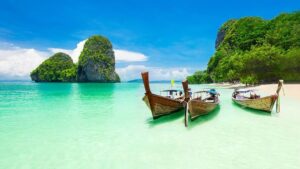
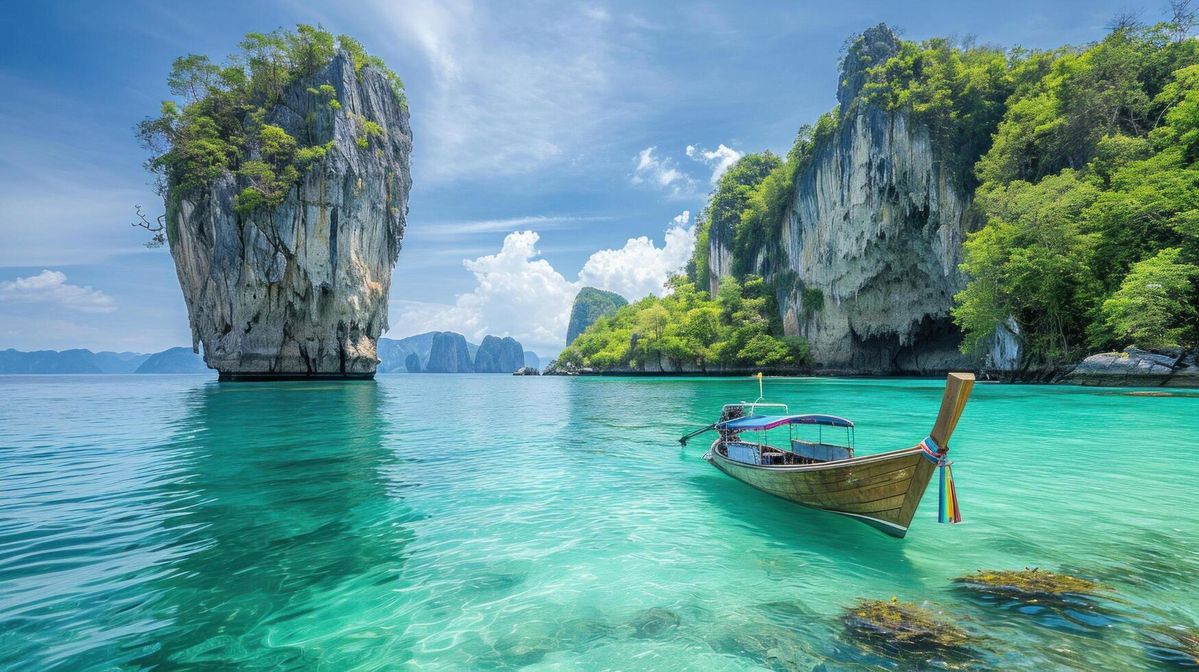
Krabi is where Thailand’s Andaman coastline reaches its most dramatic visual expression — a landscape of vertical limestone karst formations rising directly from turquoise water, the rockfaces draped in jungle vegetation, the sea between them so clear and so intensely coloured that photographs look retouched even when they’re not.
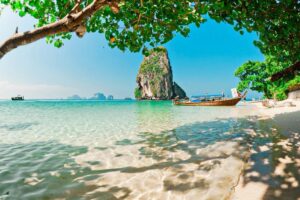
Railay Beach — accessible only by longtail boat from Krabi town (THB 100, ₹250, 15 minutes) because the limestone cliffs on either side make road access impossible — is Thailand’s most photographed beach and one of its most genuinely beautiful. The west-facing main beach at sunset, the cliffs above turning from grey to gold to rose, is a visual experience that consistently exceeds expectation.
The Four Islands tour from Krabi (THB 900–1,500, ₹2,250–₹3,750 including lunch) visits Koh Poda, Koh Gai (Chicken Island), Koh Mor, and Tup Island — connecting at low tide to form a sand peninsula that produces extraordinary wading photography. The snorkeling between the islands, with parrotfish and coral visible in clear warm water 3–5 metres deep, is genuinely excellent.
Rock climbing on the Railay and Tonsai limestone formations — among the world’s finest sport climbing destinations — costs THB 1,500–2,500 (₹3,750–₹6,250) per day with a guide and is available to complete beginners. The view from halfway up a Railay cliff face is one of the finest coastal perspectives in Thailand.
Getting there: Fly to Krabi International Airport (KBV) — direct from Bangkok 1.5 hours. Or boat from Phuket (2 hours, THB 400–600).
- Koh Samui — The Comfortable Island {#koh-samui}
Koh Samui is the largest island in the Gulf of Thailand — a fully developed resort island with excellent infrastructure, reliable accommodation quality, and a beach circuit that includes Chaweng Beach (lively, well-facilitated), Lamai Beach (quieter, equal quality), Bophut’s Fisherman’s Village (boutique restaurants and atmosphere), and the northern cape beaches (secluded, preferred by luxury resort guests).
The Ang Thong Marine National Park day trip from Koh Samui (THB 1,500–2,000, ₹3,750–₹5,000 including kayaking and lunch) covers an archipelago of 42 islands with an interior salt lake accessible by jungle trail — one of Thailand’s finest day-trip experiences and the location that inspired The Beach’s fictional island.
For couples combining Thailand’s finest beach experience with the romance infrastructure that makes Koh Samui one of Asia’s most consistent honeymoon destinations, the Tripyverse Thailand Honeymoon Package covers the most intimate island experiences with accommodation and transfers arranged.
Honest note: Koh Samui’s east-coast beaches (including Chaweng) face east and don’t receive sunset views. For sunset, you need the west-coast or northwest-coast beaches — or cross to the west side in the evenings.
- Pai — The Mountain Town Nobody Wants to Leave {#pai}

Pai is a small mountain town 150 kilometres north of Chiang Mai — a former hippy trail stopping point that has matured into a genuinely charming destination of bamboo cafés, hot spring pools, waterfall walks, rice paddy landscapes, and a pace of life so completely different from Bangkok or the southern islands that first-time visitors typically extend their stay by three days.
The road to Pai — 762 curves in 150 kilometres over the Shan Hills from Chiang Mai — is part of the experience. The minivan journey (3 hours, THB 150, ₹375) produces either motion sickness or mountain scenery appreciation depending on your physiology. The motorcycle ride from Chiang Mai (for experienced riders, 3.5 hours) is one of Southeast Asia’s finest road journeys.
The Pai Canyon — a narrow ridge of eroded clay with sheer drops on both sides and a 360-degree mountain view — takes 45 minutes to walk and costs nothing. The Mopaeng Waterfall, the Pam Bok Canyon, and the Santichon Chinese village are all within 15 kilometres of Pai town and accessible by rented motorbike (THB 150–200 per day, ₹375–₹500).
Honest note: Pai’s “3-day visa extension” phenomenon is real — most travelers who intend to spend one night spend three. Budget for the flexibility because leaving earlier than planned consistently feels like the wrong decision.
- Ayutthaya — The Ancient Capital at Sunset {#ayutthaya}
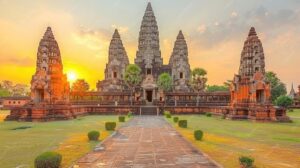
Ayutthaya is Thailand’s most important historical site and one of Southeast Asia’s finest archaeological destinations — the ruins of the Siamese kingdom’s capital from 1350 to 1767, when Burmese forces destroyed the city after a 14-month siege. The headless Buddha statues, the broken chedis, and the entire ruined temple landscape spread across a river island 80 kilometres north of Bangkok tell the story of a civilization destroyed at its apex.
Wat Phra Si Sanphet — three aligned chedis in a row that served as the royal temple — is Ayutthaya’s most iconic image and one of Thailand’s most photographed historical sites. The late afternoon light on the aged brick produces a warm amber glow that makes the ruins look simultaneously ancient and alive.
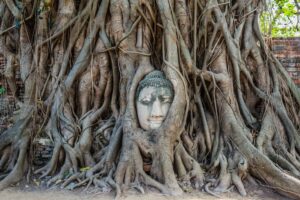
The most famous image from Ayutthaya — a Buddha head entwined in the roots of a banyan tree at Wat Mahathat — is one of those images that looks staged for tourism until you see it in person and understand that the tree grew around the head over centuries after the Burmese invasion left it on the ground.
Getting there: 80 km from Bangkok — 1.5 hours by train (THB 20, ₹50) from Hua Lamphong station. The cheapest and most atmospheric way to reach Ayutthaya.
Insider tip: Rent a bicycle at the railway station (THB 50–80, ₹125–₹200) and navigate the ruins independently rather than taking a guided tour. The temple map is available at the station. Two hours before sunset is the finest light for ruins photography.
- Koh Lanta — The Quiet Island for Slow Travelers {#koh-lanta}
Koh Lanta sits south of Krabi — larger and less crowded than Phi Phi, better developed than the most remote southern islands, with a long west-coast beach road connecting seven beaches from Klong Dao in the north (most developed, most facilities) to Klong Nin in the center (quieter, better restaurants) to the national park headland in the south (wild, largely undeveloped, spectacular).
Koh Lanta Old Town — a collection of Malay-influenced wooden shophouses on stilts over the water on the east coast — is one of Thailand’s finest undiscovered small-town experiences. The stilted houses, the fishing boats below them, and the specific quality of late afternoon light on weathered timber produce photographs of complete authenticity.
The Koh Lanta Marine National Park (accessible by longtail from the south of the island) includes snorkeling sites at Koh Rok and Koh Haa that are consistently ranked among the finest in the Andaman Sea — corals in substantially better condition than the more heavily visited Phi Phi sites.
Getting there: Ferries from Krabi (2.5 hours, THB 350–500) or from Phuket (3.5 hours, THB 600–800).
- Chiang Rai — The White Temple and the Golden Triangle {#chiang-rai}
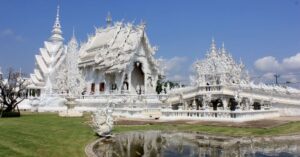
Chiang Rai is Thailand’s northernmost major city — 180 kilometres north of Chiang Mai, close to the Myanmar and Laos borders, and the site of Wat Rong Khun (the White Temple) — one of the most extraordinary contemporary temples in Southeast Asia and the most photographed single building in northern Thailand.
The White Temple, designed by Thai artist Chalermchai Kositpipat and still under construction (begun 1997, expected completion 2070), is covered entirely in white plaster embedded with mirror fragments — the effect in strong sunlight is genuinely blinding and completely unlike any other building you have seen. The interior murals, featuring Batman, Superman, and various pop culture figures alongside Buddhist imagery, represent the artist’s commentary on contemporary consumerism and require examination to fully understand.
The Golden Triangle — the confluence of the Mekong River at the point where Thailand, Myanmar, and Laos meet — is 90 kilometres north of Chiang Rai. The viewpoint is anticlimactic by famous-landmark standards (you see a river junction) but the surrounding landscape, the opium museum, and the boat trip on the Mekong border between nations make the day trip from Chiang Rai genuinely worthwhile.
Getting there: Mini-vans from Chiang Mai to Chiang Rai (3.5 hours, THB 180, ₹450) or domestic flight (35 minutes, THB 1,500–3,000).
- Koh Phi Phi — The Island That Looks Unreal {#koh-phi-phi}
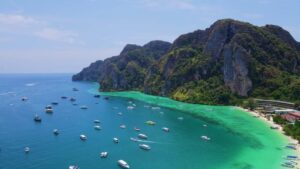
Koh Phi Phi is the island that most consistently elicits the response “this doesn’t look real” — and the response is appropriate. The twin limestone towers rising from turquoise water at the entrance to Lo Dalum Bay, visible from the Phi Phi Viewpoint above the island’s narrow isthmus, produce one of the most extraordinary coastal panoramas in Southeast Asia.
Maya Bay — the beach featured in The Beach (2000) — reopened after a multi-year conservation closure with significantly stricter visitor management. The beach itself is accessible, the coral restoration is measurably successful, and the experience of arriving by longtail in the early morning before the day-trip boats arrive is genuinely extraordinary.
The snorkeling at Phi Phi’s outer islands — Koh Phi Phi Leh specifically — is the finest in the Phuket-Krabi area, with visibility consistently exceeding 15 metres and blacktip reef sharks regularly visible at depths of 3–5 metres.
Honest note: Koh Phi Phi Tonsai village is dense, noisy, and chaotic in high season — accommodation on the quieter north coast of Don Island produces a dramatically different experience. The day-trip crowd from Phuket arrives between 10 AM and 2 PM — being on the island before or after this window transforms the experience.
Getting there: Ferries from Phuket (2 hours, THB 400–600) or Krabi (1.5 hours, THB 350–500).
Practical Travel Tips for Thailand {#practical-tips}
Cash is still essential: Thailand is significantly more cash-dependent than India’s UPI-enabled economy. Street food vendors, local markets, songthaews, tuk-tuks, longtail boats, and smaller guesthouses operate on cash. ATMs charge THB 220–250 (₹550–₹625) per foreign withdrawal — withdraw larger amounts less frequently. Keep THB 1,000–2,000 (₹2,500–₹5,000) in cash for daily transactions.
SIM card — True Move H or AIS: Buy at the airport arrivals hall immediately on landing. True Move H Tourist SIM: 30 days, unlimited data at 4G with speed cap, ₹800–₹1,200. AIS is the strongest network alternative. DTAC is a third option with slightly weaker coverage in rural areas. Data works reliably across all major tourist zones.
Grab operates in Bangkok, Chiang Mai, and Phuket: The Thai version of Uber is fully operational and consistently produces lower fares than negotiated tuk-tuks and taxis. Download before arrival. Essential for Bangkok airport transfers.
Temple etiquette: Shoulders and knees must be covered at all Thai temples — more strictly enforced than many Southeast Asian countries. Free sarong loans are available at major temples but the queue is long. Carry a lightweight scarf in your day bag. Remove shoes before entering any temple building.
Food safety: Thailand’s street food is among the safest in Southeast Asia by regional standards. Eat freshly prepared food, avoid anything that has been sitting at ambient temperature for extended periods. Drink only bottled or filtered water. Ice at established restaurants and food courts is generally safe — made from purified water.
Safety: Thailand is very safe for international travelers by any regional standard. Solo female travel is widely considered safe across all tourist zones. Motorcycle taxi helmets are mandatory — wear one, regardless of how locals behave. The traffic on Thai roads, particularly on islands, is genuinely hazardous for inexperienced riders.
For India travelers comparing Thailand with other Southeast Asian destinations, our Jaipur Travel Tips for Tourists 2026 shows the same practical approach applied to India’s heritage destinations — the same framework of arrival tips, transport hacks, and food intelligence works across both.
Best Time To Visit Thailand {#best-time}
Thailand has two distinct weather zones that require separate planning:
Southern Islands (Phuket, Krabi, Koh Lanta, Phi Phi) — Andaman Coast:
- Best: November to April (dry season, calm sea, clear visibility)
- Avoid: May to October (southwest monsoon — rough seas, ferry cancellations, some beaches closed)
- Sweet spot: November and December (post-monsoon freshness, pre-peak crowds)
Southern Islands (Koh Samui, Koh Tao) — Gulf of Thailand Coast:
- Best: February to August (opposite to the Andaman coast)
- Avoid: October to December (northeast monsoon — heavy rain, flooding)
- This means: Koh Samui and Koh Phi Phi have opposite best seasons — never combine them in November expecting both to be at their best simultaneously
Bangkok and Central Thailand:
- Best: November to February (cool season, 25–32°C, low humidity)
- Avoid: March to May (extreme heat, up to 40°C)
- Rain: June to October (afternoon showers, rarely all-day rain, still very visitable)
Northern Thailand (Chiang Mai, Pai, Chiang Rai):
- Best: November to February (cool and clear, 15–25°C, excellent trekking conditions)
- Avoid: March to May (smoke season from agricultural burning — air quality poor)
- Shoulder: June to October (green, lush, occasional showers, fewer tourists)
My recommendation for Indian travelers: November to early December for the optimal combination of good weather across all zones, pre-peak pricing, and the particular golden-dry-season light that makes Thailand photography extraordinary.
7-Day Thailand Itinerary {#itinerary}
Day 1 — Bangkok Arrival + Grand Palace
Morning: Land at Suvarnabhumi. Grab to hotel in Sukhumvit or Silom area (THB 250–350, ₹625–₹875).
Afternoon: Grand Palace + Wat Phra Kaew (arrive by 2 PM, THB 500 entry, ₹1,250). Wat Pho (Giant Reclining Buddha, THB 200, ₹500) 10 minutes walk from Grand Palace.
Evening: Chaophraya Express Boat to Wat Arun at sunset (THB 4 per crossing). Dinner at riverside restaurant.
Daily food + transport: THB 800–1,500 (₹2,000–₹3,750)
Day 2 — Bangkok Deep Dive + Overnight Train
Morning: Chatuchak Weekend Market (if Saturday/Sunday) or Or Tor Kor fresh market (daily). Best fresh fruit and regional Thai food in Bangkok.
Afternoon: Chinatown (Yaowarat) street food walk — dim sum, roast duck, mango desserts.
Evening: 6 PM overnight sleeper train from Hua Lamphong to Chiang Mai (arrive 7 AM, THB 700–1,200 sleeper, ₹1,750–₹3,000).
Daily spend: THB 1,500–2,500 (₹3,750–₹6,250) including train
Day 3 — Chiang Mai Old City
Morning: Arrive Chiang Mai by train. Check in to old city guesthouse. Bicycle rental (THB 80).
Afternoon: Old city temple circuit — Wat Chedi Luang, Wat Phra Singh, Wat Chiang Man. Walking pace, 3 hours.
Evening: Sunday Night Walking Street (if Sunday) or Nimman Road café area for dinner.
Daily spend: THB 800–1,500 (₹2,000–₹3,750)
Day 4 — Doi Suthep + Chiang Mai Market
Morning: Songthaew to Doi Suthep temple (THB 80, ₹200). Temple and city view. Return by 11 AM.
Afternoon: Thai cooking class (THB 800–1,200, ₹2,000–₹3,000 — highly recommended, includes market tour).
Evening: Saturday Night Walking Street or Chiang Mai Night Bazaar.
Daily spend: THB 1,500–2,500 (₹3,750–₹6,250)
Day 5 — Fly to Phuket + Beach Arrival
Morning: Domestic flight Chiang Mai to Phuket (1.5 hours, book 4 weeks ahead for best fares).
Afternoon: Check in to Kata Beach or Surin Beach guesthouse/hotel.
Evening: Phuket Town Sino-Portuguese old city walk + dinner at local restaurant (THB 200–400, ₹500–₹1,000).
Daily spend: THB 3,000–6,000 (₹7,500–₹15,000) including flight
Day 6 — Phi Phi Island Day Trip
7 AM: Speed boat departure for Phi Phi Islands (THB 900–1,500, ₹2,250–₹3,750 including lunch and snorkeling). Maya Bay, Viking Cave, monkey beach, snorkeling at Phi Phi Leh.
5 PM: Return to Phuket.
Evening: Sunset at Promthep Cape — the finest sunset viewpoint in Phuket (free, bring own drinks).
Daily spend: THB 1,500–2,500 (₹3,750–₹6,250)
Day 7 — Krabi + Departure
Morning: Ferry from Phuket to Krabi (2 hours, THB 400–600). Railay Beach longtail boat (THB 100).
Afternoon: Railay Beach west — swimming, limestone cliff photography, the impossibly turquoise water.
Evening: Return to Krabi town. Airport transfer for departure. Alternatively extend one night in Krabi and fly home next morning.
Daily spend: THB 1,000–2,000 (₹2,500–₹5,000)
Budget Breakdown {#budget}
| Expense | Budget | Mid-Range | Luxury |
| Return Flights | ₹15,000–₹22,000 | ₹25,000–₹40,000 | ₹60,000+ |
| Accommodation — 7 nights | ₹7,000–₹14,000 | ₹21,000–₹56,000 | ₹1,40,000+ |
| Domestic Flights | ₹5,000–₹8,000 | ₹8,000–₹15,000 | ₹20,000+ |
| Food — 7 days | ₹7,000–₹14,000 | ₹14,000–₹28,000 | ₹42,000+ |
| Transport — 7 days | ₹5,000–₹9,000 | ₹9,000–₹18,000 | ₹25,000+ |
| Activities & Entry | ₹7,000–₹12,000 | ₹12,000–₹20,000 | ₹30,000+ |
| SIM + Miscellaneous | ₹1,500–₹2,500 | ₹2,500–₹5,000 | ₹7,500+ |
| Total Per Person | ₹47,500–₹81,500 | ₹91,500–₹1,82,000 | ₹3,24,500+ |
Where to save: Overnight train over domestic flight for Bangkok-Chiang Mai (saves ₹4,000–₹6,000 and one accommodation night), street food over tourist restaurants (saves ₹500–₹1,000 per day), songthaew over private taxi on islands (saves ₹200–₹400 per journey), shoulder season booking (saves 30–40% on accommodation).
Where to splurge: The Phi Phi day trip (genuinely one of the finest island experiences in Southeast Asia), a Thai cooking class in Chiang Mai (the skills come home with you), and one sunset dinner at a Krabi or Phuket restaurant with a limestone view.

Final Verdict — Honest Assessment of Thailand {#verdict}
Thailand remains, after decades of mass tourism, genuinely extraordinary. The temples are as golden as advertised. The beaches are as turquoise as every photograph suggests. The food — from the ₹50 pad thai at a Bangkok street cart to the elevated Thai cuisine at a Chiang Mai restaurant — is consistently among the finest available in Asia at any price point.
The ten places in this guide represent different versions of the same fundamental Thailand excellence: architectural grandeur in Bangkok and Ayutthaya, cultural depth in Chiang Mai and Pai, coastal beauty in Krabi and Phi Phi and Koh Samui, historical significance in the Golden Triangle, and the specific visual experience of Koh Phi Phi that makes “this doesn’t look real” the most common response.
One honest drawback: Thailand’s most iconic destinations are genuinely crowded in high season. Phi Phi Island between 10 AM and 2 PM during December and January is not a peaceful beach experience — it is an organized social event of significant scale. The solution is not to avoid these places but to time your visits intelligently: early morning arrivals, shoulder season travel, and the willingness to walk 15 minutes beyond the crowd to find the version of the beach that most of the crowd never reaches.
Thailand is perfect for: First-time Southeast Asia visitors, beach-focused travelers, couples for whom Thailand’s honeymoon infrastructure is genuinely world-class, food explorers, temple enthusiasts, island hoppers, budget travelers who understand that excellent travel in Thailand costs significantly less than the same quality experience in Europe or Australia, and anyone who has been told Thailand is overrated — it isn’t, if you understand that the crowded version and the thoughtfully planned version are two entirely different experiences.
For the complete Southeast Asia comparison — Thailand’s beach culture measured against Bali’s temple-and-rice-terrace alternative — our Bali Travel Guide 2026: 10 Amazing Places to Visit covers Bali with the same depth this guide gives Thailand. If Kerala’s backwater and spice culture calls as the Indian alternative to both, our Kerala Travel Guide 2026: 8 Beautiful Destinations is the natural companion read.
For travelers combining Thailand with Dubai as a transit destination — Emirates and flydubai connect most Indian cities to Bangkok via Dubai — our Dubai Travel Guide 2026: 10 Must-Visit Places makes every Dubai layover worth extending.
And for the Himalayan counterpart to Thailand’s tropical warmth — a completely different register of Asian travel excellence — our Manali Travel Guide 2026: 7 Best Places + Hidden Gems completes the picture.