


📋 Table of Contents
- Why Bali Still Surprises Every Traveler Who Arrives Expecting to Know It
- Where Is Bali Located
- How To Get To Bali — Flights & Entry Tips
- Getting Around Bali
- Where To Stay in Bali
- 10 Amazing Places You Must Visit in Bali
- Ubud — The Cultural Heart of Bali
- Tegallalang Rice Terraces — Green Geometry at Its Finest
- Tanah Lot Temple — Sunset Over the Sea
- Seminyak & Kuta — Beach Life and Nightlife
- Uluwatu — Clifftop Drama and Kecak Fire Dance
- Mount Batur — Volcanic Sunrise Trek
- Nusa Penida — The Island That Looks Unreal
- Sidemen Valley — The Bali Most Tourists Miss
- Tirta Gangga — The Royal Water Palace
- Sekumpul Waterfall — Bali’s Most Beautiful Hidden Cascade
- Practical Travel Tips for Bali
- Best Time To Visit Bali
- 7-Day Bali Itinerary
Why Bali Still Surprises Every Traveler Who Arrives Expecting to Know It {#why-bali}
I thought I knew what Bali would be before I landed.
Instagram had given me a comprehensive preview: the infinity pools, the rice terraces with the perfect morning mist, the flower offerings on temple steps, the sunset at Tanah Lot with the silhouetted priest. I had seen all of it hundreds of times in other people’s photographs and I arrived at Ngurah Rai airport in a state of mild visual pre-saturation, half-convinced that the real thing could only disappoint the images I already carried.

Then I drove out of the airport at dawn, hit the first back road by mistake, and found myself in a village where women in ceremonial dress were walking single file carrying fruit offerings on their heads in the first pale light, the smell of incense and frangipani drifting across the road, a gamelan orchestra playing somewhere behind a courtyard wall. The taxi driver said nothing — this was simply what Tuesday morning looked like in Bali.
My pre-saturation dissolved in approximately forty-five seconds.
Bali is one of those destinations that has been photographed so comprehensively that people arrive expecting to recognize it — and then discover that the lived experience of the island is so layered, so spiritually textured, so physically extraordinary that no amount of prior image consumption prepares you for the actual encounter. This guide covers the ten places that produce that encounter most completely.
Where Is Bali Located {#where-bali}

Bali is a small island — approximately 5,780 square kilometres, roughly the size of Goa — in the Indonesian archipelago, situated between Java to the west and Lombok to the east. It sits just south of the equator in the Lesser Sunda Islands group, facing the Indian Ocean to the south and the Bali Sea to the north.
Despite its small geographic footprint, Bali contains an extraordinary concentration of distinct landscape types: volcanic mountains in the center (including the active Mount Agung at 3,142 metres), highland lake systems, rice terrace networks, tropical forest, river gorges, and two entirely different coastline characters — the sheltered, calm north and the dramatic, surf-defined south.
Bali is the only Hindu-majority island in the world’s largest Muslim country. This religious distinction produced a culture — visual arts, performing arts, architecture, ritual practice, food tradition, and daily spiritual life — that is unlike anything else in Southeast Asia and forms the experiential foundation of every visit.
How To Get To Bali — Flights & Entry Tips {#how-to-get}
For Indian travelers:
Ngurah Rai International Airport (DPS) in Denpasar is Bali’s only international airport and one of Southeast Asia’s most connected hubs. Direct flights from India are limited — most connect through Singapore, Kuala Lumpur, or Hong Kong — but the connection times are typically short and manageable.
Key routes from India:
- Mumbai to Bali: 7–9 hours including connection. Singapore Airlines via Singapore and AirAsia via Kuala Lumpur are the most reliable options. Return fares: ₹18,000–₹35,000 depending on season and booking window
- Delhi to Bali: 8–11 hours with connection. Similar airlines, slightly higher fares from ₹22,000–₹40,000 return
- Bangalore to Bali: 8–10 hours connecting. Similar fare range to Mumbai
Smart booking tips: Book 8–12 weeks ahead for the best combination of price and seat availability. August and December are peak Bali months — fares spike 40–60% in these windows. June, September, and October offer excellent weather at significantly lower airfares.
Visa on Arrival: Indian passport holders can obtain a Bali Visa on Arrival at Ngurah Rai Airport for USD 35 (approximately ₹2,900). Valid for 30 days with one 30-day extension available. The VOA queue can be long during peak season — consider applying online through Indonesia’s e-VOA portal (molina.imigrasi.go.id) before departure to use the faster dedicated lane.
Getting Around Bali {#getting-around}
Understanding Bali’s transport system before you arrive is genuinely important — the island has no public transport worth relying on and the pricing for private transport is negotiable in ways that consistently disadvantage first-time visitors who haven’t done their research.
Scooter/Motorbike rental: The most popular and genuinely practical way to explore Bali for confident riders. Daily rental costs IDR 60,000–₹100,000 (approximately ₹300–₹500). An International Driving Permit is technically required. Most roads outside central Ubud and southern resort areas are manageable with basic riding experience. The freedom this provides — particularly for reaching Sidemen, Tirta Gangga, and north Bali destinations — is genuinely transformative for the quality of your trip.
Private car with driver: The most comfortable and practical option for non-riders or multi-destination days. A full day (8–10 hours) costs IDR 500,000–₹700,000 (approximately ₹2,500–₹3,500). Your accommodation can arrange this — always negotiate the full-day rate rather than per-destination pricing for longer journeys.
Grab (Southeast Asia’s Uber): Available in south Bali — Kuta, Seminyak, Canggu, Denpasar — and increasingly in Ubud. Not available for tourist attractions due to local taxi regulation agreements. Use for accommodation-to-airport and accommodation-to-restaurant journeys in urban areas.
Blue Bird Taxis: The only metered taxi operator in Bali worth using. Identified by their distinctive blue colour. All other taxi operators in Bali use negotiated rates — always agree on the price before entering.
Difficulty for first-timers: Moderate. Google Maps works reliably across Bali including rural roads. The transport complexity is primarily about price negotiation and knowing which areas Grab covers. A scooter rental eliminates most of this complexity entirely.
Where To Stay in Bali {#where-to-stay}
Area selection matters more in Bali than almost anywhere else. The island’s different districts have entirely distinct characters and choosing the wrong base for your interests produces daily transport costs and time losses that compound significantly across a week.
Ubud — Best for culture, rice terraces, yoga, and spiritual experiences. Surrounded by forest and rice fields. The most architecturally and culturally atmospheric base in Bali.
Seminyak / Canggu — Best for beach life, cafés, nightlife, and surf. More international, less culturally immersive, genuinely enjoyable.
Uluwatu / Bukit Peninsula — Best for dramatic clifftop scenery, premium surf, and the best sunset views on the island.
East Bali (Sidemen / Candidasa) — Best for solitude, rice terrace landscape, and access to the island’s least-visited and most extraordinary corners.
Budget Tier — IDR 150,000–₹400,000 per night (₹750–₹2,000):
Ubud Backpackers Hostel — Clean, social, well-located in central Ubud. Dorm beds from IDR 120,000 (₹600). Private rooms from IDR 250,000 (₹1,250).
Canggu Surf Hostels (multiple) — The Canggu hostel scene is genuinely excellent — modern facilities, social atmosphere, surf-adjacent location. From IDR 150,000 (₹750) per night.
Guesthouses in Sidemen — Simple family-run guesthouses in the Sidemen Valley from IDR 200,000–₹350,000 (₹1,000–₹1,750) with rice terrace views that ₹20,000 hotels in other destinations charge a premium to approximate.
Mid-Range Tier — IDR 500,000–₹1,500,000 per night (₹2,500–₹7,500):
Bisma Eight, Ubud — Hillside property with jungle and rice terrace views from every room. Infinity pool overlooking the Campuhan ridge. One of Ubud’s most atmospherically complete mid-range stays.
The Layar, Seminyak — Private villa property with pool. The Seminyak villa experience at mid-range pricing — genuinely excellent value for couples.
Luxury Tier — IDR 2,000,000+ per night (₹10,000+):
Four Seasons Resort, Sayan, Ubud — Above the Ayung River gorge, accessible by a suspension bridge, with villas suspended over the jungle canopy. One of the most architecturally extraordinary resort experiences in Asia.
Alila Villas Uluwatu — Clifftop private pool villas with uninterrupted Indian Ocean views. The most dramatically positioned luxury property in Bali.
10 Amazing Places You Must Visit in Bali {#amazing-places}
- Ubud — The Cultural Heart of Bali {#ubud}

Ubud is where Bali’s soul lives most visibly — a town surrounded by rice terraces and rainforest in the highland center of the island, where traditional art, dance, music, and spiritual practice are not tourist performances but living daily culture that happens to welcome visitors.
The Ubud Palace hosts Legong and Kecak dance performances every evening (IDR 100,000–₹150,000, approximately ₹500–₹750). The Sacred Monkey Forest Sanctuary — 700 long-tailed macaques living in a genuine Hindu temple complex surrounded by ancient fig trees — costs IDR 80,000 (₹400) and delivers an experience that is simultaneously hilarious and genuinely sacred. The morning market on Jalan Raya Ubud operates from 5–7 AM with local produce, cooked food, flower offerings, and Balinese women shopping in ceremonial dress that makes every market morning feel like a festival.

The Campuhan Ridge Walk — a free 2-kilometre trail along a jungle ridge above the town — produces the most beautiful dawn photography available in Ubud without paying for a rice terrace swing. I walked it at 6 AM on a clear morning in October and had the ridge to myself for 45 minutes of gradually intensifying golden light across the valley.
Getting there: Ubud is 90 minutes from Ngurah Rai Airport by private car (IDR 350,000–₹500,000, approximately ₹1,750–₹2,500). No public transport from the airport.
Honest note: Ubud’s central streets can be genuinely crowded and traffic-heavy. Stay in the quieter residential areas north or east of the center for the most atmospheric experience.
- Tegallalang Rice Terraces — Green Geometry at Its Finest {#tegallalang}
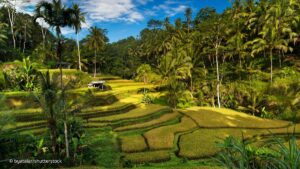
The Tegallalang rice terraces, 10 kilometres north of Ubud, are the most photographed landscape in Bali — and they are significantly more beautiful in person than any photograph suggests. The terraces cascade down a steep valley in concentric curves of vivid green, the subak irrigation system (a UNESCO-recognized water management tradition) keeping each level perfectly flooded or precisely drained depending on the cultivation stage. In the right season, the entire valley glows an electric green that seems too saturated to be real.
The famous rice terrace swing operations have expanded enormously — there are now dozens of swing operators along the terrace rim offering Instagram experiences for IDR 50,000–₹150,000. My honest assessment: skip the swings, walk the valley floor trail instead (free, 45 minutes), and spend the swing money on a proper Balinese lunch at one of the valley-rim restaurants with terrace views.
Getting there: Scooter from Ubud (25 minutes, IDR 5,000 fuel) or private driver (IDR 150,000 return trip approximately).
Best photography timing: Arrive before 7:30 AM to beat the tour buses and catch the best light. The terraces face east — morning light is dramatically better than afternoon.
Honest note: The terrace rim is commercial and crowded from 9 AM onwards. The valley itself remains genuinely beautiful regardless of the crowds above.
- Tanah Lot Temple — Sunset Over the Sea {#tanah-lot}

Tanah Lot is Bali’s most recognizable temple — a 16th-century Hindu shrine built on a dramatic offshore rock formation that is separated from the mainland at high tide, surrounded by crashing waves, and illuminated by some of the most spectacular sunsets in Southeast Asia. The image of this temple silhouetted against an orange horizon is the defining visual of Bali travel photography.
The temple itself is not accessible to non-Hindu visitors (the inner compound requires ceremonial dress and Hindu faith for entry), but the surrounding clifftop park (IDR 60,000 entry, approximately ₹300) gives full views of the temple and the coastal drama from multiple vantage points.
I arrived at 5 PM on a clear day in October and spent two hours watching the light change — the temple first golden, then copper, then deep amber, then gradually becoming a silhouette as the sun dropped into the Indian Ocean behind it. Several hundred other people were there. Nobody was speaking loudly.
Getting there: 45 minutes from Seminyak or 75 minutes from Ubud by private driver. IDR 250,000–₹350,000 for a return trip including waiting time.
Honest note: Tanah Lot is genuinely crowded at sunset in peak season. Arrive an hour before sunset and claim a position on the western clifftop. Don’t expect solitude — expect a shared moment of collective appreciation that is itself worth experiencing.
- Seminyak & Kuta — Beach Life and Nightlife {#seminyak}

Seminyak and Kuta represent the south Bali beach and entertainment district — and they are worth understanding clearly before you visit. Kuta is Bali’s original resort town, now dense, commercial, and oriented toward budget package tourism. Seminyak is its more refined northern neighbour — better restaurants, better beach clubs, better boutique shopping, and the same surf-facing beach extending uninterrupted for kilometres.
The Seminyak beach at golden hour — warm sand, surfers in the break, beach clubs playing ambient music as the sun descends into the Indian Ocean — is one of Bali’s genuinely wonderful experiences. Potato Head Beach Club (IDR 300,000 minimum spend, approximately ₹1,500) is worth one evening for the architecture and sunset view alone. La Plancha’s colourful bean bags and cheap Bintang beer at sunset is worth another.
Getting there: 30–40 minutes from the airport by Grab or Blue Bird taxi. IDR 100,000–₹150,000 (₹500–₹750).
Honest note: Kuta’s beach is frequently littered and the hawker presence can be overwhelming. Walk 10 minutes north into Seminyak and the experience improves dramatically.
- Uluwatu — Clifftop Drama and Kecak Fire Dance {#uluwatu}

Uluwatu Temple sits on the edge of a 70-metre limestone cliff at the southwestern tip of the Bukit Peninsula — a 10th-century sea temple whose dramatic position above crashing Indian Ocean waves produces one of Bali’s most genuinely awe-inspiring visual experiences. Long-tailed macaques inhabit the temple grounds and have a highly developed appreciation for sunglasses, phones, and hats — hold everything secure.
The Kecak Fire Dance performed at the Uluwatu amphitheatre at sunset (IDR 100,000 per person, approximately ₹500) is the finest traditional performance in Bali. A hundred men sitting in concentric circles chanting the “cak” rhythm — no instruments, purely voice — while performers enact scenes from the Ramayana epic, with the cliff edge and the burning sunset directly behind the performance space. The combination of the human vocal orchestra, the fire, and the ocean horizon in the background produces something that feels genuinely ancient and completely alive simultaneously.
I watched the Kecak at Uluwatu on my second Bali visit — I had skipped it on the first because it felt too touristy — and it remains one of the most powerful performance experiences of my traveling life. Don’t skip it.
Getting there: 45 minutes from Seminyak or 90 minutes from Ubud by private driver. IDR 300,000–₹400,000 return trip.
- Mount Batur — Volcanic Sunrise Trek {#mount-batur}

Mount Batur is an active volcano at 1,717 metres in north-central Bali — the most popular trekking destination on the island and one that genuinely delivers on every promise. The standard dawn trek (2 hours ascent, beginning at 4 AM with a guide) reaches the crater rim as the sun rises over Mount Agung and Lake Batur simultaneously, producing a landscape that is simultaneously volcanic, pastoral, and extraordinary.
The crater rim walk reveals the volcanic geology up close — active steam vents, hardened lava flows, and the particular smell of sulphur that confirms you are standing on a genuinely active geological feature. The descent passes through forest and the highland village of Kintamani — one of Bali’s most atmospherically complete mountain communities.
Guide fee: IDR 350,000–₹500,000 per person (approximately ₹1,750–₹2,500). Mandatory through the local guide association. The guides are knowledgeable, the trek is safe with guidance, and the sunrise is worth every rupee of the early alarm.
Getting there: 90 minutes from Ubud by private driver. Most trekkers arrange pickup from their accommodation in Ubud at 2 AM for the 4 AM start. IDR 400,000 for the return transfer.
Honest note: Mount Batur is genuinely crowded with trekkers at the summit during peak season. The sunrise experience is still extraordinary — crowds don’t diminish a volcanic sunrise. But don’t expect solitude.
- Nusa Penida — The Island That Looks Unreal {#nusa-penida}

Nusa Penida is a 20-kilometre fast boat ride from Sanur Beach on Bali’s east coast — a rugged, dramatically beautiful island of limestone cliffs, turquoise water, and landscapes so visually extreme they consistently appear computer-generated in photographs. Kelingking Beach — the famous T-Rex shaped cliff with turquoise water below — is the single most dramatic landscape image in all of Indonesia and looks, standing at the clifftop, exactly as extraordinary as it appears in photographs.
The island’s road network is rough and the distances between key attractions are significant. Hire a scooter from the Nusa Penida port (IDR 80,000 per day) or a local driver (IDR 400,000 for a full day tour of the west coast highlights). The west coast circuit — Kelingking, Angel’s Billabong, Broken Beach, Crystal Bay — covers Nusa Penida’s most dramatic geography in one long and physically demanding day.
The snorkeling at Crystal Bay (Mola Mola sunfish November–March) and at Manta Point (manta rays year-round) is among the best in Southeast Asia. Budget IDR 100,000–₹150,000 for snorkeling gear rental and IDR 350,000 for a guided manta ray boat trip.
Getting there: Fast boat from Sanur Beach, Bali. Multiple operators. IDR 200,000–₹250,000 return (approximately ₹1,000–₹1,250). Journey takes 35–45 minutes.
Honest note: Nusa Penida’s roads are genuinely rough and the distances tire you out faster than expected. The Kelingking Beach descent to the actual beach is extremely steep and requires good fitness. Most visitors photograph it from the clifftop, which is the correct decision for most people.
- Sidemen Valley — The Bali Most Tourists Miss {#sidemen}

Sidemen is where Bali hides its most quietly extraordinary landscape — a highland valley of rice terraces, river gorges, and small villages in east Bali with Mount Agung visible on the northern horizon, still smoking gently from its most recent eruption in 2017. It receives a fraction of the visitors that Ubud and Tegallalang handle, yet produces rice terrace scenery that is arguably more beautiful than its overcrowded counterparts.
The Sidemen valley walk — a 3–5 hour self-guided route through working rice terraces, river crossings on bamboo bridges, and farming villages where the community barely registers your presence because you are simply not that remarkable to them — is the finest and most authentic landscape walk available in Bali. No entrance fee. No ticket booth. No swing operators. Just terraces, birds, and the sound of the irrigation water moving between the levels.
I spent two nights in a guesthouse with a rice terrace view that cost IDR 250,000 (₹1,250) per night and watched Agung turn from grey to gold to orange at sunset from my room’s veranda for two consecutive evenings. Both times I was the only person watching.
Getting there: 90 minutes from Ubud by scooter or private driver. IDR 350,000–₹500,000 for a full-day private driver trip from Ubud.
Honest note: Sidemen has very limited restaurant options. Eat where your guesthouse cooks — the home-cooked Balinese food in valley guesthouses is consistently better than the tourist restaurants in Ubud anyway.
- Tirta Gangga — The Royal Water Palace {#tirta-gangga}

Tirta Gangga is a 1948 royal water palace in east Bali — a series of pools, fountains, and ornamental gardens fed by a sacred spring, surrounded by the rice terraces of the Karangasem regency with Mount Agung visible beyond. The palace pools are still used for ritual bathing by local Hindu communities and are open for swimming to visitors (IDR 50,000 entry, approximately ₹250, separate IDR 15,000 swimming fee).
Swimming in Tirta Gangga’s clear spring-fed pools in the morning — before tour groups arrive from Ubud — with rice terraces on one side and Agung on the horizon on the other, is one of Bali’s most specific and quietly extraordinary experiences. The water is cool, slightly mineral-tasting, and genuinely sacred in the way that places continuously used for ritual over decades develop a particular quality of atmosphere.
The surrounding village of Tirta Gangga is worth spending a morning in — the rice terrace walks accessible directly from the palace grounds cost nothing and produce landscape photography comparable to Tegallalang at 10% of the crowd density.
Getting there: 2.5 hours from Ubud by scooter or private driver. Typically combined with Nusa Penida day trips or east Bali circuits.
- Sekumpul Waterfall — Bali’s Most Beautiful Hidden Cascade {#sekumpul}

Sekumpul is consistently rated the most beautiful waterfall in Bali — a cluster of seven cascades (the main fall drops approximately 80 metres) in a narrow jungle gorge in north Bali, reached by a 45-minute descent through rice terraces and jungle that is itself beautiful enough to justify the trip.
The combined roar of seven waterfalls converging in a narrow gorge — the mist reaching 50 metres up the gorge walls, the spray soaking everything within 30 metres, the light filtering through the jungle canopy above creating a quality of green-lit illumination that feels staged — is one of the most viscerally impressive natural experiences Bali offers.
Entry fee: IDR 20,000 (₹100). Mandatory local guide: IDR 200,000–₹300,000 for the group (approximately ₹1,000–₹1,500 for a group of 4, significantly less per person for larger groups). The guide is genuinely useful — the trail is steep, occasionally slippery, and the waterfall approach involves river crossings that vary with rainfall.
Getting there: 2.5 hours from Ubud by private driver. Usually combined with the Munduk highlands or north Bali circuit. IDR 500,000–₹700,000 for a full-day north Bali driver trip from Ubud.
Honest note: The descent to Sekumpul is steep and returns the same way — uphill. Allow 3–4 hours total including the ascent back. Wear proper footwear rather than sandals. Arrive before 9 AM for the best light and thinnest crowds.
Practical Travel Tips for Bali {#practical-tips}
Currency: Indonesian Rupiah (IDR). 1 IDR ≈ ₹0.005. So IDR 100,000 ≈ ₹500. Always calculate in your head before agreeing to any price — the large denominations make it easy to spend significantly more than you intend without noticing.
Cash is essential: Bali runs primarily on cash outside major hotels and restaurants in south Bali. ATMs are available throughout the island but carry fees (IDR 25,000–₹50,000 per withdrawal from most machines). Withdraw larger amounts less frequently to minimize fees. Never exchange currency at airport desks — the rates are significantly worse than in-town money changers.
Money changers: Use authorised money changers (Dirgahayu and Central Kuta are reliable chains) rather than street operators who frequently use sleight-of-hand counting techniques to shortchange. Count your money before leaving the counter.
SIM Card: Buy a Telkomsel tourist SIM at the airport arrivals hall — IDR 80,000–₹150,000 for 10–15 days of solid data coverage including in most rural areas. Telkomsel has the best rural coverage of all Indonesian carriers.
Temple dress code: Temples require a sarong and sash covering the lower body. Most temples provide rental sarongs for IDR 10,000–₹15,000 at the entrance. Carry a light sarong in your day bag as a respectful gesture that eliminates every temple entry situation instantly.
Safety: Bali is very safe for international travelers by Southeast Asian standards. Standard urban awareness applies in tourist areas — Kuta and parts of Seminyak have active scooter bag-snatching incidents that are entirely preventable by carrying bags on the inland rather than road-facing side. Solo female travel is widely considered safe across Bali.
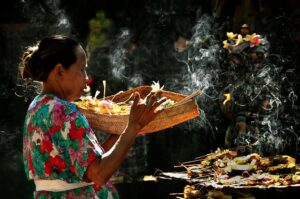
Offerings and temples: Balinese daily life involves elaborate spiritual ritual — flower and food offerings on the ground, temple ceremonies, religious processions. Step over, not on, ground offerings. Remove shoes before entering temple compounds. Ask before photographing ceremonies.
Useful apps: Grab (urban transport), Google Maps offline (essential for rural areas), XE Currency (rate checking), Gojek (food delivery and urban transport alternative).
Best Time To Visit Bali {#best-time}

April to October — Dry Season (Best Overall): Bali’s dry season produces the clear skies, low humidity, and consistently beautiful light that defines most Bali travel photography. April, May, June, and September are the optimal months — excellent conditions without the peak August crowds or December-January pricing.
July to August — Peak Season: School holiday crowds from Australia and Europe make this Bali’s busiest window. Accommodation prices rise 30–50%. Popular beaches and attractions are at maximum capacity. Still beautiful — just busier and more expensive than adjacent months.
November to March — Wet Season: Bali’s wet season brings daily rain — typically intense afternoon showers lasting 1–3 hours rather than all-day rainfall. Mornings are frequently clear and beautiful. Accommodation prices drop 30–40%. Many travelers specifically enjoy the wet season for the lush green landscape, reduced tourist numbers, and dramatically lower prices. Waterfalls are at maximum flow. Rice terraces are at their most vivid green.
My recommendation: May, June, or September for the optimal combination of dry weather, good photography light, manageable crowds, and pre-peak pricing. April and October are close seconds.
7-Day Bali Itinerary {#itinerary}

Day 1 — Arrival + Seminyak Land at Ngurah Rai Airport. VOA collection. Grab or Blue Bird to Seminyak accommodation. Beach sunset walk. Dinner at a Seminyak restaurant. La Plancha beanbag sunset if timing works. Daily spend: IDR 300,000–₹500,000 (₹1,500–₹2,500)
Day 2 — Uluwatu + Kecak Dance Private driver to Uluwatu (45 minutes). Temple clifftop exploration. Kecak Fire Dance at sunset (IDR 100,000). Return to Seminyak via Jimbaran Bay for seafood dinner on the beach. Daily spend: IDR 500,000–₹800,000 (₹2,500–₹4,000)
Day 3 — Transfer to Ubud + Tegallalang Morning check-out from Seminyak. Private driver via Tegallalang rice terraces (valley floor walk, free). Arrive Ubud by noon. Afternoon: Sacred Monkey Forest (IDR 80,000). Evening: Ubud Palace Legong dance performance (IDR 100,000). Daily spend: IDR 600,000–₹900,000 (₹3,000–₹4,500)
Day 4 — Campuhan Ridge Walk + Ubud Exploration 5:30 AM alarm for Campuhan Ridge Walk at dawn (free, 2 hours). Morning: Ubud market at 6 AM. Afternoon: cooking class or temple visit (IDR 350,000–₹500,000). Evening: dinner with rice terrace view. Daily spend: IDR 500,000–₹800,000 (₹2,500–₹4,000)
Day 5 — Mount Batur Sunrise Trek 2 AM pickup from Ubud accommodation. 4 AM trek start. Summit sunrise over Lake Batur and Agung. Descent and return to Ubud by 10 AM. Afternoon rest. Evening at leisure in Ubud. Daily spend: IDR 700,000–₹1,000,000 (₹3,500–₹5,000) including guide and transfer
Day 6 — Nusa Penida Day Trip Early departure to Sanur Beach. Fast boat to Nusa Penida (IDR 200,000 return). West coast circuit by scooter or local driver — Kelingking, Angel’s Billabong, Broken Beach, Crystal Bay. Return boat to Sanur by 5 PM. Daily spend: IDR 600,000–₹900,000 (₹3,000–₹4,500)
Day 7 — Sidemen or Tirta Gangga + Departure Early private driver to Sidemen Valley for morning rice terrace walk, or Tirta Gangga royal water palace swimming. Return to Ubud or direct to airport. Depart. Daily spend: IDR 500,000–₹700,000 (₹2,500–₹3,500)
Budget Breakdown {#budget}

| Expense | Budget Option | Mid-Range | Luxury |
| Return Flights (per person) | ₹18,000–₹25,000 | ₹28,000–₹40,000 | ₹50,000+ |
| Accommodation — 7 nights | ₹5,000–₹14,000 | ₹17,500–₹52,500 | ₹70,000+ |
| Transport (7 days) | ₹3,500–₹7,000 | ₹10,500–₹17,500 | ₹25,000+ |
| Food (7 days) | ₹3,500–₹7,000 | ₹10,500–₹21,000 | ₹35,000+ |
| Activities & Entry | ₹4,000–₹7,000 | ₹10,000–₹17,500 | ₹25,000+ |
| VOA + SIM | ₹3,400–₹4,000 | ₹3,400–₹4,000 | ₹3,400–₹4,000 |
| Total Per Person | ₹37,400–₹64,000 | ₹79,900–₹1,52,500 | ₹2,08,400+ |
Where to save: Scooter rental over private drivers, guesthouses in Sidemen over Ubud boutique hotels, warung local restaurants over tourist-facing cafés, free walks (Campuhan Ridge, Sidemen valley) over paid tours.
Where to splurge: The Kecak Fire Dance at Uluwatu (IDR 100,000 is genuinely the best-value cultural performance in Southeast Asia), one properly guided Sekumpul Waterfall visit, one beach club sunset in Seminyak for the full south Bali experience.

🤔 Final Verdict — Honest Assessment of Bali
Bali is extraordinary. I say this having visited multiple times with full awareness of how aggressively it has been marketed, how crowded its headline attractions become in peak season, and how thoroughly its image has been constructed and curated by the global travel content industry.
It is still extraordinary. The Kecak at Uluwatu is still one of the most powerful performance experiences available anywhere in the world. The Sidemen valley is still deeply quiet and genuinely beautiful in the way that only places untouched by mass tourism can be. The sunrise from Mount Batur is still volcanic and sweeping and worth every minute of the 2 AM alarm without exception. Nusa Penida still looks completely unreal from the Kelingking clifftop. And the Balinese daily spiritual practice — the offerings placed on every threshold at dawn, the temple ceremonies that close roads and fill the air with gamelan music, the incense smoke drifting across back roads from courtyard walls — is still alive, still real, and still completely unlike anything else available anywhere in the world.
One honest drawback worth naming clearly: Bali’s overtourism at its headline destinations is real and measurably worsening year on year. Tegallalang’s swing operators now line the entire terrace rim. Ubud’s central streets move at a permanent traffic crawl from 9 AM onwards. Kuta’s beach condition reflects its visitor volume honestly and not flatteringly. Nusa Penida’s road infrastructure is genuinely struggling to absorb the number of scooters and minibuses attempting to reach Kelingking simultaneously. None of this makes Bali not worth visiting. All of it makes intelligent time allocation essential. More Sidemen, more Tirta Gangga, more Sekumpul, more 5 AM starts before the tour buses depart, more unmarked back roads — the 20% of Bali that most visitors never reach is the 20% where the island is still entirely, completely itself. That 20% is what this guide was written to help you find.
Bali is perfect for: First-time Southeast Asia visitors discovering the region’s depth for the first time, couples and honeymooners for whom Bali’s romantic infrastructure is genuinely world-class, cultural travelers drawn to living Hindu tradition, surfers chasing the Bukit Peninsula’s reef breaks, yoga practitioners for whom Ubud remains one of the world’s most concentrated practice environments, food explorers willing to eat at warungs rather than tourist restaurants, photographers who will never run out of extraordinary compositions, and anyone who has been told Bali is overrated and hasn’t gone yet — it isn’t overrated, if you go beyond the Instagram itinerary.
You might find Bali genuinely challenging if: You’re traveling in August with a tight budget and no advance bookings, you’re seeking complete solitude (even the hidden corners receive some visitors now and that number is growing), or you have fewer than 5 days — Bali rewards time and depth and punishes rushing more than almost any destination in Southeast Asia.
Ready to book your Bali trip? Whether you’re traveling with a group, planning a romantic escape, or looking for a complete Bali experience, Tripyverse has packages designed for every style of traveler:
For group travelers, the Tripyverse Bali Bliss 5N/6D Group Package covers Bali’s essential circuit with shared accommodation, guided sightseeing, and all transfers arranged in one transparent booking — the most stress-free way to experience the island with friends.
For couples and honeymooners, the Tripyverse Bali Honeymoon Package and the Tripyverse Bali Romance Escape both curate the most intimate and beautiful version of Bali — private villa stays, sunset dinners, temple visits at dawn, and the specific experiences that make Bali one of Asia’s most enduringly romantic destinations.
For a complete Bali experience covering the island’s full range, the Tripyverse Bali Tour Package builds a comprehensive itinerary that moves through south Bali, Ubud, east Bali’s hidden corners, and north Bali’s waterfalls — the complete Bali that this guide describes.
For travelers combining Bali with an India leg — Kerala and Bali are both tropical, spiritual, and extraordinarily food-rich in ways that make them natural travel companions. Our Kerala Food Guide 2026: Traditional Dishes You Must Try is essential reading for building the India section of a broader Asia itinerary.
And if you’re routing through Dubai on your way to or from Bali — which many India-Bali flights do — our Dubai Food Guide 2026: Best Street Food & Restaurants makes the perfect layover companion read. The contrast between Bali’s temple food culture and Dubai’s extraordinary multicultural street food scene tells the entire story of Asia’s food diversity in two unforgettable stops.
For the mountain counterpart to all this tropical warmth, our Manali Travel Guide — 7 Best Places + Hidden Gems (2026) completes the picture — because the traveler who finds the real Bali will always want to find the real Manali too.